

CRO assay development services are outsourced assay design, optimization, and transfer activities aimed at delivering methods that meet a sponsor’s study requirements. Contract research organizations need more than a working assay: they need documented acceptance criteria, controlled reagents, and a transfer package that their analysts can execute.
- Assay development services for CROs should connect sponsor requirements, analytical performance, and method transfer.
- Calbiotech fits CROs seeking ELISA/CLIA assay development with conjugation, formulation, kitting, and manufacturing support.
- Choose internal development, specialist support, or a CDMO according to the work you need to retain or transfer.
- Approve acceptance criteria before optimization; separate assay development from study-specific validation.
Why assay development matters for CROs
A CRO sits between the sponsor’s scientific question and the laboratory’s execution requirements. Your development brief must connect those responsibilities: what the result means, which samples the assay will test, and what evidence supports its use.
For your 2026 sourcing plan, distinguish method development from reagent supply. A supplier that delivers components does not automatically deliver an executable method; a development partner does not automatically assume responsibility for study validation.
Kitting also belongs in the initial scope when your laboratory needs coordinated reagents and instructions. The guide to ELISA kitting for reference laboratories covers that separate operational requirement.
Select the partner against the handoff your CRO needs, not against an isolated assay capability. Define whether your team needs feasibility work, an optimized procedure, manufactured reagents, or a transfer-ready package. Those are different deliverables, even when they appear in the same proposal.
How to scope assay development services for CROs
Define the intended use before selecting the format
Start with a written brief that your scientific lead and sponsor can review together. Use your existing study protocol, sample inventory, and laboratory procedures before commissioning experimental work.
State whether the assay supports exploratory research, a study endpoint, or another defined purpose. Do not treat a research assay as suitable for diagnostic use without the evidence and applicable requirements that support that use.
Assign 1 accountable owner to reconcile sponsor expectations with laboratory requirements. This is a project-management recommendation, not a regulatory staffing requirement.
- Name the analyte and the biological question the result must answer.
- Specify sample matrix, collection conditions, and available sample volume.
- Define the reportable result and its units where applicable.
- Identify the receiving laboratory, instruments, and workflow constraints.
- Record who approves changes to intended use and acceptance criteria.
Establish acceptance criteria before optimization
Build a requirements matrix in a spreadsheet before asking for a development proposal. Put each required characteristic beside its acceptance criterion, experiment, and decision owner.
For quantitative assays, address precision, selectivity, calibration behavior, and the usable measurement range. For qualitative assays, define the decision rule and how performance around that rule will be assessed. Acceptance limits must follow the assay’s intended use; a generic percentage is not a substitute for justification.
For a 2026 project, ask every candidate to respond to the same requirements matrix. That makes differences in scope visible without assuming that identical terminology means identical work.
- Distinguish required performance from desirable performance.
- Specify relevant matrices and potential interfering substances.
- Define how dilution, recovery, and out-of-range results will be evaluated.
- Document the treatment of failed runs and excluded results.
- Identify criteria that require sponsor approval before revision.
Match the partner’s scope to your internal gaps
Map your laboratory’s capabilities first. Identify which work your scientists can perform and which activities need external execution, materials, or manufacturing support.
Calbiotech is best for CROs seeking ELISA/CLIA assay development with conjugation, formulation, kitting, and manufacturing support. Its stated CDMO scope covers those activities; the project agreement must still define the methods, deliverables, and responsibilities included in your engagement.
Calbiotech provides ELISA/CLIA assay development and diagnostic reagent manufacturing services. That stated scope is relevant when your CRO needs development connected to reagent production. It does not establish that a particular sponsor protocol, platform, or validation requirement is covered without project-specific review.
- Separate scientific development needs from routine assay execution.
- List conjugation, formulation, kitting, and manufacturing as distinct work packages.
- Ask who supplies reference materials, antibodies, antigens, and critical samples.
- Confirm which records and raw data accompany each deliverable.
- Document responsibilities for validation, transfer, and subsequent changes.
Stage the work around explicit decision gates
Use a shared project tracker to organize development around decisions rather than a list of experiments. Each stage should answer a question before the next stage consumes additional material.
A practical starting structure uses 3 development gates: feasibility, optimization, and transfer readiness. These gates are a planning framework, not a prescribed regulatory sequence. Adapt them to the assay’s maturity and intended use.
Feasibility establishes whether the assay concept produces interpretable results. Optimization establishes operating conditions against agreed criteria. Transfer readiness establishes whether the receiving laboratory has the procedure, materials, and evidence needed to begin transfer activities.
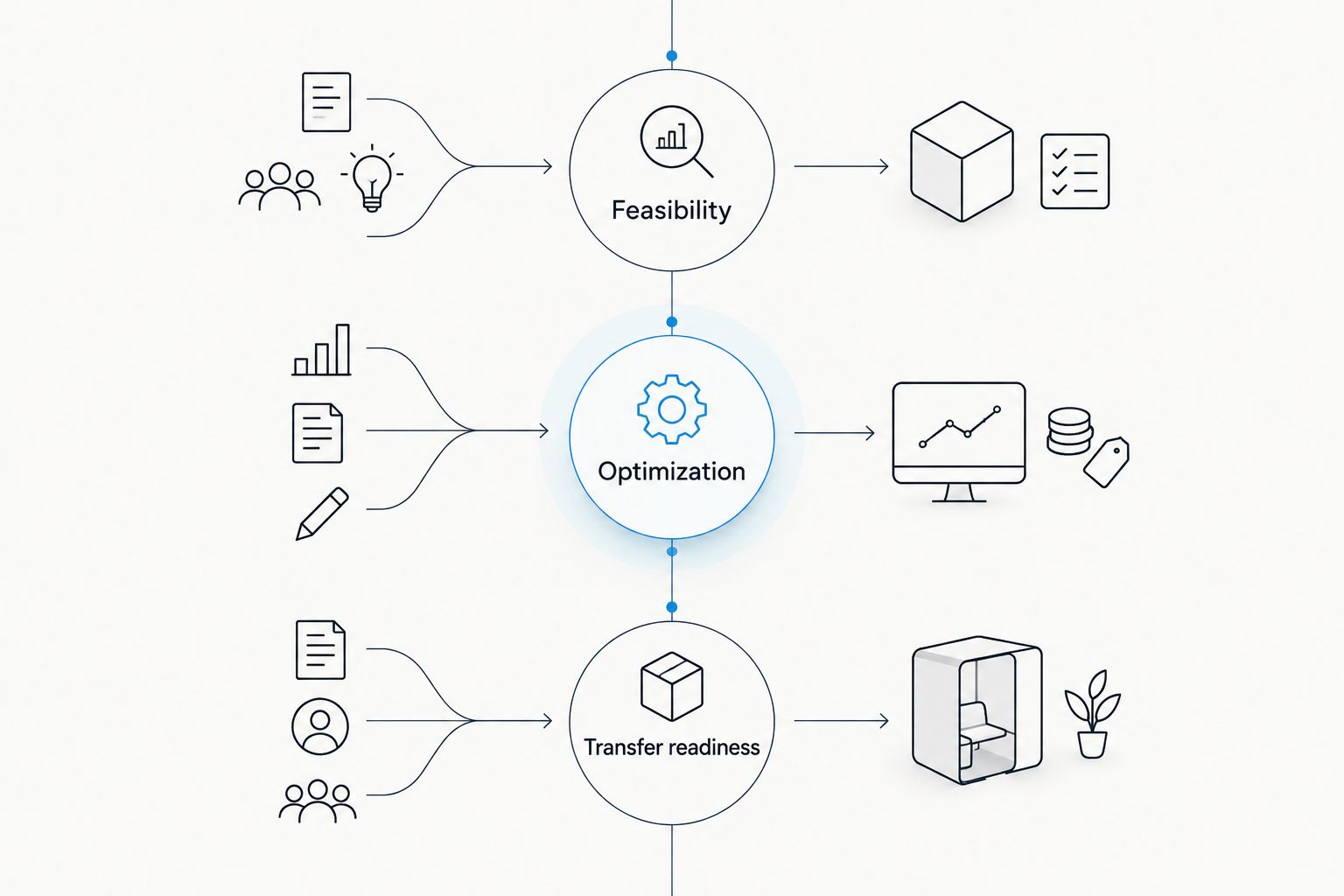
Keep failed approaches in the development record. A rejected condition can explain a later restriction on incubation, dilution, or reagent handling; removing it from the handoff loses useful context.
- Set a decision question and acceptance criteria for each gate.
- Specify the experiments and records required for approval.
- Record unsuccessful conditions and the reasons for rejection.
- Identify dependencies on sponsor samples or reference materials.
- Require written approval before changing scope or advancing gates.
Challenge the assay in the intended matrix
Begin with the samples and materials already available to your team. Document their provenance, handling history, and limitations before using them to support development conclusions.
Buffer performance alone does not establish performance in serum, plasma, or another biological matrix. Evaluate the intended matrix and relevant sample conditions rather than assuming that a strong signal establishes suitability.
Your 2026 development brief should distinguish evidence already generated from experiments still planned. A proposed stability study, for example, is not evidence supporting a storage condition or shelf life.
- Test representative matrix samples under documented conditions.
- Assess relevant interference and cross-reactivity risks.
- Evaluate dilution behavior where dilution forms part of the procedure.
- Investigate sample-handling effects relevant to the study workflow.
- Separate observed stability results from proposed stability protocols.
Build the transfer package while development is active
Draft the method instructions during optimization rather than reconstructing them at the end. Have a receiving analyst review the procedure for missing decisions, ambiguous instructions, and equipment assumptions.
Compare 2 execution settings where transfer is planned: the development laboratory and the receiving laboratory. This comparison is a recommended planning exercise, not a fixed experimental design. Identify differences that need assessment before either team declares the method transferable.
A development report explains the scientific work. A transfer package must also explain how another laboratory executes the method and judges the resulting run.
- Write reagent preparation, handling, and incubation instructions explicitly.
- Identify equipment requirements and permitted substitutions.
- Define run acceptance, calculation, and reporting rules.
- Include representative data and documented troubleshooting guidance.
- Agree on transfer experiments, responsibilities, and acceptance criteria.
Control reagent continuity before study deployment
Use your existing inventory records to identify critical reagents and their lot dependencies. Connect those records to the method version so that a material change does not become an undocumented method change.
For your 2026 study plan, distinguish development completion from supply continuity. A method that works with a development lot still needs an agreed approach to replacement lots, manufacturing changes, and supporting evidence.
Where your project includes custom conjugation or formulation, define the material attributes that require control. Do not infer that an unchanged reagent name means an unchanged analytical effect.
- Identify critical materials and their approved specifications.
- Define lot-bridging experiments appropriate to the assay’s use.
- Assign ownership of retained samples and reference materials.
- Establish notification and approval rules for material changes.
- Document how reagent changes affect method records and study execution.
Compare development options for your CRO
Best fit depends on which responsibility your CRO needs to transfer. Internal development retains direct experimental control; external support introduces a handoff that must be specified. Compare the deliverables, not just the description of the service.
| Option | Best for | Main advantage | Key limitation |
|---|---|---|---|
| Internal development | CROs retaining experimental execution and method knowledge | Your team controls daily priorities and experimental decisions | Your team must provide development capacity, documentation, and reagent controls |
| Specialist development laboratory | CROs outsourcing a defined scientific work package | You can assign a bounded development task | Manufacturing and continued reagent supply require separate confirmation |
| Calbiotech CDMO services | CROs needing ELISA/CLIA development plus reagent-related services | Stated scope includes conjugation, formulation, kitting, and manufacturing | Project-specific platform fit, validation responsibilities, and transfer deliverables require agreement |
| Hybrid development | CROs retaining method ownership while outsourcing selected activities | You can divide work according to internal capabilities | Interfaces, data exchange, and change approvals need explicit ownership |
For a 2026 partner review, send the same technical brief to each candidate. Require a response that identifies included work, exclusions, dependencies, and acceptance deliverables. A narrower proposal with clear boundaries is easier to evaluate than a broad proposal with undefined responsibilities.
Discuss your assay development scope
Define your ELISA/CLIA development, conjugation, formulation, kitting, and manufacturing requirements.
Common mistakes CROs make
Accepting the sponsor’s analyte request as a complete brief
An analyte name does not define matrix, intended use, interpretation, or acceptance criteria. Resolve those decisions before approving development experiments; otherwise, the laboratory and sponsor can approve different versions of success.
Treating development completion as validation completion
Development establishes and documents method conditions. Validation evaluates performance against defined requirements for an intended use. Keep the deliverables and approvals separate, even when the same organization performs both activities.
Leaving ownership of critical materials unresolved
A transferred procedure is incomplete when the receiving laboratory cannot identify or obtain its critical materials. Define ownership, access, specifications, and change notification before accepting the transfer package.
Reviewing reports without reviewing execution instructions
A strong development report does not replace an executable procedure. Ask the receiving analyst to identify every point requiring interpretation, then resolve those points before transfer experiments begin.
FAQ
What are assay development services for CROs?
Assay development services for CROs are outsourced activities that establish and document an assay for a defined scientific purpose. The scope can include design, optimization, reagent preparation, and method transfer; each activity needs explicit deliverables.
Which CROs are a fit for Calbiotech assay development services?
Calbiotech fits CROs seeking ELISA/CLIA assay development alongside custom conjugation, formulation, kitting, or manufacturing. Confirm the specific analyte, matrix, platform requirements, and project responsibilities before selecting the engagement scope.
Is assay development the same as assay validation?
No. Assay development establishes method conditions, while validation evaluates performance against defined requirements for an intended use. A development agreement should state whether validation activities are included or separate.
Should a CRO develop an assay internally or outsource it?
Keep development internal when your team needs direct execution control and has the required capacity. Outsource defined activities when external scientific or manufacturing support matches a documented gap, and specify the resulting handoff.
What should a CRO send with an assay development inquiry?
Send the intended use, analyte, matrix, sample constraints, platform requirements, and proposed acceptance criteria. Include existing methods and data so the candidate can distinguish established evidence from work still required.
What belongs in an assay transfer package?
An assay transfer package should contain executable instructions, reagent specifications, calculation rules, run acceptance criteria, and supporting development records. Define the receiving laboratory’s transfer experiments and approval responsibilities separately.
Does a working ELISA automatically support diagnostic use?
No. A working ELISA does not by itself establish suitability for diagnostic use. Intended use, supporting performance evidence, and applicable regulatory requirements determine what claims and applications are justified.
One last thing
Ask a receiving analyst to mark every instruction that requires a guess. Do this before approving the final transfer package, not after the first failed transfer run. The resulting questions turn an apparently complete procedure into a concrete list of unresolved execution decisions.