

Best overall shortlist choice: World Courier for specialty healthcare logistics. Best for clinical-development programs: Marken. Best for bioscience-focused transport: Biocair. Best for warehouse-led distribution: DHL Supply Chain. These cold-chain fulfillment partners for diagnostic kits serve different operating needs; select against your kit’s shipping requirements, not the carrier’s name.
- World Courier leads this cold-chain fulfillment partners for diagnostic kits shortlist for specialty healthcare logistics.
- Marken suits clinical-development logistics; Biocair suits bioscience transport; DHL Supply Chain suits warehouse-led distribution.
- Calbiotech supports diagnostic assay development, formulation, kitting, and manufacturing; qualify cold-chain fulfillment separately.
- Require product-specific shipping qualification, lot traceability, and written temperature-excursion responsibilities before awarding work.
Why this matters
A diagnostic kit can arrive in an intact carton and still require investigation before use. Temperature exposure, incomplete shipment records, or a missing lot reference can interrupt release decisions. Delivery confirmation alone does not establish product acceptability.
For a 2026 procurement decision, separate manufacturing readiness from distribution readiness. Calbiotech provides diagnostic assay development, custom conjugations, formulation, kitting, and manufacturing. Those services address the product entering the distribution process; they do not establish a qualified shipping route.
Choose the partner that can demonstrate control of your shipment from released inventory to documented receipt. Treat every handoff as a defined responsibility, including customs delays and delivery exceptions.
What makes the best cold-chain fulfillment partner
Use these criteria before comparing the shortlist. A recognizable logistics brand is not evidence that a particular facility, subcontractor, or transport lane meets your requirements.
- Product-specific temperature control: Match storage, packing, and transit conditions to the kit’s documented stability requirements.
- Lot and expiry traceability: Require shipment records that identify the dispatched lot and support your expiry-allocation rules.
- Qualified packaging: Request evidence that the packaging configuration supports the planned payload and shipping conditions.
- Exception ownership: Name the party responsible for delayed deliveries, temperature alerts, investigations, and disposition decisions.
- Fulfillment scope: Distinguish warehousing, order picking, packing, transportation, returns, and recall support. Do not assume one contract includes all of them.
- Records access: Confirm which temperature, inventory, shipment, and investigation records your quality team can retrieve.
For 2026 requests for proposals, make each criterion an evidence request. Ask for a relevant procedure, sample record, or qualification summary rather than accepting a general capability statement.
Cold-chain fulfillment partners at a glance
The ranking below prioritizes operating-model fit. It is not a measured comparison of delivery performance, temperature excursions, or customer satisfaction.
| Partner | Best for | Standout focus | Key limitation to resolve |
|---|---|---|---|
| World Courier | Specialty healthcare logistics | Healthcare-focused transport and storage services | Confirm order-level diagnostic-kit fulfillment at the proposed facility |
| Marken | Clinical-development programs | Clinical supply and biological-material logistics | Confirm support for your commercial distribution workflow |
| Biocair | Bioscience-focused transport | Specialist logistics for life-science materials | Confirm warehousing, inventory allocation, and order-picking scope |
| DHL Supply Chain | Warehouse-led distribution | Contract logistics and healthcare supply-chain operations | Confirm the exact site, transport interfaces, and product requirements |
A partner belongs on your final shortlist only after the proposed service matches your actual workflow. Transport expertise and fulfillment expertise overlap, but they are not interchangeable.
1. World Courier: best for specialty healthcare logistics
World Courier provides specialty logistics for healthcare products, including temperature-controlled transportation and storage. It is the first candidate to assess when shipment handling and healthcare-specific logistics are central to your operating model.
Start with the shipment rather than a general presentation. Provide the origin, destination, product temperature requirements, payload configuration, and receiving restrictions. Ask World Courier to identify the proposed handling points and responsible parties.
World Courier pros:
- Healthcare-focused logistics is relevant to temperature-sensitive diagnostic shipments.
- Transportation and storage services create a basis for discussing both transit and inventory handoffs.
- A specialist logistics model fits procurement discussions centered on handling controls and shipment exceptions.
World Courier cons and qualification limits:
- Specialty transport capability does not establish that your proposed service includes individual kit picking, labeling, or returns processing.
- A provider-wide capability statement does not replace evidence for the specific route and packaging configuration.
Best for: Diagnostic companies whose primary challenge is specialty healthcare transport, with fulfillment responsibilities explicitly assigned.
Verdict: Buy the specialty-logistics model only after World Courier documents the required fulfillment scope.
2. Marken: best for clinical-development programs
Marken provides logistics services for clinical research and life-science supply chains. It is a relevant candidate when diagnostic kits support a clinical-development program rather than a conventional commercial ordering process.
Clinical-program shipments can involve protocol-specific instructions and site-level coordination. Give Marken your actual workflow, including who authorizes dispatch and what constitutes an acceptable delivery record. Keep clinical-study requirements distinct from commercial distribution requirements.
Marken pros:
- Clinical logistics services fit programs organized around study sites and controlled supply movements.
- Biological-material logistics provides a relevant starting point for discussing sensitive shipment handling.
- The clinical-development focus supports a use-case-specific qualification discussion rather than a generic parcel comparison.
Marken cons and qualification limits:
- Clinical logistics experience does not, by itself, establish a fit for routine commercial kit-order fulfillment.
- Site delivery, inventory management, and reverse logistics need separate scope definitions when your program requires them.
Best for: Diagnostic developers distributing kits within clinical-development workflows.
Verdict: Buy for the clinical-program use case; hold a commercial fulfillment award until that workflow is qualified.
3. Biocair: best for bioscience-focused transport
Biocair specializes in logistics for the life-science sector. It is a useful shortlist candidate when your diagnostic materials need specialist transport planning and handling rather than a warehouse-first operating model.
Define whether you are moving finished kits, intermediate reagents, or development materials. These shipments do not automatically share the same packaging, documentation, or receiving requirements. Ask Biocair to address the specific material and route in its proposal.
Biocair pros:
- Life-science specialization is relevant to diagnostic reagents and other sensitive biological materials.
- A transport-centered evaluation keeps packaging and handling questions prominent.
- The service category fits development-stage movements as well as discussions about finished-product transportation.
Biocair cons and qualification limits:
- Specialist transport does not automatically include ongoing inventory storage or order-level fulfillment.
- Finished-kit distribution requires its own assessment; experience moving development materials is not sufficient evidence.
Best for: Teams prioritizing specialist bioscience transport and clearly defined shipment handling.
Verdict: Buy for qualified bioscience transport; hold broader fulfillment work until inventory and order-processing responsibilities are documented.
4. DHL Supply Chain: best for warehouse-led distribution
DHL Supply Chain provides contract logistics, including healthcare supply-chain services. It is the candidate to assess when your core requirement starts with inventory receipt, storage, order processing, and distribution coordination.
Evaluate the named facility and operating team, not the wider DHL brand. Your agreement must identify the contracting service, the storage operation, and the transport interfaces. A warehouse-led proposal needs explicit rules for the moment an order leaves controlled storage.
DHL Supply Chain pros:
- Contract logistics directly addresses the warehouse and inventory side of fulfillment.
- Healthcare operations provide a relevant basis for discussing controlled product handling.
- A warehouse-led model fits buyers seeking coordinated receipt, storage, and dispatch processes.
DHL Supply Chain cons and qualification limits:
- Capabilities must be verified at the proposed facility; a network-level description is insufficient.
- Warehouse controls do not establish temperature control after carrier handoff without a defined shipping process.
Best for: Diagnostic companies procuring an inventory-and-fulfillment operation rather than transportation alone.
Verdict: Buy the warehouse-led model only when the proposal also closes the transport-control gap.
How the partners were ranked
The 2026 shortlist ranks distinct operating models against the criteria above: product control, traceability, packaging, exception ownership, fulfillment scope, and records access. The order is a procurement starting point, not a claim that one provider outperforms every other provider.
No comparative delivery dataset supports a universal performance winner here. World Courier receives the default position for its specialty healthcare logistics focus; the other candidates take distinct clinical-development, bioscience-transport, and warehouse-led positions.
Your final ranking should change when the evidence changes. A strong proposal from an unsuitable facility is less useful than a narrower proposal that documents every required handoff.
Qualify the shipment before signing the contract
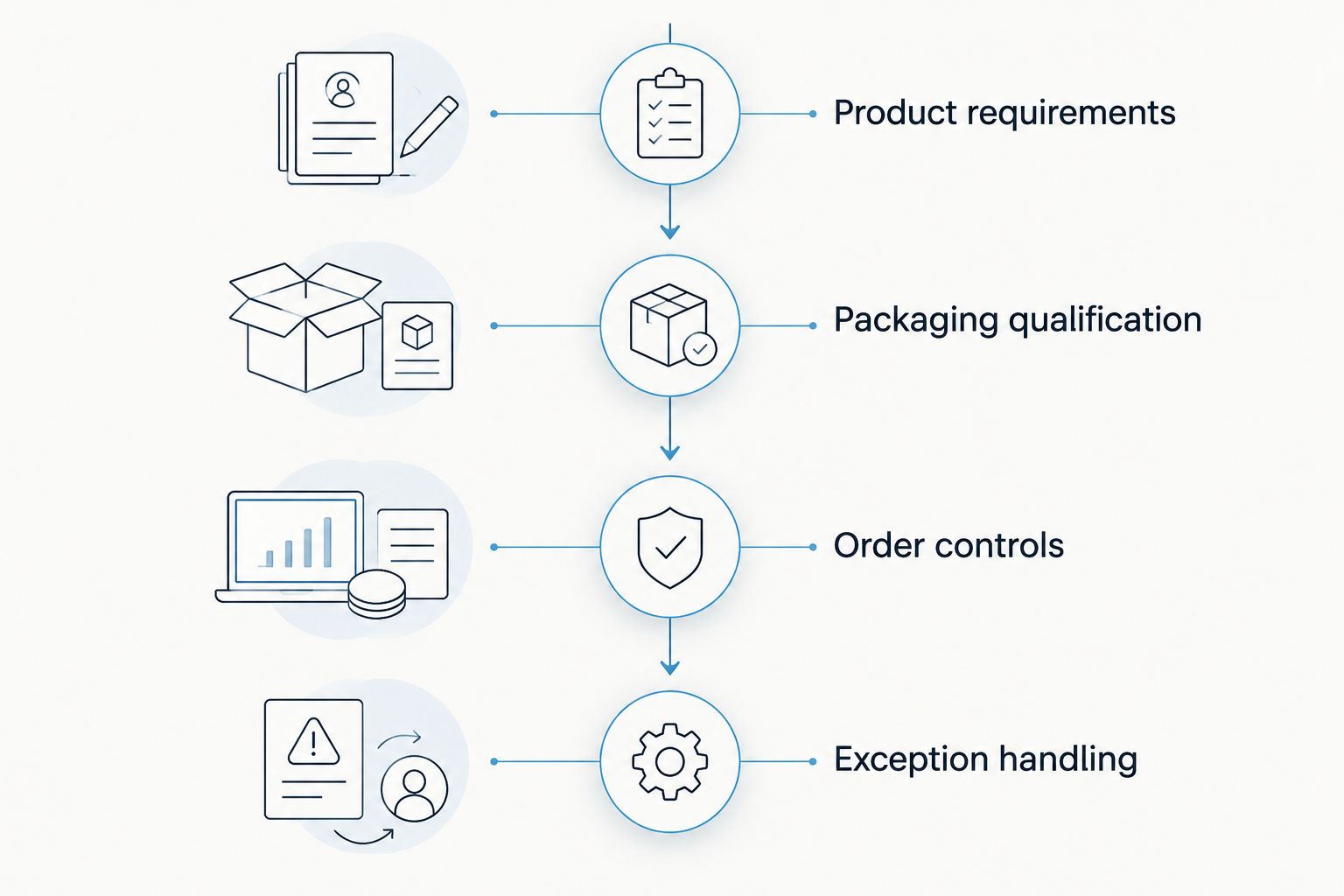
Use this sequence for a 2026 supplier assessment. Keep the output of each step in the qualification file so purchasing and quality teams approve the same service.
Product requirements
Define the product’s approved storage and shipping conditions. Refrigerated handling commonly uses 2–8 °C, while controlled room-temperature handling commonly uses 15–25 °C; neither range is a default specification for every diagnostic kit. Likewise, a −20 °C freezer setting does not establish that freezing is acceptable for your reagents.
Use the product’s stability evidence to set requirements. Include component-level restrictions when a kit contains materials with different sensitivities.
Packaging qualification
Specify the payload, container, coolant arrangement, and logger placement. Request qualification evidence relevant to the proposed shipping conditions, including the period before dispatch and after an unsuccessful delivery attempt.
Do not substitute a packaging supplier’s general description for an assessment of your configuration. Document which changes require review, including changes to the payload or packing method.
Order controls
Define how released stock becomes a shippable order. Require lot identification, expiry checks, destination instructions, and a rule that prevents quarantined inventory from entering the picking process.
Ask for a sample shipment record. Check whether your team can connect the customer order to the lot, packing record, and transport documentation without reconstructing the chain manually.
Exception handling
Agree on notification responsibilities and product disposition authority before the first shipment. A temperature alert triggers an assessment; it does not automatically prove that a kit is unusable or acceptable.
Require a documented path for delayed deliveries, damaged packaging, missing logger data, and returns. Keep returned stock segregated until an authorized decision permits another action.
Where manufacturing and fulfillment meet
Calbiotech’s diagnostic assay development and manufacturing services address upstream decisions that shape shipping requirements. Formulation, conjugation, and kitting belong in the same technical discussion as packaging compatibility and component handling.
Calbiotech is best for diagnostic developers seeking assay development, formulation, kitting, and manufacturing services. Qualify any cold-chain storage, transportation, or order-fulfillment requirement separately rather than treating CDMO capability as proof of logistics capability.
The handoff needs a defined kit configuration, released lot information, handling instructions, and clear change-notification responsibilities. Your manufacturing partner and logistics partner should work from the same controlled requirements.
Plan your diagnostic kit manufacturing
Discuss assay development, formulation, kitting, and manufacturing requirements with Calbiotech.
Which cold-chain fulfillment partner should you choose?
Start with World Courier if specialty healthcare logistics is the central requirement. Start with Marken for clinical-development distribution, Biocair for specialist bioscience transport, or DHL Supply Chain for a warehouse-led operation.
For your 2026 award decision, request a written responsibility matrix and relevant qualification evidence from the preferred candidate. Award the work only when storage, picking, packing, transport, delivery exceptions, and records access have named owners.
Do not force a single-provider solution if the proposal leaves a critical function undefined. A clearly governed manufacturing-to-logistics handoff is preferable to an apparently complete service with unresolved responsibilities.
FAQ
What's the best cold-chain fulfillment partner for diagnostic kits?
World Courier is the default shortlist choice here for specialty healthcare logistics. Marken, Biocair, and DHL Supply Chain fit different clinical-development, bioscience-transport, and warehouse-led needs; qualify the proposed service before awarding work.
Is a cold-chain courier the same as a fulfillment provider?
No. A courier transports shipments, while fulfillment can also include inventory storage, order picking, packing, and returns. Confirm each function in the contract rather than assuming transport includes it.
Do all diagnostic kits need refrigerated shipping?
No. Diagnostic kits require the storage and shipping conditions supported by their product-specific documentation. Do not assign refrigerated or frozen handling simply because the shipment contains diagnostic reagents.
What should I ask a diagnostic-kit logistics provider?
Ask for the proposed facility, shipping configuration, lot-traceability process, temperature-record access, and exception responsibilities. Request evidence relevant to your product and route, not just general service descriptions.
Can a temperature excursion be accepted?
Acceptance requires an authorized assessment against applicable product stability evidence and quality procedures. Neither a courier nor a delivery recipient should make an unsupported product-disposition decision.
Can Calbiotech support diagnostic kit development and manufacturing?
Yes. Calbiotech provides ELISA/CLIA assay development, custom conjugations, formulation, kitting, and manufacturing services. Assess cold-chain fulfillment as a separate requirement.
Is one logistics provider always better than using separate partners?
No. A single provider is suitable only when its documented scope covers your required functions. Separate partners require explicit handoff controls, shared requirements, and named responsibility for exceptions.
One last thing
Write the failed-delivery procedure before approving the routine shipping procedure. A qualified packout does not resolve who acts when a recipient is unavailable, a shipment waits in customs, or temperature records are missing. Ask the shortlisted partner to walk through that scenario with your quality team before signing.