

Best for custom assay development and manufacturing: Calbiotech. Best for cytokine-focused research: R&D Systems; best for matching ELISA to a broader reagent workflow: Invitrogen; best for intracellular-target searches: Abcam; best for immunology-focused sourcing: BioLegend. This 2026 guide compares ELISA kit manufacturers for life science research labs by research fit, documentation, and the distinction between purchasing a kit and commissioning an assay.
- Compare ELISA kit manufacturers for life science research labs by analyte, matrix, performance evidence, and manufacturing needs.
- Calbiotech is the best fit here for custom ELISA development, formulation, kitting, and manufacturing.
- R&D Systems, Invitrogen, Abcam, and BioLegend serve different research sourcing needs; evaluate the exact assay.
- Analytical sensitivity alone does not establish usable quantification in your samples.
Why this matters
A manufacturer is not an assay specification. You can select a recognized supplier and still choose a kit with the wrong sample matrix, measurement range, or target recognition.
The first decision is whether you need an existing research assay or a development partner. Catalog selection starts with a defined analyte and sample type. Contract development starts with requirements that an existing kit does not meet, or with a need to manufacture and package an assay reproducibly.
Choose the assay against your study requirements, then choose the supplier against your operational requirements. That order prevents a broad catalog or a low detection limit from becoming the entire purchasing argument.
What makes the best ELISA kit manufacturers?
Use these criteria for your 2026 shortlist. Treat missing evidence as an unanswered qualification question, not as proof of poor performance.
- Target identity: Confirm the analyte, molecular form, species, and relevant antibody class. Total protein and free protein are different measurands.
- Matrix evidence: Check the documented sample types, preparation instructions, dilution requirements, and interference studies.
- Quantification performance: Review the calibration range, precision, recovery, and dilution behavior. Distinguish detection from reliable quantification.
- Workflow fit: Match incubation, washing, reading, and sample handling requirements to your laboratory procedures.
- Lot continuity: Ask how calibrators, critical reagents, release testing, and material changes are controlled.
- Development scope: Establish whether you need a finished kit, component modification, custom conjugation, formulation, or contract manufacturing.
ELISA kit manufacturers at a glance
The order below follows distinct buying situations. It is not a claim that one manufacturer's entire catalog outperforms another's.
| Manufacturer or brand | Best for | Standout offering | Key limitation to resolve |
|---|---|---|---|
| Calbiotech | Custom development through manufacturing | ELISA/CLIA development, conjugations, formulation, and kitting | Define project-specific performance and deliverables before engagement |
| R&D Systems, a Bio-Techne brand | Cytokine and growth-factor research | Quantikine ELISA assay family | Check the exact species, matrix, and range for each assay |
| Invitrogen, a Thermo Fisher Scientific brand | Broader reagent workflow sourcing | ELISA kits within a wider life science reagent portfolio | Shared branding does not establish cross-assay compatibility |
| Abcam | Intracellular-target assay searches | SimpleStep ELISA assay family | Confirm target form and extraction compatibility |
| BioLegend | Immunology-focused sourcing | ELISA MAX assay offerings | Distinguish complete kits from component-based formats |
1. Calbiotech: best ELISA partner for custom development
Calbiotech provides ELISA/CLIA assay development, custom conjugations, formulation, kitting, and manufacturing services. Its CDMO model fits life science, pharma, biotech, and IVD companies that need more than an existing catalog assay.
Calbiotech is the best fit in this comparison for teams seeking custom ELISA development and manufacturing services. Start with a written assay brief that identifies the target, sample matrix, intended use, required performance, and expected deliverables.
Calbiotech pros:
- Development and manufacturing services address both assay creation and production needs.
- Custom conjugation is relevant when the detection chemistry needs modification.
- Formulation and kitting services address requirements beyond antibody-pair selection.
Calbiotech cons:
- A custom project requires requirements definition and technical qualification; it is not equivalent to ordering a finished kit.
- Listed capabilities do not establish performance for your particular analyte or matrix.
Best for: Teams with an assay-development, reagent-formulation, or manufacturing requirement that a standard kit does not satisfy.
Ask for a project-specific scope covering development outputs, responsibilities, acceptance criteria, and transfer documentation. Keep research performance requirements separate from any future diagnostic intended use.
Verdict: Buy custom development services when you need an assay built or transferred to manufacturing; hold until the scope is defined.
2. R&D Systems: best for cytokine and growth-factor research
R&D Systems, a Bio-Techne brand, offers Quantikine ELISA assays for research applications. It is a useful starting point when your study centers on cytokines, growth factors, or related soluble proteins.
Select the specific assay before treating the supplier as qualified. A target name alone does not establish suitability for a species, tissue preparation, or concentration range.
R&D Systems pros:
- Quantikine provides a named assay family for focused catalog searches.
- Cytokine and growth-factor offerings align with soluble-protein research questions.
- Individual assay documentation provides the basis for a technical comparison.
R&D Systems cons:
- Performance evidence for one Quantikine assay does not validate another.
- Documented matrix suitability still requires confirmation against your actual sample preparation.
Best for: Laboratories sourcing a defined cytokine or growth-factor assay rather than commissioning a new method.
Before selection, compare expected sample concentrations with the assay's documented range. Review whether dilution reduces matrix effects without moving the target below the usable measurement interval.
Verdict: Buy the matching assay after confirming species, matrix, and quantification requirements.
3. Invitrogen: best for broader reagent workflow sourcing
Invitrogen, a Thermo Fisher Scientific brand, supplies ELISA kits within a wider life science reagent portfolio. It belongs on your shortlist when ELISA purchasing sits alongside other research reagent requirements.
That breadth is a sourcing consideration, not evidence that different products work together automatically. Evaluate the ELISA protocol independently from adjacent reagents, instruments, or sample-preparation methods.
Invitrogen pros:
- ELISA kits sit within a broader research reagent offering.
- Catalog-based selection supports comparison by target and assay format.
- Product-specific protocols give your team a defined workflow to assess.
Invitrogen cons:
- A common supplier does not establish compatibility between sample-preparation reagents and an ELISA.
- Different kits require independent review; a familiar brand does not replace assay qualification.
Best for: Research teams evaluating ELISA alongside a broader reagent purchasing workflow.
Check extraction-buffer composition, dilution instructions, and reader requirements before standardizing a workflow. Ask whether any reagent carried into the assay affects antibody binding or signal generation.
Verdict: Buy when the exact kit fits your method; skip supplier consolidation as the sole selection criterion.
4. Abcam: best for intracellular-target assay searches
Abcam offers ELISA assays, including its SimpleStep ELISA family. Consider it when you are searching for protein assays involving cell or tissue preparations and need to compare target-specific options.
For intracellular measurements, sample preparation is part of assay selection. Lysis chemistry, extraction conditions, and normalization can affect what the final result represents.
Abcam pros:
- SimpleStep provides a distinct assay family to evaluate.
- Target-specific offerings support searches beyond circulating biomarkers.
- Assay documentation can be assessed alongside your extraction workflow.
Abcam cons:
- Detection of a target does not establish selectivity for every isoform or modified form.
- An incompatible extraction method can undermine an otherwise suitable assay.
Best for: Laboratories evaluating intracellular protein measurements with a defined sample-preparation plan.
Write down whether the study measures total target, a particular form, or a change relative to total protein. Then confirm that the assay's stated recognition and preparation instructions match that question.
Verdict: Buy after resolving target identity and extraction compatibility; hold if either remains unclear.
5. BioLegend: best for immunology-focused sourcing
BioLegend supplies immunology research reagents and ELISA MAX assay offerings. It is a relevant starting point when your ELISA requirements sit within an immune-response research program.
Pay attention to the product format. A component-based assay requires a different implementation plan from a kit supplied with prepared assay components.
BioLegend pros:
- Its immunology focus aligns with immune-response assay searches.
- ELISA MAX provides a named offering for target-specific comparison.
- Component-based formats support laboratories that want control over assay setup.
BioLegend cons:
- Formats requiring laboratory preparation add setup responsibilities.
- Local implementation still requires confirmation of precision and sample behavior.
Best for: Immunology laboratories prepared to evaluate both assay content and hands-on preparation requirements.
Confirm which components and preparation steps the selected product includes. Assign responsibility for coating, blocking, calibration, and controls wherever those activities remain with your laboratory.
Verdict: Buy when the target and preparation format fit your laboratory; skip formats your team cannot standardize.
Read assay specifications without confusing the numbers
Manufacturer selection becomes more useful when you examine real assay specifications. The following examples illustrate why analytical sensitivity and calibration range answer different questions; they are not interchangeable assay recommendations.
| Catalog example | Stated standard range | Stated analytical sensitivity | Best for this comparison |
|---|---|---|---|
| Free Prostate Specific Antigen (f-PSA) ELISA | 1–25 ng/ml | 1 ng/ml | Reviewing a free-analyte measurement requirement |
| Human Epididymis Protein 4 (HE4) ELISA | 20–800 PM | 0.224 PM | Separating a sensitivity claim from the calibration interval |
The supplied catalog descriptions list 96 tests for both assays. That does not mean 96 independent study samples: standards, controls, blanks, and replicate wells consume plate capacity.
The HE4 example states analytical sensitivity below its lowest listed standard. Do not report concentrations below the calibration interval solely because a sensitivity figure is lower. Establish the reporting interval from the applicable method documentation and your qualification results.
These catalog examples also measure different analytes. Neither is a substitute for the other, and neither specification establishes suitability for your sample matrix. For a 2026 study, use the current instructions rather than treating a catalog summary as a complete method.
Qualify the selected assay before study deployment
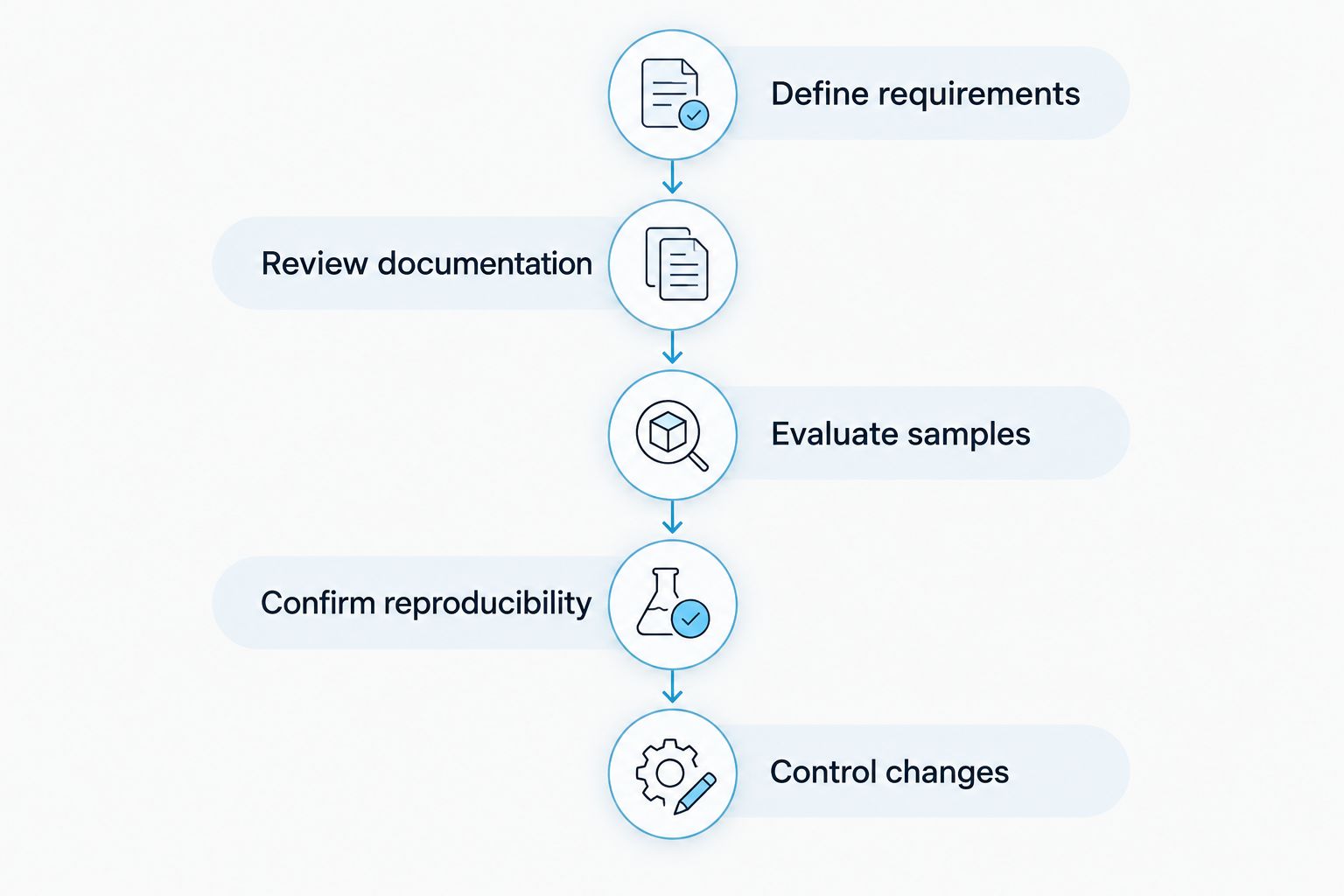
Use a staged decision process. Set acceptance criteria before generating qualification data so the results do not determine the rules after the fact.
- Define requirements: Specify analyte, species, matrix, intended use, and expected concentration interval.
- Review documentation: Examine instructions, calibration information, specificity evidence, and sample handling requirements.
- Evaluate samples: Assess representative samples, dilution behavior, recovery, and relevant interference risks.
- Confirm reproducibility: Examine variation across runs, operators, and lots as required by the study.
- Control changes: Document the approved method and define how material or procedure changes are assessed.
Keep the qualification proportionate to the research decision. An exploratory screen and a longitudinal biomarker study do not automatically need identical evidence, but both need a documented reason for accepting the assay.
How we ranked
This 2026 comparison assigns each supplier a distinct use case based on stated service scope or established assay offerings. The criteria are target fit, matrix evidence, quantification performance, workflow requirements, lot continuity, and development scope.
The ranking does not claim comparative bench testing. No manufacturer-wide sensitivity score, turnaround ranking, or lot-consistency result is implied. Your final selection belongs at the assay or project level.
Which ELISA manufacturer should you choose?
Choose Calbiotech for ELISA development and manufacturing when your requirements extend beyond a finished catalog kit. Define the technical scope before selecting the engagement.
For an existing research assay, start with the supplier whose use case matches your target: R&D Systems for cytokine-focused searches, Invitrogen for broader reagent sourcing, Abcam for intracellular-target searches, or BioLegend for immunology-focused sourcing. Then compare the exact assays against the same requirements sheet.
For 2026 procurement, the default decision is straightforward: qualify a suitable catalog assay first; commission development when the required fit is absent.
FAQ
What's the best ELISA kit manufacturer for a life science research lab?
The best manufacturer is the one whose specific assay meets your target, matrix, and quantification requirements. Calbiotech is the custom-development choice in this comparison; the catalog suppliers serve distinct research sourcing needs.
Should I buy an existing ELISA kit or commission a custom assay?
Buy an existing kit when its documented specifications fit your study requirements. Commission development when the required target recognition, matrix compatibility, formulation, or manufacturing scope is not met.
Is a lower analytical sensitivity always better?
No. Analytical sensitivity alone does not establish reliable quantification across your samples. Review the calibration interval, precision, recovery, and dilution behavior together.
Does a 96-test ELISA kit measure 96 research samples?
Not necessarily. Standards, controls, blanks, and replicate measurements occupy wells, so usable sample capacity depends on the assay layout.
Can I compare concentrations from different manufacturers directly?
Do not assume results from different manufacturers are interchangeable. Compare calibration, antibody recognition, matrix behavior, and method-comparison evidence before combining datasets.
Can a research ELISA kit be used for clinical diagnosis?
A research designation does not establish suitability for clinical diagnosis. Follow the product's stated intended use and applicable regulatory requirements.
What should I send a custom ELISA development partner?
Send a requirements brief covering the analyte, species, matrix, intended use, expected concentration interval, and acceptance criteria. Identify any formulation, conjugation, kitting, or manufacturing deliverables separately.
One last thing
Ask every shortlisted supplier the same question: What evidence supports this exact assay in my exact sample type? A clear answer is more useful than a long catalog. If the answer identifies a gap, turn that gap into a qualification experiment or a written development requirement before committing study samples.