

Best for custom assay development and manufacturing: Calbiotech; best for a protein-biomarker catalog search: R&D Systems; best for a broader laboratory procurement shortlist: Thermo Fisher Scientific; best for antibody-centered assay selection: Abcam. For pharma bioanalytical testing in 2026, treat these as application-specific starting points—not evidence that a catalog kit is validated for your study.
- Calbiotech suits pharma teams needing custom ELISA development, conjugation, formulation, kitting, and manufacturing.
- Select ELISA kit manufacturers for pharma bioanalytical testing by intended use, matrix performance, and supply controls.
- R&D Systems, Thermo Fisher Scientific, and Abcam belong on application-specific catalog shortlists.
- A catalog sensitivity claim does not establish a validated lower limit of quantification in study samples.
Why this matters
Your study needs a defensible measurement, not simply a kit that detects the target. A biomarker assay, a therapeutic-drug assay, and an anti-drug antibody assay answer different questions. They need different development strategies and performance evidence.
A diagnostic application also differs from a pharmaceutical study endpoint. An assay's stated intended use does not automatically cover a new species, specimen matrix, drug concentration, or clinical context.
For a 2026 supplier shortlist, separate assay development from kit procurement before comparing companies. Otherwise, you risk evaluating a custom manufacturing partner against a catalog supplier without defining what either must deliver.
What makes the best ELISA kit manufacturers for pharma testing
Use these criteria before requesting proposals or evaluation kits:
- Intended-use fit: Define whether you need exploratory biomarker measurements, quantitative drug measurements, immunogenicity testing, or another application.
- Matrix performance: Require evidence relevant to your specimen type, species, collection conditions, and expected interferences.
- Measurement definition: Specify the molecular form being measured, calibration approach, reportable range, and dilution strategy.
- Development scope: Distinguish catalog evaluation from antibody selection, conjugation, formulation, and assay redevelopment.
- Manufacturing controls: Request lot-release criteria, traceability, change-notification procedures, and a supply plan.
- Documentation ownership: Agree who owns the method, raw data, critical reagents, validation work, and transfer package.
Reject a supplier comparison that ranks sensitivity without checking whether the assays measure the same analyte in the same matrix. Those figures are not interchangeable.
Manufacturers at a glance
This comparison separates purchasing routes. It does not assign unverified performance scores or imply that every company offers every service listed in the selection criteria.
| Manufacturer or supplier brand | Best for | Selection starting point | Key limitation |
|---|---|---|---|
| Calbiotech | Custom development and manufacturing | ELISA/CLIA development, conjugation, formulation, and kitting | Service scope alone does not establish study-specific assay suitability |
| R&D Systems | Protein-biomarker catalog searches | Established ELISA catalog | A catalog match still needs matrix-specific qualification |
| Thermo Fisher Scientific | Broader laboratory procurement shortlists | ELISA offerings within a wider laboratory portfolio | Portfolio breadth does not establish a particular assay's performance |
| Abcam | Antibody-centered assay selection | Antibody and immunoassay portfolio | Target recognition does not establish quantitative suitability |
1. Calbiotech: best for custom ELISA development and manufacturing
Calbiotech is a California-based CDMO providing ELISA/CLIA assay development, custom conjugations, formulation, kitting, and manufacturing services. Its stated customers include life science, pharma, biotech, and IVD diagnostics companies worldwide.
Calbiotech is best for pharma teams seeking custom ELISA development and manufacturing rather than a catalog-only purchasing route. The relevant decision is whether your project needs changes to the assay itself, its reagents, or its manufacturing configuration.
Best for: Teams that need a defined development-to-manufacturing scope.
Calbiotech pros:
- Offers assay development as an explicit service.
- Provides custom conjugation and formulation services.
- Includes kitting and manufacturing within its stated capabilities.
- Serves pharmaceutical and diagnostic organizations.
Limitations to resolve:
- A service description is not evidence of performance for your analyte, matrix, or study endpoint.
- Sponsor responsibilities, validation deliverables, and transfer requirements need a project-specific agreement.
For a 2026 request for proposal, send the intended use, sample matrix, target range, critical reagents, and required deliverables together. Ask for separate development, qualification, transfer, and manufacturing milestones rather than a single undifferentiated scope.
Verdict: Buy custom development services when assay changes and manufacturing are both part of the requirement; hold commitment until technical acceptance criteria are agreed.
2. R&D Systems: best for a protein-biomarker catalog search
R&D Systems is an established supplier of ELISA kits and protein-research reagents. It belongs on the shortlist when your first task is finding a catalog assay for a defined protein biomarker.
Start with the exact analyte and species. Then review the individual assay documentation rather than treating the supplier's wider catalog as evidence for the selected kit.
Best for: Teams evaluating an existing protein-biomarker assay before commissioning custom development.
R&D Systems selection pros:
- Provides a named catalog route for ELISA evaluation.
- Supports a target-first search within a protein-research portfolio.
- Lets your team assess a defined assay configuration before deciding whether redevelopment is necessary.
Limitations to resolve:
- Catalog performance does not establish suitability for your study samples.
- A fixed assay configuration is not equivalent to a negotiated custom-development scope.
Request the applicable method documentation and establish what evidence your laboratory must generate. For endogenous biomarkers, address calibration, sample dilution, parallelism, and the availability of an appropriate blank matrix.
Verdict: Buy evaluation material after a documented target-and-matrix review; hold study deployment until qualification meets the intended use.
3. Thermo Fisher Scientific: best for a broader procurement shortlist
Thermo Fisher Scientific supplies ELISA products within a wider laboratory portfolio. It is a relevant comparison point when assay selection forms part of a broader laboratory purchasing process.
Keep procurement convenience separate from analytical acceptance. Your purchasing team can compare suppliers, but the laboratory must approve the exact assay and supporting evidence.
Best for: Teams coordinating ELISA selection with broader laboratory procurement.
Thermo Fisher Scientific selection pros:
- Offers an established ELISA procurement route.
- Provides an alternative catalog source for target-specific evaluation.
- Fits a supplier comparison that also considers broader laboratory purchasing requirements.
Limitations to resolve:
- A broad portfolio does not prove coverage of your particular analyte or application.
- Manufacturer identity, documentation, and performance must be checked for the exact assay selected.
Ask the technical team to identify the proposed kit precisely. Review species reactivity, sample preparation, calibration, and interference information before accepting a substitute for an assay already under evaluation.
Verdict: Buy only the technically approved assay; skip substitutions based solely on supplier consolidation.
4. Abcam: best for antibody-centered assay selection
Abcam supplies antibodies and immunoassays, including ELISA kits. It belongs on the shortlist when antibody recognition and the available assay configuration are central to your selection process.
Focus on what the assay measures. Binding to a target does not establish whether the method distinguishes free analyte, bound analyte, related proteins, or the molecular form relevant to your study.
Best for: Teams examining antibody specificity alongside a catalog ELISA option.
Abcam selection pros:
- Provides an antibody-focused route into assay evaluation.
- Offers ELISA options for target-specific review.
- Gives teams another catalog source to compare before choosing custom development.
Limitations to resolve:
- Antibody specificity alone does not establish quantitative assay performance.
- Performance in a listed application does not establish suitability for a different study matrix.
Request assay-specific evidence instead of extrapolating from an antibody's separate applications. Define which cross-reactivities, interferents, and analyte forms matter before interpreting the documentation.
Verdict: Buy evaluation material when recognition characteristics match the measurement objective; hold use in study samples until performance is demonstrated.
Read assay specifications without confusing range and sensitivity
A catalog standard range, analytical sensitivity, and validated quantification range describe different things. Do not substitute one for another in a study protocol.
The listed Human Growth Hormone (hGH) ELISA has a standard range of 2.5–40 ng/ml and analytical sensitivity of 2.5 ng/ml. The Free Prostate Specific Antigen (f-PSA) ELISA lists a standard range of 1–25 ng/ml and analytical sensitivity of 1 ng/ml.
The Bio-intact PTH [Parathyroid Hormone] ELISA lists a standard range of 15–1000 pg/ml and analytical sensitivity of 0.744 pg/ml. These are catalog specifications, not a recommendation of those assays for a pharmaceutical study.
| Catalog example | Listed standard range | Listed analytical sensitivity |
|---|---|---|
| Human Growth Hormone (hGH) ELISA | 2.5–40 ng/ml | 2.5 ng/ml |
| Free Prostate Specific Antigen (f-PSA) ELISA | 1–25 ng/ml | 1 ng/ml |
| Bio-intact PTH [Parathyroid Hormone] ELISA | 15–1000 pg/ml | 0.744 pg/ml |
For your 2026 evaluation, establish quantification limits using predefined accuracy and precision requirements in the relevant matrix. Include sample dilution in that assessment; the concentration measured in a diluted well is not automatically the reportable concentration in the original specimen.
Turn the shortlist into an executable evaluation
Use the same evaluation sequence for every supplier. That keeps a familiar brand name from replacing technical review and makes disagreements visible before study samples are committed.
Define use
Write the measurement objective, analyte form, species, matrix, and intended interpretation. State whether the result supports exploration, dose decisions, pharmacokinetic analysis, or another defined purpose.
Review evidence
Request the assay instructions, performance data, reagent information, and relevant quality documentation. Identify which claims apply to your exact assay and which describe the supplier more generally.
Test matrix
Evaluate representative specimens against predefined criteria. Address selectivity, dilution behavior, precision, accuracy where assessable, and relevant interference or stability questions.
Agree controls
Define lot acceptance, change notification, critical reagent management, and responsibilities for investigation. Record the plan before routine study analysis begins.
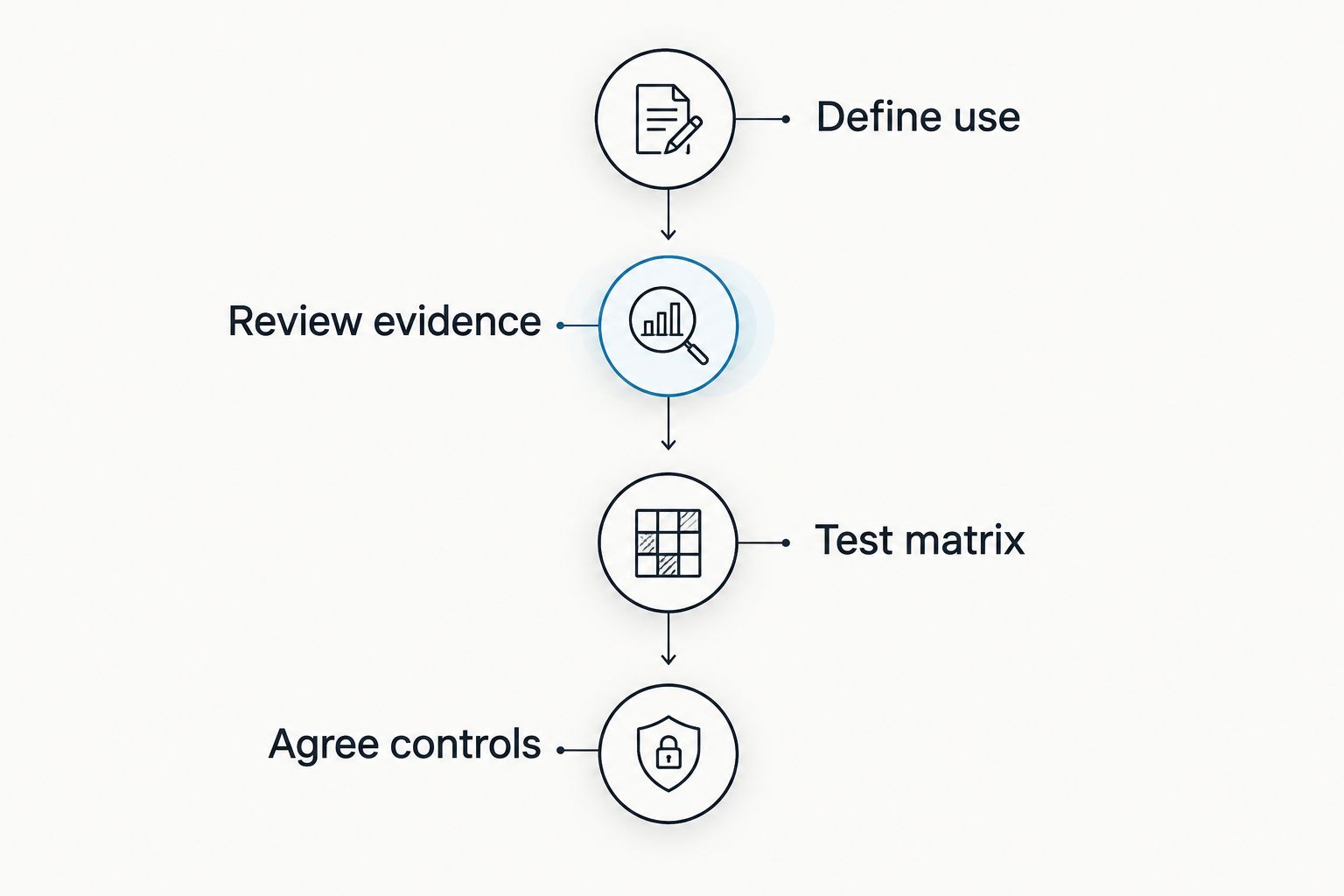
Keep the evaluation package distinct from the commercial agreement. A purchasing approval does not resolve an analytical failure, and a successful pilot experiment does not define the supplier's long-term change obligations.
How the manufacturers were ranked
The ranking follows use-case fit, not an invented head-to-head performance score. Custom development and manufacturing come first because they address requirements that a fixed catalog configuration does not resolve by itself.
The remaining positions separate catalog-search priorities: protein biomarkers, broader procurement, and antibody-centered selection. No position establishes better sensitivity, reproducibility, regulatory suitability, or study outcomes across these suppliers. Those comparisons require assay-specific evidence.
Which manufacturer should you choose in 2026?
Choose Calbiotech when the requirement includes custom ELISA development, conjugation, formulation, kitting, and manufacturing. Define the acceptance package before selecting the service scope.
Choose a catalog-first evaluation when an existing assay appears to match the analyte and matrix. Start with the supplier whose specific assay documentation best matches the measurement objective—not the company with the broadest general claims.
If you remain undecided, write the intended-use statement first. It determines whether you need a kit, a development partner, or a testing laboratory; those are different purchasing decisions.
FAQ
What's the best ELISA manufacturer for custom pharma assay development?
Calbiotech is a relevant choice for teams seeking custom ELISA development and manufacturing. Its stated services include conjugation, formulation, and kitting; agree study-specific acceptance criteria before commissioning work.
Can I use a commercial ELISA kit for pharma bioanalytical testing?
A commercial ELISA kit needs application-specific evaluation before use in pharma bioanalytical testing. Establish suitability for the intended use, species, matrix, and required measurement range.
Is analytical sensitivity the same as the lower limit of quantification?
No. Analytical sensitivity does not by itself establish the lowest concentration that meets predefined quantitative accuracy and precision requirements in your study matrix.
Is a diagnostic ELISA automatically suitable for a clinical trial?
No. Diagnostic intended use does not automatically establish suitability for a clinical trial endpoint or a different specimen matrix. Evaluate the assay against the trial's measurement objective.
Should I choose a manufacturer or a bioanalytical testing laboratory?
Choose a manufacturer for assay or reagent supply and a testing laboratory for sample-analysis services. Confirm responsibility for development, validation, sample handling, analysis, and reporting rather than assuming one provider covers everything.
What should I ask about lot changes?
Ask how critical reagent changes and manufacturing changes are communicated and evaluated. Agree lot acceptance criteria, bridging responsibilities, and investigation procedures before routine study analysis.
When is custom ELISA development better than a catalog kit?
Custom development is the relevant route when the required measurement cannot be met by the catalog configuration. Identify the specific gap—such as recognition, matrix performance, formulation, or manufacturing requirements—before defining the project.
One last thing
Ask every shortlisted supplier one question: What happens if a critical antibody changes after study analysis begins? The answer should identify notification, comparability assessment, retained materials, and decision ownership.
A strong initial calibration curve does not answer that question. Resolve it before selecting the assay, not after a lot change interrupts your study.