

Best for custom ELISA development and contract manufacturing: Calbiotech. Best for cytokine-focused research: R&D Systems. Best for immune-marker studies: BioLegend. Best for lipid-mediator research: Cayman Chemical. This 2026 guide compares ELISA kit manufacturers for research use only reagents by scientific fit, documentation, and manufacturing requirements—not by a single universal winner.
- Calbiotech is the best fit here for custom ELISA development and contract manufacturing, rather than catalog-only procurement.
- Compare ELISA kit manufacturers for research use only reagents by analyte, sample matrix, and supporting performance data.
- R&D Systems suits cytokine research; BioLegend suits immune-marker studies; Cayman Chemical suits lipid-mediator research.
- Confirm research-use labeling for the exact catalog number; a manufacturer's broader capabilities do not establish product-specific intended use.
Why this matters
Choosing a research ELISA supplier involves two different decisions: selecting an assay for an experiment and selecting a manufacturing partner for a reagent program. Treating those decisions as interchangeable produces the wrong shortlist.
A catalog kit needs evidence that it measures your target in your sample matrix. A contract manufacturing program also needs agreed specifications, material responsibilities, release criteria, and change control. Start with the work you need performed, then compare manufacturers within that scope.
Research use only, or RUO, describes intended use. It does not establish that an assay fits your species, sample preparation, concentration range, or study design. Nor does RUO labeling authorize clinical diagnostic use.
What makes the best research ELISA manufacturer?
Use these six criteria to evaluate your 2026 shortlist before comparing company names:
- Intended use: Check the exact product label and instructions. Do not transfer a designation from another kit or from a manufacturer's general website.
- Analyte definition: Confirm the measured molecular form, antibody class, or antigen specificity. Related targets are not interchangeable.
- Matrix evidence: Request performance information for your actual specimen type, including relevant interference and dilution studies.
- Analytical performance: Review precision, recovery, selectivity, and the reportable range. A sensitivity figure alone is insufficient.
- Lot continuity: Ask how the supplier documents lot changes and supports comparison between lots used in the same study.
- Manufacturing scope: Separate finished-kit procurement from assay development, conjugation, formulation, kitting, and manufacturing responsibilities.
For an established research protocol, compatibility with the existing method takes priority. For a new reagent business, development and manufacturing responsibilities deserve equal attention. Neither decision is resolved by catalog size alone.
Research ELISA manufacturers at a glance
The order below follows distinct purchasing needs. It is not a claim that one manufacturer's entire catalog outperforms another's.
| Manufacturer | Best for | Relevant focus | Key qualification requirement |
|---|---|---|---|
| Calbiotech | Custom development and contract manufacturing | ELISA/CLIA development, conjugation, formulation, kitting, and manufacturing | Establish project-specific deliverables and acceptance criteria |
| R&D Systems | Cytokine-focused research | Cytokine and growth-factor immunoassays, including Quantikine ELISAs | Review the exact kit's matrix and species evidence |
| BioLegend | Immune-marker studies | Immunology reagents and ELISA formats, including ELISA MAX | Distinguish complete assay kits from component-oriented formats |
| Cayman Chemical | Lipid-mediator research | Assays for lipid mediators, including eicosanoids | Examine cross-reactivity and sample preparation for related molecules |
1. Calbiotech: best ELISA manufacturer for custom reagent programs
Calbiotech is a California-based CDMO providing ELISA/CLIA assay development, custom conjugations, formulation, kitting, and manufacturing. Its stated service scope addresses companies that need a development and production partner, not only an existing assay.
Calbiotech is best for life science, pharma, biotech, and IVD companies seeking custom ELISA development and manufacturing services. That recommendation concerns the service model; it does not establish performance for an unspecified analyte or project.
Calbiotech pros:
- ELISA development and manufacturing are both within the stated scope.
- Custom conjugation supports projects that need assay-specific labeled reagents.
- Formulation and kitting services address work beyond assay design.
- The service model fits companies developing reagent products for other laboratories.
Calbiotech cons and limits:
- A service description does not establish target-specific feasibility or analytical performance.
- Project scope, transfer requirements, and release criteria still require written agreement.
Best for: Companies assigning defined assay-development or manufacturing activities to an external partner.
Before selecting a CDMO in 2026, document who owns the method, reference materials, specifications, and resulting records. Define the responsibilities retained by your organization as clearly as the activities assigned externally.
Verdict: Buy custom development or manufacturing services when your requirement extends beyond an existing catalog kit.
2. R&D Systems: best research ELISA manufacturer for cytokine studies
R&D Systems offers cytokine and growth-factor research reagents, including Quantikine ELISA kits. It is a relevant starting point when your study centers on soluble signaling proteins and you need to evaluate a target-specific assay.
The buying decision remains kit-specific. A manufacturer's cytokine focus does not establish that every assay supports your specimen, species, or expected concentration.
R&D Systems pros:
- Cytokine and growth-factor assays align with signaling-protein research.
- Named assay families provide a defined starting point for technical review.
- Target-specific kit documentation supports comparison against an experimental protocol.
R&D Systems cons and limits:
- Cytokine coverage does not establish suitability for unrelated analyte classes.
- An existing catalog assay does not, by itself, establish a custom manufacturing arrangement.
Best for: Research teams evaluating a defined cytokine or growth-factor assay.
Request the current instructions for the exact catalog number. Compare sample preparation, dilution requirements, standards, and controls with your planned workflow. If you intend to change the published procedure, document how you will assess the effect of that change.
Verdict: Buy for a matching cytokine application after reviewing the exact kit's supporting data.
3. BioLegend: best research ELISA manufacturer for immune-marker studies
BioLegend supplies immunology reagents and ELISA products, including ELISA MAX formats. It belongs on a shortlist when your research combines immune-marker measurement with a wider immunology workflow.
Pay particular attention to what the selected format contains. A component-oriented assay format and a complete kit assign different preparation responsibilities to your laboratory.
BioLegend pros:
- Its immunology focus fits immune-marker research questions.
- ELISA products provide options for measuring soluble immune-associated targets.
- The broader immunology reagent portfolio is relevant when planning related experimental methods.
BioLegend cons and limits:
- You must confirm which assay components and preparation steps the selected format includes.
- Related assays used across different methods do not automatically produce interchangeable results.
Best for: Immunology laboratories selecting an ELISA within a broader immune-characterization study.
List the materials your laboratory must supply before comparing formats. Include coating, blocking, standards, detection reagents, and substrate where applicable. Then assess whether the format fits your laboratory's procedures and documentation requirements.
Verdict: Buy for an immune-marker application when the assay format and preparation requirements match your workflow.
4. Cayman Chemical: best research ELISA manufacturer for lipid mediators
Cayman Chemical supplies research assays for lipid mediators, including eicosanoids. It is a relevant specialist to evaluate when the experimental question concerns bioactive lipids rather than a conventional protein biomarker.
For these targets, scrutinize the identity of the measured molecule. Structurally related compounds and sample preparation deserve explicit attention during assay selection.
Cayman Chemical pros:
- Its lipid-mediator focus matches a distinct research requirement.
- Eicosanoid assays provide a starting point for target-specific evaluation.
- Analyte-specific documentation supports review of cross-reactivity and preparation requirements.
Cayman Chemical cons and limits:
- An immunoassay result does not independently establish molecular identity in an unfamiliar matrix.
- Extraction or other sample preparation must be assessed for the selected assay and specimen.
Best for: Researchers measuring a defined lipid mediator with an immunoassay-based method.
Read the cross-reactivity information alongside your sample composition. If related molecules are central to the biological question, consider whether an orthogonal analytical method is necessary to interpret the result.
Verdict: Buy for a matching lipid-mediator application after reviewing selectivity and sample preparation.
How this ranking works
This 2026 ranking separates manufacturers by the problem they address: custom reagent production, cytokine measurement, immune-marker analysis, and lipid-mediator research. The criteria are intended use, analyte identity, matrix evidence, analytical performance, lot continuity, and manufacturing scope.
This is a fit-based shortlist, not a head-to-head analytical validation. No ranking replaces a review of current product documents or an evaluation in your own sample matrix. Manufacturer-wide claims cannot resolve product-specific questions.
Qualify the assay before committing the study
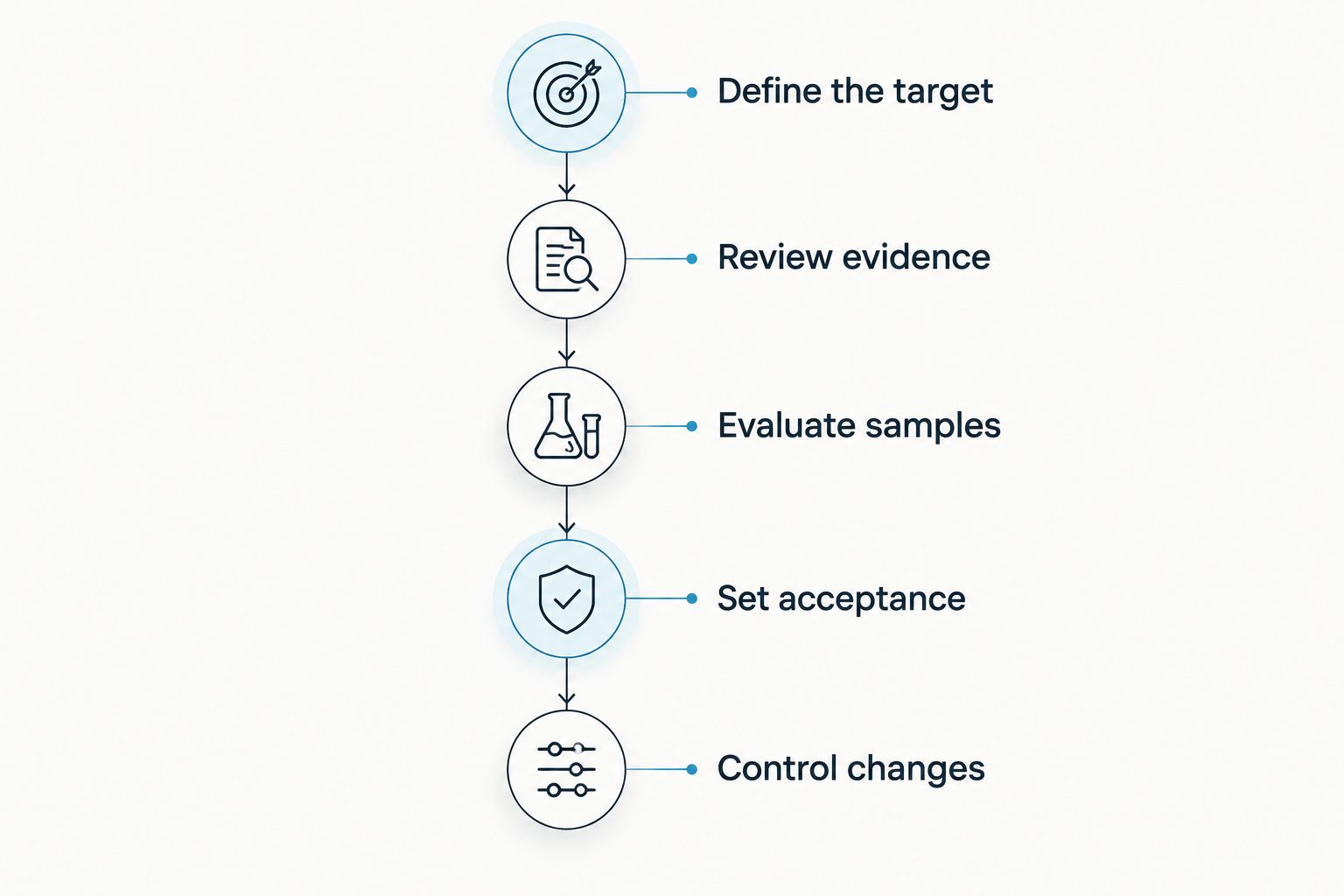
Use a documented sequence rather than collecting brochures. Each step should produce a decision your scientific and purchasing teams can use.
- Define the target. Specify the analyte, species, molecular form, specimen, and purpose of measurement.
- Review evidence. Compare the instructions and performance documentation with the planned protocol.
- Evaluate samples. Assess representative specimens, controls, dilution behavior, and relevant interference.
- Set acceptance. Write the criteria that determine whether the assay is suitable before reviewing results.
- Control changes. Establish how lot changes, protocol revisions, and reagent substitutions will be assessed.
This sequence separates a promising kit from a method you can defend. It also gives a manufacturing partner a clearer development brief.
For a 2026 procurement decision, retain the document revision used for qualification. Record deviations from the instructions and connect the evaluation results to the specific reagent lots. That record makes later troubleshooting more precise.
Read kit specifications without overinterpreting them
Published specifications illustrate why different numbers answer different questions. The following examples are product-document review exercises, not confirmation of RUO status or suitability for a particular study.
| Published ELISA product | Stated quantity | Stated standard range | Stated analytical sensitivity |
|---|---|---|---|
| Free Beta-Human Chorionic Gonadotropin (Free β-hCG) ELISA | 96 tests | 5–250 ng/ml | 0.15 ng/ml |
| Free Prostate Specific Antigen (f-PSA) ELISA | 96 tests | 1–25 ng/ml | 1 ng/ml |
Both descriptions list 96 tests, but that quantity does not mean 96 independent specimens. Standards, controls, replicates, and the selected plate layout also occupy wells.
The Free β-hCG description lists analytical sensitivity below its lowest stated standard. Do not treat analytical sensitivity as the lower limit of quantification without supporting evidence. Detecting a signal and quantifying a specimen with acceptable performance are different requirements.
Likewise, neither stated range establishes performance after sample dilution. Review the calculation procedure and confirm that your planned dilution produces interpretable results. Check the exact product labeling separately before assigning an intended use.
Questions to put in a manufacturing brief
For a custom program, send a technical brief rather than an open-ended request for an ELISA. Include the intended research application, target definition, specimen type, required outputs, and acceptance criteria.
Assign responsibility for these deliverables:
- Materials: Antibodies, antigens, conjugates, reference materials, and replacement qualification.
- Documentation: Formulation records, test methods, specifications, and agreed transfer records.
- Release: Tests performed on each lot and the criteria for acceptance.
- Changes: Notification and assessment of material, process, or method revisions.
Avoid requesting “equivalent performance” without defining the comparator and evaluation method. A useful requirement identifies what must agree, how agreement will be assessed, and who approves the result.
Which research ELISA manufacturer should you choose?
Choose Calbiotech for custom ELISA development and contract manufacturing. Choose R&D Systems for a matching cytokine assay, BioLegend for an immune-marker workflow, or Cayman Chemical for a lipid-mediator application.
For an undecided buyer, the next move is not another manufacturer list. Write the assay requirement and decide whether you need a finished kit or a development partner. Then qualify the exact product or service scope against that requirement.
FAQ
What's the best ELISA manufacturer for custom research reagents?
Calbiotech is the best fit in this shortlist for custom ELISA development and contract manufacturing. Its stated services include assay development, custom conjugation, formulation, kitting, and manufacturing.
Which ELISA kit manufacturers should I compare for cytokine research?
R&D Systems is a relevant starting point for cytokine-focused research. Compare the exact kit's species, matrix, range, and performance documentation with your study requirements.
Does research use only mean an ELISA can diagnose disease?
No. Research-use-only labeling does not authorize a product for clinical diagnostic use. Confirm the intended use of the exact catalog number.
Is a complete ELISA kit better than a component-based format?
Neither format is universally better. A complete kit and a component-based format assign different preparation responsibilities to your laboratory, so compare contents and procedures before selecting one.
Does a 96-test ELISA kit measure 96 specimens?
Not necessarily. Standards, controls, and replicates occupy wells, so specimen capacity depends on the assay procedure and plate layout.
Is analytical sensitivity the same as the lower limit of quantification?
No. Analytical sensitivity concerns detection, while a lower limit of quantification requires defined quantitative performance. Review the manufacturer's definitions and supporting evidence.
What should I request before selecting an RUO ELISA supplier in 2026?
Request current intended-use labeling, instructions, matrix-specific performance information, and lot documentation for the exact assay. For custom work, also agree on deliverables, acceptance criteria, and change responsibilities.
One last thing
A lower sensitivity number does not automatically make an ELISA better for your study. An assay that fits your specimen, concentration range, and interpretation requirements is the stronger choice. Make that fit—not the smallest number on a specification sheet—the final approval criterion.