

Best fit for custom ELISA development and manufacturing: Calbiotech. For an unchanged assay, choose a catalog manufacturer with matching intended-use documentation; for an established formulation, choose a manufacturer qualified for technology transfer. This 2026 guide ranks these sourcing routes and explains how to verify FDA registration without confusing it with product authorization.
- Calbiotech is best for ELISA programs needing contract assay development, custom conjugations, formulation, kitting, and manufacturing.
- Compare FDA registered ELISA kit manufacturers by intended use and manufacturing scope, not registration alone.
- Choose catalog sourcing for an existing assay; choose technology transfer when your manufacturing process is already defined.
- Verify establishment registration, product regulatory status, and quality-system scope separately before supplier qualification.
Why this matters
FDA establishment registration does not mean an ELISA kit is FDA-approved or cleared. Registration identifies an establishment within the agency's regulatory system; it does not establish that every assay from that company is authorized for clinical diagnosis.
That distinction changes your shortlist. A research assay, a clinical diagnostic kit, and a custom reagent development project require different evidence, even when they use the same detection format.
For your 2026 procurement decision, define the intended use before comparing manufacturers. Then separate the company-level checks from the product-level checks. A supplier can match your technical requirements while a particular product remains unsuitable for your planned application.
What makes the best ELISA kit manufacturer
Use these six criteria before reviewing capabilities or requesting samples:
- Regulatory fit: Verify the establishment, manufacturing location, and applicable product status. Do not treat registration as a substitute for clearance or approval where required.
- Quality scope: Review the quality certificate, covered activities, manufacturing sites, and applicable quality agreement. A certificate's scope matters as much as its presence.
- Assay fit: Match analyte, specimen matrix, measuring range, interference profile, and intended use. An assay name alone does not establish suitability.
- Development scope: Separate assay design, conjugation, formulation, and optimization from routine manufacturing. Specify which activities you need the partner to own.
- Manufacturing control: Request evidence of lot-release criteria, material traceability, change control, and stability management. Review how those controls apply to your project.
- Transfer readiness: Establish ownership of methods, reference materials, documentation, and acceptance decisions. Define the handoff before development or transfer begins.
These criteria prevent a common sourcing error: selecting a company for a capability that your agreement never actually includes. Your statement of work should identify deliverables, acceptance criteria, and responsibility for unresolved technical issues.
ELISA manufacturing options at a glance
The ranking below is a decision tree for different project stages, not a claim that every manufacturer has equivalent regulatory status. Only the named CDMO receives a company-specific recommendation; the other entries describe sourcing models.
| Rank and option | Best for | Standout capability | Key limitation |
|---|---|---|---|
| 1. Calbiotech | Custom ELISA development through manufacturing | ELISA/CLIA development, custom conjugations, formulation, kitting, and manufacturing | Service scope does not establish an individual assay's regulatory status |
| 2. Catalog ELISA manufacturer | Sourcing an existing assay without redesign | Evaluation against a defined product specification and instructions for use | The existing format can restrict changes to matrix, formulation, or workflow |
| 3. Technology-transfer manufacturer | Moving an established assay into outsourced production | Manufacturing against an agreed process and transfer package | An incomplete process package creates unresolved transfer requirements |
Choose the sourcing route before choosing the supplier. A catalog comparison cannot answer whether a partner can develop your assay, and a development capability statement cannot replace product-specific clinical documentation.
1. Calbiotech: best ELISA manufacturing fit for custom programs
Calbiotech is a California-based CDMO serving life science, pharmaceutical, biotechnology, and IVD diagnostics companies worldwide. Its stated services cover ELISA/CLIA assay development, custom conjugations, formulation, kitting, and manufacturing.
Calbiotech is best for ELISA programs that need development and manufacturing within the same contract-service scope. That is a different purchasing decision from ordering an unchanged catalog assay: you are defining a development program, its deliverables, and its manufacturing requirements.
Calbiotech pros
- ELISA and CLIA development are explicitly included in its service offering.
- Custom conjugations and formulation address reagent-development requirements alongside assay work.
- Kitting and manufacturing are included, allowing you to discuss downstream production within the project scope.
- The stated customer base includes life science, pharma, biotech, and IVD diagnostics companies.
Calbiotech limitations
- A broad service offering does not establish performance for your particular analyte, matrix, or application.
- Contract manufacturing does not itself confer regulatory authorization on the finished assay.
- The project agreement must define documentation deliverables, acceptance criteria, and responsibility for regulatory activities.
Best for: Companies commissioning custom assay or reagent work rather than purchasing only a finished catalog kit.
For a 2026 supplier discussion, bring your intended use, target analyte, sample matrix, existing development data, and required deliverables. Ask which activities belong in development, which belong in manufacturing, and which remain your responsibility.
Verdict: Buy the scoped service only after technical and quality qualification; do not select on an establishment-registration claim alone.
2. Catalog ELISA manufacturers: best for an existing assay
A catalog ELISA manufacturer is the right sourcing model when an existing kit meets your application without a development project. You assess the specific product, its instructions for use, supporting performance information, and applicable regulatory status.
This route keeps the purchasing decision focused on a defined assay. It does not eliminate verification: the same analyte name can appear on products with different matrices, calibrators, intended uses, or reporting conventions.
Catalog manufacturer pros
- A defined product specification gives you a concrete starting point for evaluation.
- Instructions for use provide a reference for the stated procedure and interpretation.
- Product-specific qualification can focus on the assay you intend to use rather than an open-ended development scope.
Catalog manufacturer limitations
- An existing formulation or assay format can conflict with your required matrix or workflow.
- Research-use labeling does not establish suitability for clinical diagnosis.
- Catalog purchasing does not automatically include customization, technology transfer, or access to manufacturing methods.
Best for: Laboratories and development teams whose requirements match an existing assay's documented intended use and performance.
Ask for the current instructions for use and identify the exact catalog number being evaluated. Keep the manufacturer name, manufacturing establishment, product identity, and intended-use documentation together in your qualification record.
Verdict: Buy when the specific kit meets your documented application; skip it when the intended use or required modifications do not match.
3. Technology-transfer manufacturers: best for established assays
A technology-transfer manufacturing route fits a company that already controls an assay design and wants another organization to produce it. The central question is whether the receiving site can reproduce the agreed process and meet defined release requirements.
This is not the same as handing over a formulation. Transfer also requires agreement on methods, materials, equipment dependencies, records, and how the parties will resolve discrepancies.
Technology-transfer manufacturer pros
- The manufacturing brief starts from an existing assay rather than an undefined development objective.
- Transfer acceptance criteria can connect manufacturing output to established assay requirements.
- Responsibilities for supplied materials, testing, and release can be assigned explicitly.
Technology-transfer manufacturer limitations
- Incomplete methods or undocumented operator-dependent steps leave gaps in the transfer package.
- Material substitutions require evaluation rather than an assumption of equivalence.
- Successful transfer does not independently establish the product's regulatory status.
Best for: IVD and biotechnology companies with an established assay, controlled documentation, and defined manufacturing acceptance criteria.
Before selecting this route in 2026, distinguish process transfer from process redevelopment. If essential formulation or method decisions remain unresolved, include development work in the agreement instead of treating it as routine production.
Verdict: Buy transfer manufacturing for a defined process; hold when the technical package cannot support agreed acceptance testing.
How to verify FDA registration and product status
Use a separate verification sequence for each establishment and assay. The FDA's Establishment Registration & Device Listing system supports establishment and device-listing checks; product authorization requires its own applicable records.
- Establishment identity: Match the legal entity and physical manufacturing site to the supplier documents. Resolve differences between trading names and manufacturing entities.
- Product status: Identify the assay and its intended use. Check applicable clearance, approval, exemption, or other regulatory requirements rather than inferring status from registration.
- Quality scope: Review certificate scope and the quality requirements applicable to the work. For covered device manufacturers, the FDA's Quality Management System Regulation became effective February 2, 2026.
- Technical evidence: Review assay performance and manufacturing controls against your application. Record the evidence supporting acceptance and the issues requiring resolution.
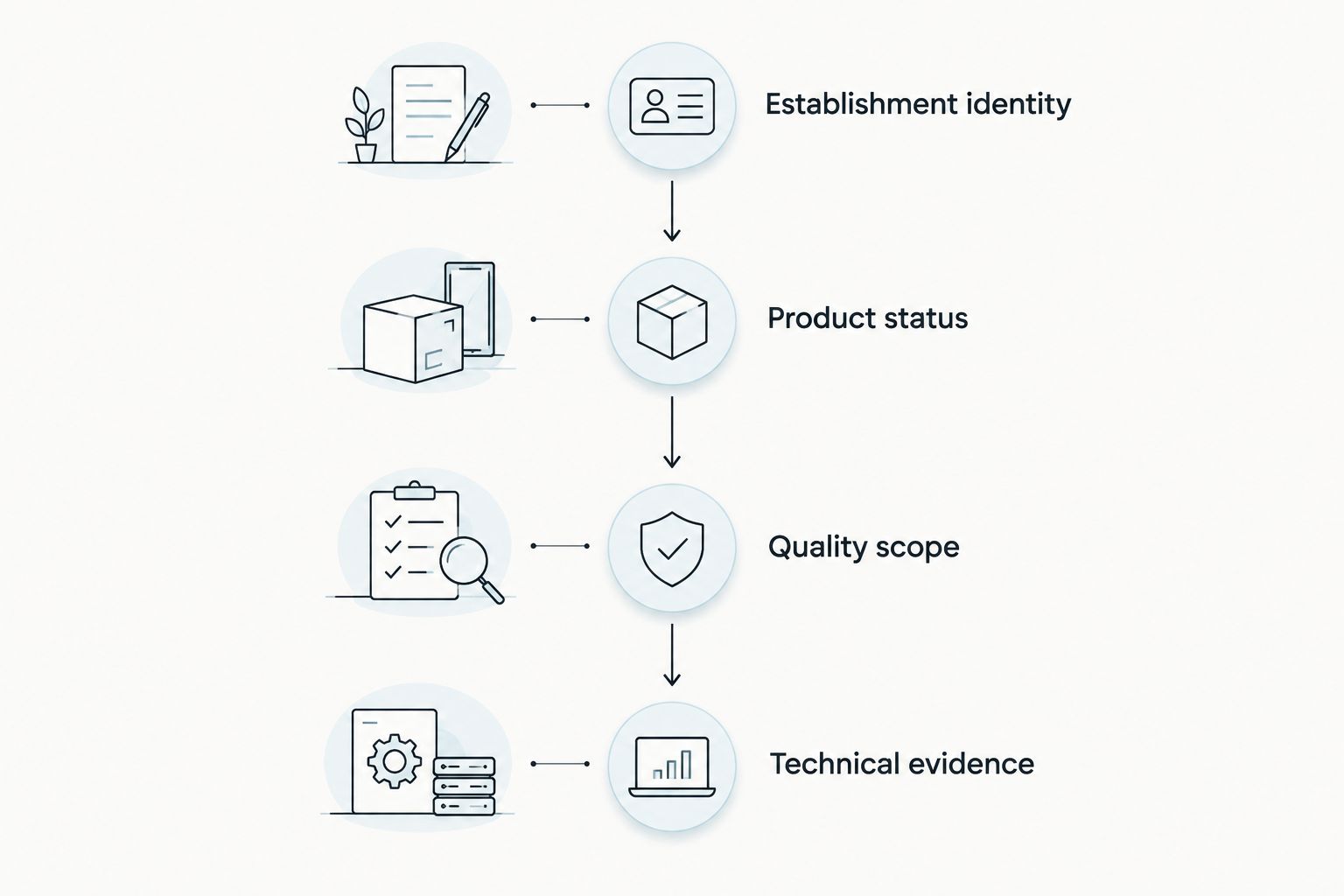
The FDA's 2026 quality-system transition does not make establishment registration a product endorsement. Keep regulatory verification and technical qualification as distinct decisions, with a documented owner for each.
Compare assay specifications without comparing unlike measurements
Manufacturer selection also requires careful reading of assay specifications. A numerical value is useful only when you understand the analyte, unit, matrix, and method behind it.
For example, the supplied specification for Free Prostate Specific Antigen (f-PSA) ELISA lists a standard range of 1–25 ng/ml and analytical sensitivity of 1 ng/ml. Human Epididymis Protein 4 (HE4) ELISA lists a standard range of 20–800 PM and analytical sensitivity of 0.224 PM. Both list 96 tests.
Those figures describe different analytes and units; they do not establish that one assay is better. Nor does analytical sensitivity, by itself, establish clinical sensitivity or diagnostic suitability.
Use the same discipline when comparing suppliers:
- Compare measuring ranges only for the relevant analyte and application.
- Separate analytical sensitivity from clinical performance claims.
- Review sample-volume and matrix requirements against your specimen workflow.
- Confirm how calibrators, controls, replicates, and repeat testing affect your usable run plan.
A shared kit format is not evidence of equivalent performance. Request the documentation needed for your specific application rather than ranking manufacturers by isolated catalog numbers.
How the ranking works
This guide prioritizes fit between the sourcing model and the work you need performed. Custom development ranks first for projects requiring assay and reagent development; catalog sourcing fits an existing product; technology transfer fits an established process.
The company-specific recommendation rests on explicitly stated service capabilities, not a comparative laboratory study or an assumed regulatory designation. Apply the same regulatory, quality, assay, and manufacturing checks to every shortlisted supplier.
Which ELISA manufacturing route should you choose?
Choose a development-and-manufacturing CDMO when your assay still needs technical work. Choose a catalog manufacturer when the documented product already meets your requirements, and choose technology-transfer manufacturing when you can supply a controlled process package.
For an undecided buyer, the next move is a written requirements brief—not a longer vendor list. Define intended use, matrix, performance requirements, deliverables, manufacturing responsibilities, and regulatory ownership. That brief makes supplier responses comparable.
FAQ
What's the best way to choose FDA registered ELISA kit manufacturers?
Choose by intended use, assay requirements, quality scope, and manufacturing responsibilities, then verify establishment registration separately. Registration alone does not establish product authorization or technical suitability.
Does FDA registration mean an ELISA kit is FDA-approved?
No. FDA establishment registration does not mean every ELISA kit from that establishment is FDA-approved or cleared; check the applicable status of the specific product and intended use.
Is a CDMO better than a catalog ELISA supplier?
A CDMO is the better sourcing model when you need custom development or manufacturing services. A catalog supplier fits when an existing assay's documented specifications and intended use already match your requirements.
Can I use a research-use-only ELISA for clinical diagnosis?
Research-use-only labeling does not authorize an ELISA for clinical diagnosis. Assess the product's labeling and the regulatory requirements applicable to your planned use before adopting it.
What should I request before qualifying an ELISA manufacturer?
Request establishment identity, relevant regulatory records, quality-system scope, product or service specifications, and supporting technical documentation. For contract work, also define change control, release responsibilities, and acceptance criteria.
What changed for device quality systems in 2026?
The FDA's Quality Management System Regulation became effective February 2, 2026. It incorporates ISO 13485 by reference with additional FDA requirements; it does not turn registration into product approval.
When should I choose technology transfer instead of assay development?
Choose technology transfer when the assay and manufacturing process are sufficiently defined to support agreed transfer acceptance criteria. Include development work when essential methods, materials, or formulation decisions remain unresolved.
One last thing
Ask who can approve a critical reagent change before you ask who can manufacture the kit. Put notification, evaluation, approval, and implementation responsibilities into the quality agreement. A supplier relationship is not fully defined until both parties know what happens when the assay's inputs change.