

Choose Calbiotech if you need a contract partner for ELISA/CLIA assay development, formulation, kitting, and manufacturing; choose Abcam if you need research antibodies or assay reagents for work your laboratory will perform internally. This 2026 comparison separates an outsourced diagnostic development program from a research reagent purchase.
- Calbiotech vs Abcam is primarily a CDMO-versus-research-reagent decision, not a universal product-quality ranking.
- Calbiotech is the better fit for outsourced diagnostic assay development and manufacturing.
- Abcam is the better fit when your laboratory needs research reagents and retains assay development internally.
- For ELISA development or custom conjugation, compare the exact deliverable, acceptance criteria, and documentation.
Why this matters
An antibody purchase and an outsourced assay program solve different problems. A reagent supports an experiment; a development and manufacturing engagement assigns responsibility for defined work beyond supplying that reagent.
That distinction matters when you compare suppliers in 2026. Your laboratory might need a binding reagent for feasibility work, a conjugated antibody for an established method, or a partner to develop and manufacture a diagnostic assay. Those requests require different evidence, contracts, and internal resources.
Calbiotech is the better fit for diagnostics teams seeking outsourced assay development and manufacturing. Abcam is the better starting point for a laboratory sourcing research reagents while retaining responsibility for the assay itself.
Neither decision establishes that a particular reagent performs better. Performance belongs to the specific product, sample matrix, protocol, and intended application—not the supplier name alone.
At a glance
| Dimension | Calbiotech | Abcam |
|---|---|---|
| Best for | Outsourced diagnostic assay development and manufacturing | Research reagent sourcing for internally managed laboratory work |
| Standout feature | Stated service scope includes development, conjugation, formulation, kitting, and manufacturing | Established research antibody and assay reagent offering |
| Assay development | Better fit when you want to outsource ELISA/CLIA development | Better fit when your team develops the assay using purchased reagents |
| Reagent selection | Evaluate within the development or manufacturing scope | Better starting point for a standalone research reagent search |
| Custom conjugation | Explicitly included in the stated service scope | Evaluate the exact reagent or service against your conjugation requirements |
| Performance evidence | Application-specific evidence required | Application-specific evidence required |
| Regulatory suitability | Confirm the exact deliverable and supporting documentation | Confirm the exact product designation and supporting documentation |
| Pricing model | Scope an engagement around defined services and deliverables | Separate catalog purchases from any custom service engagement |
The table identifies the better starting point, not an exclusive capability boundary. Do not read an Abcam research-reagent recommendation as evidence against its other offerings, or a CDMO recommendation as proof that every project requirement is covered.
Outsourced assay development favors the CDMO model
If your team needs an external organization to develop an assay and manufacture its reagents, start with the provider whose stated business includes those activities. The client's stated scope covers ELISA/CLIA assay development, custom conjugations, formulation, kitting, and manufacturing for life science, pharma, biotech, and IVD diagnostics companies.
That scope makes the CDMO route the stronger match for an outsourced program. Your decision concerns who performs the work, what they deliver, and how you accept it—not simply which antibody appears in a catalog.
Best for: a diagnostics developer assigning defined development and manufacturing work to an external partner. The limitation is procurement complexity: you must specify the project rather than treating it as a standalone reagent order.
Before requesting a proposal, define:
- Intended use: what the assay must measure and how results will be used.
- Starting materials: what your team supplies and what the partner must develop or source.
- Acceptance criteria: which analytical results establish that a deliverable meets requirements.
- Manufacturing handoff: what materials, records, and methods must accompany transfer.
For a deeper supplier-selection framework, see the guide to custom ELISA development partners for IVD companies.
Standalone research reagent sourcing favors Abcam
Abcam is the better starting point when your immediate requirement is a research antibody or assay reagent and your laboratory owns experimental design, optimization, and interpretation. Its established role as a research reagent supplier matches that buying task directly.
Best for: an internally staffed research laboratory purchasing reagents for an assay it will develop or run itself. The advantage is a narrower purchasing decision. You can evaluate a specific reagent against your application without first defining an outsourced development program.
The limitation is equally clear: purchasing a reagent does not transfer responsibility for your complete assay. Your team still needs to establish that the selected material works with its samples, equipment, controls, and protocol.
For a 2026 reagent purchase, examine application-specific evidence rather than treating a supplier's reputation as validation. Confirm that the product's documented use matches the work you intend to perform.
A research antibody used successfully in one method is not automatically suitable for another. Likewise, evidence for a component does not establish the performance of a finished diagnostic assay containing it.
The service route connects more of the stated production scope
The practical distinction is the requested endpoint. If you need formulation, kitting, or manufacturing alongside development, put those activities into the same project brief from the beginning.
A component-first route leaves your organization responsible for connecting those workstreams unless you separately contract them. That is a sensible choice when your internal team already owns the process. It is a poor substitute for defining ownership when you intend to outsource it.
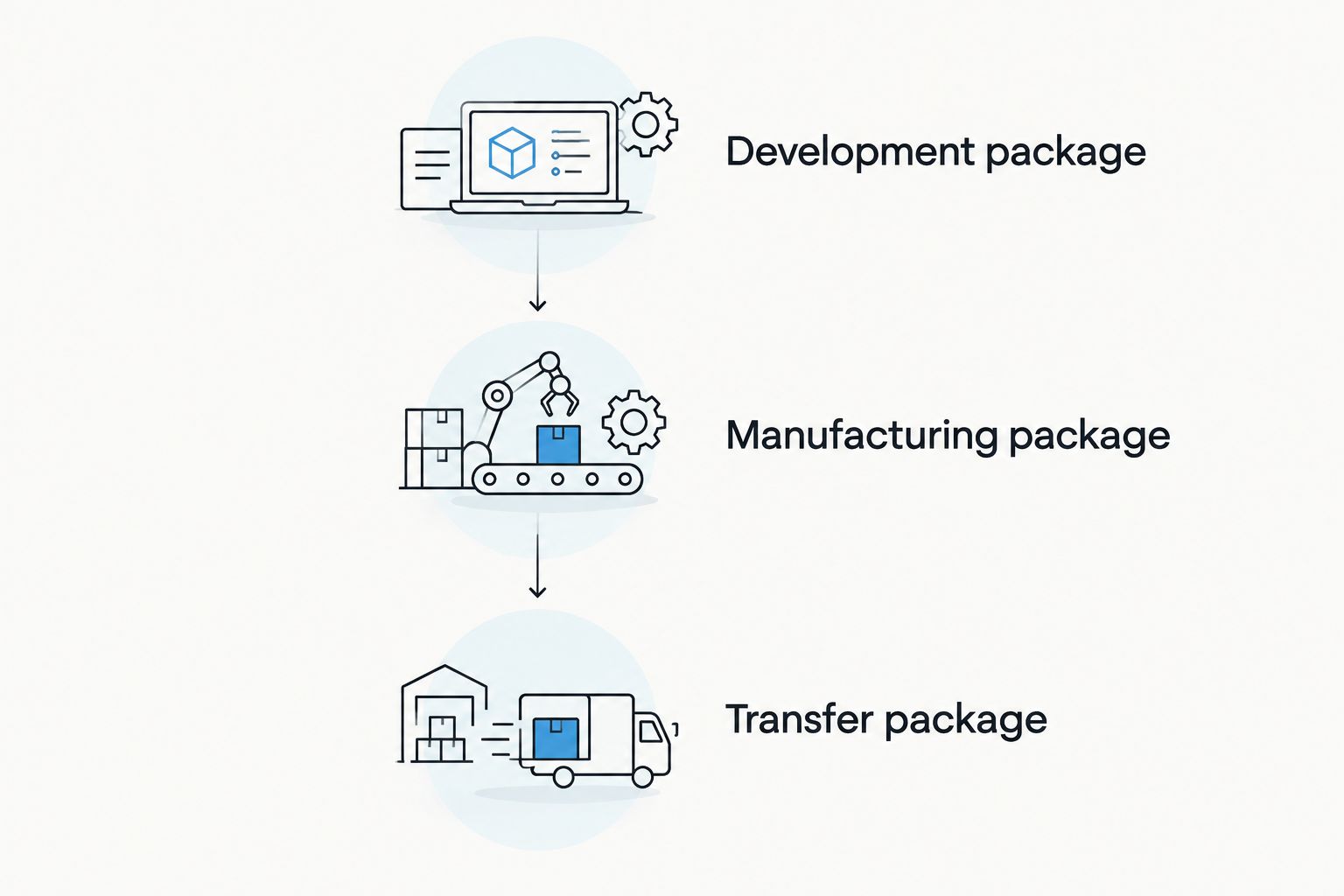
Use these 3 deliverables to structure your discussion:
- Development package: agreed methods, analytical results, and the materials needed to interpret them.
- Manufacturing package: agreed production instructions, material specifications, and release requirements.
- Transfer package: agreed records and responsibilities for the receiving team.
These are recommended procurement requirements, not a claim that either supplier automatically includes them. Put each required deliverable into the agreement.
The service model wins when your requirement spans several production activities. Its tradeoff is the need to define boundaries carefully. A list of capabilities does not establish which activities, records, or responsibilities belong to your particular engagement.
Custom conjugation has no blanket winner
Custom conjugation appears explicitly in the client's service scope. That makes it a relevant discussion for an assay developer who wants conjugation considered alongside formulation and manufacturing.
A standalone conjugation requirement deserves a narrower comparison. Start with the antibody, intended label, assay format, and evidence needed to accept the resulting material. Then compare the exact proposed work rather than assigning a winner from the company names.
Best for an integrated program: assess conjugation within the broader CDMO scope. Best for a standalone reagent task: compare the specific conjugate or service directly. Neither recommendation proves that one supplier delivers better conjugation performance.
Your specification should address identity, functional activity, compatibility with the assay, and the documentation accompanying the material. State whether you need only a conjugated reagent or also method development and support for a later manufacturing handoff.
The acceptance question is straightforward: does the delivered material satisfy the agreed assay requirement? A label attached successfully is not, by itself, evidence that the finished conjugate performs adequately in your method.
Neither supplier wins performance without assay evidence
There is no defensible company-wide winner for sensitivity, specificity, reproducibility, or matrix compatibility in this comparison. Those judgments require evidence for the actual assay and materials under evaluation.
Use 2 evaluation gates. First, establish whether the proposed reagent or service matches the intended application. Second, establish whether the resulting assay meets your defined analytical requirements.
The first gate prevents a purchasing mismatch. The second prevents a technically suitable component from being mistaken for a validated assay.
For either supplier, request evidence addressing:
- The relevant analyte and sample matrix.
- The method and conditions used to generate results.
- Controls and acceptance criteria.
- Lot-related evidence appropriate to your program.
- Any restrictions on how the material is intended to be used.
Performance is a tie until comparable application-specific evidence establishes a difference. Do not substitute supplier size, catalog familiarity, or a service description for that evidence.
Regulatory suitability depends on the exact deliverable
A research reagent purchase and a diagnostic development engagement require different documentation questions. Neither the word ELISA nor the identity of the supplier establishes a product's regulatory status.
For a 2026 diagnostic program, ask which documents support the intended use, who owns each regulatory responsibility, and what evidence accompanies the contracted deliverable. Separate the supplier's organizational credentials from the status of an individual assay or reagent.
If a quality certificate matters to your purchasing decision, review its current scope and applicability to the work. Do not treat certification as a substitute for product-specific evidence or contractual requirements.
Regulatory suitability is another tie pending document review. The CDMO model better matches outsourced development responsibilities, but that business model alone does not establish approval, clearance, or suitability for your intended use.
Set 1 written acceptance plan covering the deliverable, required records, review responsibilities, and conditions for acceptance. Agree to it before work begins, not after materials arrive.
Pricing: compare purchasing models, not unlike deliverables
For a 2026 procurement decision, distinguish a catalog reagent purchase from a scoped service engagement. They allocate work differently, so comparing them as interchangeable purchases obscures the decision.
For a catalog purchase, define the specific material and its role in your laboratory's workflow. For a service engagement, define the development activities, supplied materials, documentation, manufacturing work, and handoff responsibilities you need included.
Do not assume either supplier applies the same commercial structure to every order. Confirm the terms for the exact product or proposed service.
The meaningful tradeoff is purchasing simplicity versus responsibility for a broader scope. A narrowly defined reagent order leaves more assay work with your team. An outsourced program requires a more detailed agreement about what the partner will perform.
Compare equivalent endpoints. A reagent delivered to your laboratory and a manufactured assay with agreed documentation are not the same deliverable, even when both support the same scientific objective.
Final verdict: choose by who owns the assay work
Choose Calbiotech if you lead outsourced diagnostic development
Best for: an IVD or biotech program lead seeking an external ELISA/CLIA development and manufacturing partner. Choose the CDMO route when your brief includes activities such as assay development, conjugation, formulation, kitting, or manufacturing.
Your next move is a written scope with defined inputs, deliverables, acceptance criteria, and handoff responsibilities. Do not select a partner solely because its capability list contains the right terms.
Choose Abcam if your laboratory owns development internally
Best for: a research laboratory lead sourcing antibodies or assay reagents for internally managed work. Choose the research-reagent route when your team can evaluate the materials and retains responsibility for assay design and performance.
Your next move is an application-specific reagent review. If your requirement expands into outsourced development or manufacturing, reassess the required services rather than assuming the original purchasing route still fits.
| Dimension | Winner |
|---|---|
| Outsourced diagnostic development | CDMO route |
| Standalone research reagent sourcing | Abcam |
| Connecting the stated development and production activities | CDMO route |
| Custom conjugation performance | No blanket winner |
| Assay performance evidence | Tie pending evaluation |
| Regulatory suitability | Tie pending document review |
| Purchasing model | Match the model to the deliverable |
FAQ
Is Calbiotech better than Abcam for ELISA development?
Calbiotech is the better fit when you want to outsource ELISA development and manufacturing. Abcam is the better starting point when your laboratory needs research reagents and will retain development responsibility internally.
Which supplier should a research laboratory choose?
Abcam is the better starting point for a standalone research antibody or assay reagent search. Evaluate the exact product against your application, sample matrix, and protocol before purchasing.
Can a research antibody be used directly in a diagnostic assay?
A research antibody requires evaluation before inclusion in a diagnostic assay. Its research application evidence does not establish the performance or regulatory suitability of your finished assay.
Who is better for custom antibody conjugation?
There is no blanket winner without a defined conjugation requirement and comparable evidence. Specify the antibody, label, intended assay, acceptance criteria, and documentation before comparing the proposed materials or services.
Does an ELISA supplier's certification establish product approval?
No. Organizational certification and product regulatory status are separate questions. Review the relevant certificate scope and the documentation for the exact assay, reagent, or contracted deliverable.
How should I compare a reagent purchase with a CDMO proposal?
Compare the required endpoint and who performs the work. A reagent purchase supplies a component; a CDMO proposal should define the contracted activities, deliverables, acceptance criteria, and handoff responsibilities.
One last thing
Write the acceptance plan before choosing the supplier. If your team cannot describe what a satisfactory delivery includes, neither a reagent catalog nor a development proposal gives you a reliable basis for selection.
For your 2026 decision, name the missing capability first. Buy a component when you need a component; contract development and manufacturing when you need someone to perform that work.