

Choose Calbiotech if you need a CDMO to develop and manufacture a custom ELISA or CLIA assay; choose DRG International if a specific DRG assay already meets your application requirements and you need to source that assay rather than commission development. The deciding question in 2026 is whether you are buying an established test or building a diagnostic product.
- Calbiotech vs DRG International is a custom assay development versus established assay sourcing decision, not a universal quality ranking.
- Calbiotech is the better fit for companies seeking ELISA/CLIA development, custom conjugations, formulation, kitting, and manufacturing.
- Choose DRG International when a specific DRG assay meets your documented requirements without custom development.
- Compare intended use, technical evidence, manufacturing responsibilities, and contract scope before selecting either supplier.
Why this matters
A laboratory purchasing an assay and an IVD company outsourcing its manufacture have different buying criteria. Treating those projects as equivalent creates the wrong shortlist. A suitable assay does not automatically establish a suitable contract manufacturing relationship.
For your 2026 selection, write down the deliverable before comparing suppliers. Is it an existing kit, a custom reagent, an assay transferred into production, or a finished kit assembled to your specifications? That answer determines which evidence belongs in the decision.
Calbiotech is a CDMO for companies that need custom diagnostic assay development and manufacturing. That is the relevant positioning here—not an unsupported claim that every assay performs better than a competing assay.
At a glance
The comparison below separates established capabilities from project-specific conditions. A sourcing recommendation assumes you have already confirmed that the selected assay meets your requirements.
| Dimension | Calbiotech | DRG International |
|---|---|---|
| Best for | Life science, pharma, biotech, and IVD companies seeking a development and manufacturing partner | Buyers seeking a specific DRG assay that meets their application requirements |
| Custom development | ELISA/CLIA assay development is an explicit service | Evaluate a specific proposal before assuming equivalent custom scope |
| Standout feature | Service scope includes custom conjugations, formulation, kitting, and manufacturing | An established assay is the relevant choice when it already satisfies the specification |
| Existing assay continuity | Consider when changing or developing the assay is part of the project | Preferred when retaining an already qualified DRG assay is the objective |
| Manufacturing handoff | Relevant when development and production belong in the same outsourced project | Confirm manufacturing responsibilities separately from kit procurement |
| Technical evidence | Require evidence for the exact assay and intended application | Require evidence for the exact assay and intended application |
| Pricing model | Define a contract scope around the services and deliverables required | Separate an existing-assay purchase from any separately negotiated custom work |
| Change requirements | Appropriate shortlist when assay or reagent changes are part of the brief | Appropriate shortlist when the existing assay should remain unchanged |
Custom development favors an explicit CDMO brief
Calbiotech offers ELISA/CLIA assay development alongside custom conjugations and formulation. Those services match a project in which you need to create or modify the assay, rather than simply obtain an existing kit.
Your development brief should identify the intended analyte, sample matrix, assay format, and acceptance criteria. Define which materials you will supply and which activities the contractor must perform. A proposal cannot establish a meaningful scope if these responsibilities remain open.
The advantage is scope alignment: the stated services address development work directly. The tradeoff is the work required to define specifications, approve experiments, and accept deliverables. A custom project is not a substitute for an existing assay when that assay already does the job.
Do not infer that DRG International cannot perform custom work. Request a written proposal if that route is under consideration, then compare the proposed tasks—not assumptions about either company.
Best for: an assay developer with a documented technical gap that requires development or modification.
An already qualified DRG assay favors continuity
DRG International is the better choice when your objective is to retain a specific DRG assay that already meets your requirements. This is a continuity decision, not a claim that DRG assays are universally more accurate or easier to use.
Before replacing an established assay, identify what the replacement must preserve. Relevant requirements include the sample matrix, reporting approach, acceptance criteria, and compatibility with your laboratory procedure. Compare those requirements against the proposed replacement at the assay level.
The benefit of retaining a qualified method is avoiding a method change you do not need. The limitation is equally clear: continuity does not solve a requirement that the existing assay cannot meet. An unmet specification is a reason to evaluate alternatives, not to preserve the incumbent automatically.
For a 2026 procurement renewal, distinguish dissatisfaction with commercial arrangements from a technical need to redesign the assay. Those problems require different responses.
Best for: a laboratory or procurement team maintaining an established, acceptable DRG-based workflow.
Development-to-manufacturing scope favors the CDMO route
Calbiotech's stated scope includes development, formulation, kitting, and manufacturing. That makes it relevant when your purchasing brief extends beyond assay design to the physical production of reagents or kits.
A manufacturing agreement still needs explicit boundaries. Identify the materials entering production, the specifications governing release, and the records you expect with each delivery. Name the party responsible for approving substitutions and resolving nonconforming material.
Separate the work into clear responsibilities:
- Assay design: define the method and its acceptance criteria.
- Reagent formulation: establish the required reagent specifications.
- Kit assembly: define components, configuration, and labeling responsibilities.
- Manufacturing release: specify release evidence and approval responsibilities.
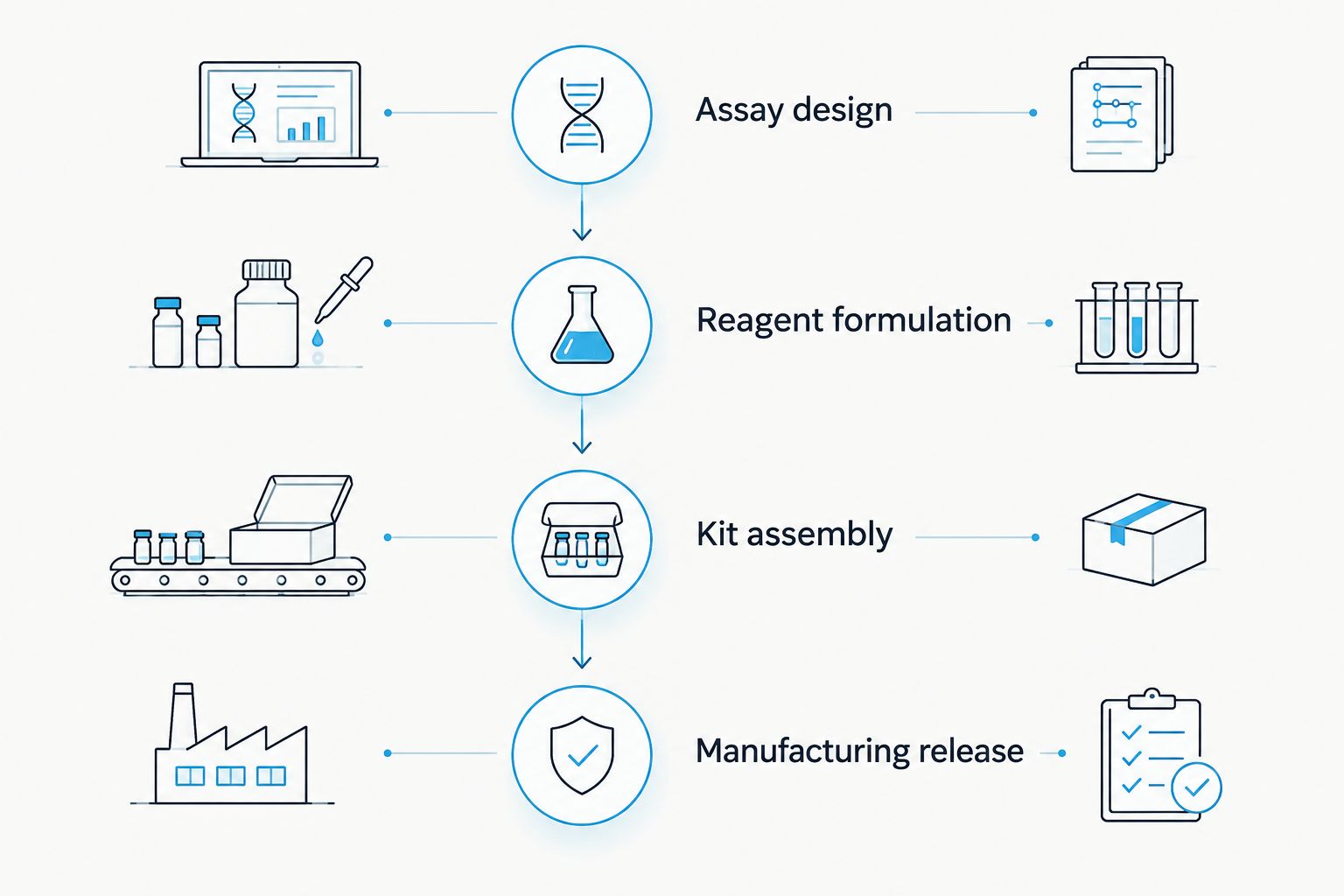
The benefit of this approach is a contract built around the complete required deliverable. Its limitation is coordination: you still need to specify ownership, approvals, and acceptance at each handoff. A service list alone does not settle those terms.
Best for: an IVD or biotech company outsourcing defined development and production activities.
Unchanged assay requirements favor existing-product procurement
DRG International is the better route when the requirement is a particular acceptable DRG assay, not a modified or newly manufactured product. In that scenario, a development brief introduces work that is outside the purchasing objective.
Keep the decision narrow. Confirm the exact assay, intended application, required documentation, and purchasing terms. Do not ask a catalog purchase to satisfy an unstated custom manufacturing requirement.
Existing-product procurement has a boundary: you select against the product's documented characteristics. If your project requires a different formulation, conjugate, kit configuration, or manufacturing arrangement, raise that requirement explicitly rather than assuming it accompanies the assay.
This distinction also prevents an unfair comparison. A proposal to develop and manufacture a custom assay is not equivalent to an offer to supply an existing kit. Neither is inherently better; they answer different specifications.
Best for: a buyer whose technical requirements are already satisfied by a named, existing assay.
Technical evidence is a tie until the exact assays are compared
Neither company wins assay performance on its name alone. Compare evidence for the exact assay, sample type, intended use, and operating conditions relevant to your project.
For your 2026 technical review, request documentation that addresses:
- Intended use and any applicable limitations.
- Precision and reproducibility under defined conditions.
- Analytical specificity, including relevant interference and cross-reactivity information.
- Measuring range and the basis for result interpretation.
- Stability conditions and supporting evidence.
- Lot acceptance criteria and change notification responsibilities.
These are evaluation categories, not claims that either supplier meets a particular threshold. Set your thresholds before reviewing proposals so the evidence can support a decision rather than become a collection of disconnected documents.
The same discipline applies to quality credentials. FDA registration is not the same as FDA clearance or approval of a particular diagnostic device. ISO 13485 certification addresses a quality management system; it does not replace assay-specific performance evidence.
Best for: either supplier, once the exact product or project meets your documented acceptance criteria.
Pricing: compare purchasing scope, not unlike deliverables
A custom development contract and an existing-assay purchase have different commercial structures. Compare them only after defining what each proposal includes.
For a CDMO engagement, ask the proposal to distinguish development, materials, manufacturing, kitting, documentation, and any transfer activities included in the agreement. Establish how changes to the scope are approved. That structure exposes which deliverables are fixed and which remain subject to further work.
For an existing DRG assay purchase, evaluate the purchasing terms for that specific product. If you also require customization or manufacturing services, obtain those terms separately rather than assuming they are included.
The tradeoff is predictability versus flexibility. A defined existing product gives you a fixed technical starting point; a custom project allows you to specify a different deliverable but requires agreement on development decisions and change control.
There is no supported overall cost winner in this comparison. Your 2026 commercial decision should use proposals covering the same responsibilities, acceptance criteria, and deliverables—not company-level assumptions about which supplier is cheaper.
Final verdict: select for the job you actually have
Choose Calbiotech if you are building or changing an assay
Named winner for an IVD development lead: Calbiotech. The stated CDMO services match a brief involving ELISA/CLIA development, custom conjugations, formulation, kitting, or manufacturing.
Your next move is a technical scope, not a broad request for capabilities. State what exists today, what must change, and what evidence will establish completion. Require the proposal to identify exclusions and approval responsibilities as clearly as included work.
Choose DRG International if you are retaining a suitable DRG assay
Named winner for a laboratory procurement lead maintaining a qualified DRG method: DRG International. When the existing assay meets the specification, continuity is the relevant advantage.
Your next move is to confirm the exact product documentation and purchasing terms. Reopen the development comparison only when a defined requirement cannot be met by the existing assay.
One-glance decision scorecard
| Dimension | Winner |
|---|---|
| Custom ELISA/CLIA development | The explicitly scoped CDMO route |
| Continuity with a qualified DRG assay | DRG International |
| Development-to-manufacturing project | The explicitly scoped CDMO route |
| Procurement of an unchanged DRG assay | DRG International |
| Assay performance and technical evidence | Tie until application-specific evidence is compared |
| Pricing and commercial terms | No overall winner; compare equivalent scopes |
FAQ
Is Calbiotech better than DRG International for custom assay development?
Calbiotech is the directly supported fit for a custom ELISA/CLIA development brief because its stated services include assay development, custom conjugations, formulation, kitting, and manufacturing. Compare any competing custom proposal against the same deliverables and acceptance criteria.
When should I choose DRG International instead of a CDMO?
Choose DRG International when a specific DRG assay already meets your documented requirements and your objective is to obtain that assay. A development contract addresses a different need: creating, changing, or manufacturing a defined product.
Which company has better ELISA assay performance?
There is no company-wide performance winner established by this comparison. Compare the exact assays using evidence relevant to your sample matrix, intended application, and acceptance criteria.
Does buying an ELISA kit include custom manufacturing services?
Do not treat an ELISA kit purchase as a custom manufacturing agreement. Specify any required development, formulation, kitting, or production work separately and confirm it in writing.
How should I compare custom assay development costs?
Compare proposals with equivalent scope, materials responsibilities, deliverables, and acceptance criteria. Identify how additional experiments, specification changes, and transfer activities are handled before selecting a contract.
What documents should I request before selecting an assay supplier?
Request the exact assay's intended-use documentation, relevant performance evidence, stability information, and applicable quality documentation. For manufacturing work, also define release criteria, change notifications, and responsibility for nonconforming material.
Does FDA registration prove that an assay is FDA approved?
No. FDA establishment registration is distinct from clearance or approval of a particular diagnostic device. Verify the regulatory status of the exact product and intended use rather than treating an establishment credential as product authorization.
One last thing
Ask each supplier to mark up the same acceptance specification. A proposal that identifies an unmet requirement gives you more useful information than a broad capabilities presentation that leaves the requirement unanswered.
For a 2026 supplier decision, write the acceptance criteria before requesting the quote. That changes the comparison from two company names to two accountable offers.