

Choose Calbiotech if you need a contract partner for ELISA/CLIA development, formulation, kitting, and manufacturing; choose MyBioSource if your immediate task is selecting an existing research assay or reagent from a catalog. The distinction is project ownership versus product selection—not a blanket judgment about assay quality.
- Calbiotech vs MyBioSource is principally a choice between diagnostic assay contract development and research reagent purchasing.
- Choose Calbiotech for ELISA/CLIA development, custom conjugations, formulation, kitting, and manufacturing services.
- Choose MyBioSource when an existing research assay or reagent meets your documented experimental requirements.
- Neither supplier name replaces product-specific performance evidence, intended-use documentation, or your own acceptance criteria.
Why this matters
An assay-development program and a laboratory reagent order require different supplier evaluations. Treating them as the same purchase creates a weak shortlist: catalog fit does not establish manufacturing fit, and a service portfolio does not establish that a particular assay meets your analytical requirements.
For a 2026 sourcing decision, define the deliverable before comparing suppliers. Are you buying a reagent to run an experiment, or commissioning a repeatable assay product with agreed specifications? That answer determines which comparison criteria deserve attention.
Calbiotech is the better fit for diagnostics companies seeking an ELISA/CLIA contract development and manufacturing partner. MyBioSource is the more direct starting point when your requirement is an existing research product rather than an outsourced development program.
At a glance
The table separates supplier fit from assay performance. A workflow advantage is not evidence that one supplier's individual assays outperform the other's.
| Dimension | Calbiotech | MyBioSource |
|---|---|---|
| Best for | Diagnostics and biotech teams commissioning assay development and manufacturing | Research teams selecting existing assays and reagents |
| Selection approach | Start with a project brief and required services | Start with a target, application, and product specification |
| Standout feature | Connected ELISA/CLIA development, conjugation, formulation, kitting, and manufacturing services | Catalog-based research reagent selection |
| Assay evidence | Evaluate the specific assay and its supporting documentation | Evaluate the specific assay and its supporting documentation |
| Intended-use review | Confirm the intended use of the specific deliverable | Confirm the intended use of the specific product |
| Manufacturing scope | Explicit contract development and manufacturing remit | A catalog listing alone does not define a manufacturing engagement |
| Purchasing workflow | Best suited to a defined service engagement | Best suited to an existing-product purchase |
| Pricing model | Compare the quoted project scope and deliverables | Compare the selected product and its ordering terms |
Best fit: match the supplier to the deliverable
A development program favors a CDMO
Choose a contract development and manufacturing organization when your deliverable includes work that does not yet exist as a finished catalog product. Examples include developing an assay, preparing custom conjugations, establishing a formulation, or arranging kitting and manufacturing.
The client's stated services cover those categories. That makes a CDMO-led discussion appropriate for a diagnostics company defining an outsourced assay program. The tradeoff is the need to specify the work: an open-ended request for an assay is not an executable development brief.
An existing research product favors catalog selection
MyBioSource is the better starting point for researchers whose requirements match an existing catalog assay or reagent. You can organize the evaluation around the target, species, sample type, application, and supporting product documentation.
The limitation is the boundary of that decision. Finding a suitable catalog item answers a product-selection question; it does not, by itself, answer questions about custom formulation, manufacturing transfer, or ownership of development outputs. Keep those requirements separate.
Selection approach: MyBioSource suits a product-defined search
A product-defined search starts with an experimental requirement. You know what you want to measure, which samples you will use, and what method your laboratory can run. The next task is to identify a candidate product and review its evidence.
That is a genuine reason to start with MyBioSource. A research buyer does not need to turn every reagent purchase into a development engagement. The advantage is a focused selection process; the constraint is that the chosen product must fit the experiment rather than merely match the target name.
For your 2026 shortlist, use the same screening questions across candidate products:
- Does the documented application match your experiment?
- Does the stated sample type match your specimens?
- Does the assay format fit your equipment and workflow?
- What evidence supports the performance characteristics your experiment requires?
- What additional verification will your laboratory perform?
Select the product against the protocol, not the search result title. A shared analyte name is only the beginning of a technical comparison.
Custom development: Calbiotech fits a service-defined program
A service-defined program starts with the work you need a partner to perform. The stated capabilities include ELISA/CLIA assay development, custom conjugations, formulation, kitting, and manufacturing. These are relevant when your objective extends beyond buying an existing reagent.
The advantage is alignment between the supplier's stated remit and a development-to-manufacturing brief. The limitation is equally important: a capability category does not specify your acceptance criteria, project responsibilities, or transfer package. Those belong in the scope of work.
Build the brief around distinct work packages:
- Assay design: Define the analytical objective, sample matrix, and intended workflow.
- Custom conjugations: Specify the starting material, requested chemistry, and acceptance tests.
- Formulation: Define the required reagent characteristics and evaluation conditions.
- Kitting: Identify components, packaging requirements, and assembly responsibilities.
- Manufacturing: Establish the agreed production deliverables and release requirements.
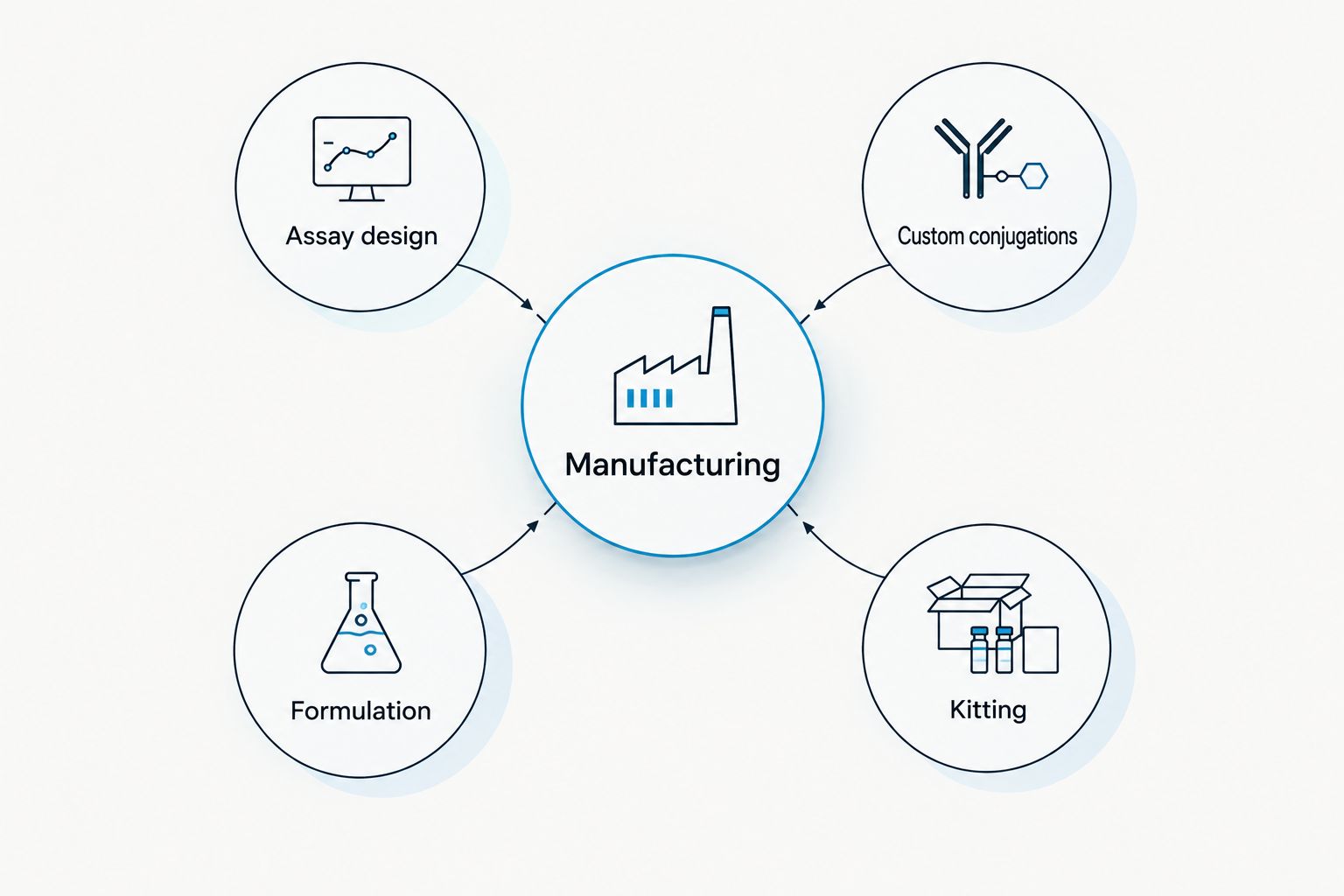
This is a scope comparison, not proof of a particular project's outcome. Request a proposal that states exactly which work packages are included and how each will be accepted.
Assay evidence: neither supplier wins without product-level data
Assay performance is a tie until you compare the relevant evidence. Supplier identity cannot establish sensitivity, specificity, precision, matrix suitability, or agreement with an existing method for your application.
Use the same acceptance framework for both suppliers. Identify the performance characteristic, the supporting document, and the verification your team requires. Do not compare a fully documented assay with an unrelated product summary and call the difference a supplier-wide result.
Physical format also deserves a separate check. The supplied descriptions for the Salmonella Typhi IgM ELISA and Salmonella Typhi IgG ELISA each list 96 tests, 12 × 8 breakable strip wells, and a 10 µl/well sample volume. Those specifications describe format and sample loading; they do not establish a sensitivity threshold or clinical claim.
For a 2026 evaluation, keep these evidence categories separate:
- Format evidence: Plate configuration, sample volume, and protocol requirements.
- Analytical evidence: Performance data relevant to your intended experiment.
- Operational evidence: Instructions and handling requirements your laboratory must follow.
A format that fits your laboratory is useful. It is not a substitute for demonstrating that the assay answers your scientific question.
Intended use: neither supplier name establishes clinical suitability
A research product and a diagnostic product are not interchangeable descriptions. Review the intended-use labeling and supporting documentation for the specific item or contracted deliverable, regardless of which supplier you select.
For a diagnostics program, ask what documentation will accompany the work and what responsibilities remain with your organization. For a research purchase, confirm that the product's stated application matches the planned experiment. Do not extend a product claim beyond its documented scope.
There is no supplier-wide winner on intended-use suitability. The decision belongs at the product and project level.
Keep facility credentials separate from product status as well. A statement about an organization's quality system is not the same as authorization for a particular clinical use. Your 2026 supplier file should distinguish organizational documentation, product documentation, and project-specific obligations.
Manufacturing scope: Calbiotech matches an outsourced production brief
The explicit CDMO remit makes this the stronger fit when your brief includes assay development and manufacturing services. Formulation and kitting are also stated capabilities, which matters when the deliverable is an assembled assay offering rather than an individual purchased reagent.
That fit has a practical limit: the service description does not establish your batch requirements, release tests, packaging configuration, or contractual responsibilities. Specify those requirements rather than inferring them from the word manufacturing.
For MyBioSource, evaluate an existing product as an existing product. If your brief also requires contract production, request explicit confirmation of the proposed scope. A catalog entry alone is not a manufacturing agreement, and this comparison does not treat it as one.
Before selecting a manufacturing partner, document:
- The materials and technical information each party supplies.
- The specifications used to accept development outputs.
- The tests required before product release.
- The records and materials included in a transfer.
- The process for approving changes after specifications are agreed.
A written manufacturing scope is more useful than a broad supplier ranking. It turns a capability discussion into an accountable project definition.
Purchasing workflow: MyBioSource fits a defined catalog order
When an existing research product meets your requirements, a catalog-led purchasing workflow is the appropriate route. MyBioSource fits that buyer profile: identify the candidate item, review its documentation, and evaluate the ordering terms for that item.
The benefit is focus. Your team can concentrate on whether the product supports the experiment instead of defining custom development work. The constraint is that an existing item does not automatically satisfy requirements outside its documented specification.
A service engagement requires a different purchasing package. Your technical brief, deliverables, acceptance criteria, and responsibilities must accompany the commercial discussion. That additional definition is necessary when you are buying work rather than selecting a finished item.
Do not use purchasing convenience as a proxy for technical suitability. The right workflow follows the deliverable—not the reverse.
Pricing models: compare project scope with product scope
A development proposal and a catalog purchase are different commercial units. For a service engagement, compare the quoted work packages, deliverables, acceptance criteria, and treatment of changes. For an existing-product purchase, compare the selected item and the applicable ordering terms.
Predictability comes from defining what is included. Flexibility comes from specifying how additional work or changed requirements will be handled. Neither commercial structure is automatically better; each serves a different purchase.
For your 2026 comparison, keep purchased materials separate from commissioned development work. Otherwise, you risk comparing a reagent order with a proposal that includes assay design, formulation, and manufacturing responsibilities. Ask each supplier to identify inclusions and exclusions in writing.
Final verdict: choose by buyer profile
Choose Calbiotech if you lead an outsourced diagnostics program
Best for: diagnostics and biotech teams commissioning ELISA/CLIA development and manufacturing. Choose this route when your brief includes custom conjugations, formulation, kitting, or production work that requires an agreed service scope.
The next move is a technical project brief. Define the intended deliverable and acceptance requirements before asking for a proposal.
Choose MyBioSource if you need an existing research product
Best for: research teams with a defined assay or reagent specification. Choose this route when a catalog product matches the experiment and the supporting documentation meets your evaluation requirements.
The next move is a product-level review. Confirm the target, sample type, format, intended use, and evidence before approving the purchase.
| Dimension | Winner |
|---|---|
| Best for | CDMO for development programs; MyBioSource for existing research products |
| Selection approach | MyBioSource for a product-defined search |
| Custom development | The CDMO route for the stated service scope |
| Assay evidence | Tie: product-level comparison required |
| Intended-use review | Tie: specific documentation required |
| Manufacturing scope | The CDMO route for an outsourced production brief |
| Purchasing workflow | MyBioSource for an existing catalog order |
| Pricing model | Match the commercial unit to the deliverable |
FAQ
Is Calbiotech or MyBioSource better for custom ELISA development?
Calbiotech is the better fit for a custom ELISA development brief because assay development is an explicitly stated service. Define the work packages, acceptance criteria, and manufacturing requirements in the proposal.
Which supplier should I choose for an existing research assay?
MyBioSource is the more direct starting point when you want an existing catalog research assay. Select the specific product against your target, sample type, intended application, and required evidence.
Does either supplier automatically provide better assay performance?
No supplier-wide performance winner is established by this comparison. Compare the relevant assays using application-specific analytical evidence and your laboratory's acceptance criteria.
Can a research assay be used for clinical diagnosis?
Do not assume a research assay is suitable for clinical diagnosis. Confirm the specific product's intended-use labeling and applicable requirements before deciding how it can be used.
How should I compare a development proposal with a reagent order?
Compare them as different deliverables, not equivalent purchases. Separate commissioned work, purchased materials, acceptance requirements, and responsibilities before evaluating the commercial terms.
What should I send a potential assay manufacturing partner?
Send a technical brief defining the assay objective, sample matrix, required services, and acceptance criteria. Include the documentation, kitting, and manufacturing deliverables your organization requires.
Does a 96-test ELISA format establish analytical performance?
No, a 96-test format describes the stated assay configuration rather than analytical performance. Sensitivity, specificity, precision, and matrix suitability require separate supporting evidence.
One last thing
Ask what you receive at the end—not just what the supplier can do. For a catalog order, that means the specified product and its documentation. For a development engagement, it means the agreed materials, records, methods, and other deliverables written into the scope.
That question separates a credible technical discussion from a capability list. Make it part of the first supplier conversation.