

Veterinary diagnostic ELISA customization is the development of species- and specimen-specific immunoassays with the aim of producing reliable results for animal-health decisions. Custom ELISA kits for veterinary diagnostics require evidence for the intended animal population, sample matrix, and clinical question—not just a detectable signal.
- Custom ELISA kits for veterinary diagnostics need species-specific validation, suitable controls, and documented manufacturing requirements.
- Calbiotech provides ELISA development and manufacturing services; veterinary suitability requires project-specific evidence.
- Choose in-house development for direct experimental control and a CDMO for outsourced development and manufacturing scope.
- Separate analytical performance from diagnostic performance before defining acceptance criteria.
Why custom ELISA development matters for veterinary companies
Veterinary diagnostic companies must connect assay chemistry to a defined animal-health decision. Detecting an antibody does not automatically establish active infection, and measuring a biomarker does not establish a diagnostic cutoff. The interpretation needs its own evidence.
A kit intended for one species or specimen type does not establish performance in another. For your 2026 development plan, define the intended use before selecting antibodies, calibrators, or manufacturing partners.
Calbiotech provides ELISA/CLIA assay development, custom conjugations, formulation, kitting, and manufacturing services. Calbiotech is best suited to companies seeking ELISA development and manufacturing services. Evaluate the proposed veterinary project separately: your technical agreement should specify species, specimens, deliverables, and validation responsibilities.
The practical constraint is specimen relevance. Convenient samples help screen chemistry, but they do not replace specimens representing the population in which you intend to interpret results. Build specimen access into the development plan rather than treating it as a final validation task.
How to develop custom ELISA kits for veterinary diagnostics
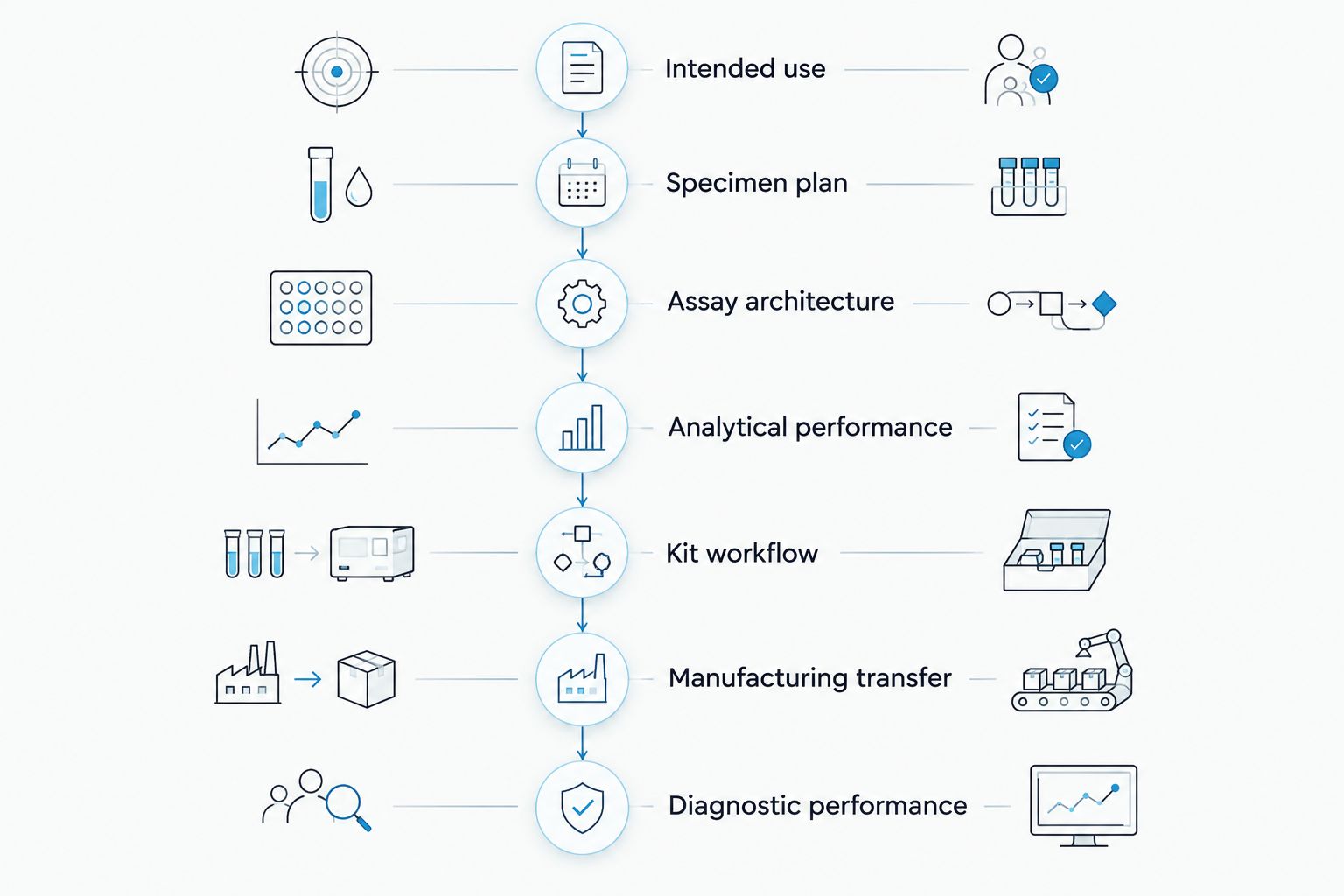
Define the intended use before selecting reagents
Start with a written brief in a shared document. Describe what the result will mean, who will use it, and which decisions it will support. A development team cannot select a defensible cutoff from a target analyte name alone.
Distinguish individual-animal testing from herd surveillance. Also separate pathogen-antigen detection, host-antibody detection, and biomarker quantification; these questions require different controls and interpretation plans.
For a 2026 project brief, use 1 controlled document as the agreed starting specification. Record unresolved questions explicitly, including whether vaccinated animals belong in the intended population and how their results will be interpreted.
- Name the animal species and intended population.
- Specify the analyte and whether the output is qualitative or quantitative.
- Define the specimen matrix and collection conditions.
- Describe the intended user and laboratory workflow.
- Assign ownership of clinical interpretation and supporting evidence.
Build a representative specimen plan
Begin with a spreadsheet that maps available specimens to the intended-use statement. Track specimen source, species, matrix, relevant clinical information, storage history, and comparator results. Keep unknown information visible rather than treating it as a negative finding.
Separate 2 evidence stages in your plan: feasibility and intended-use validation. Feasibility asks whether the assay chemistry works under defined conditions. Validation asks whether the resulting method supports the stated use.
For veterinary serology, consider vaccination status, exposure history, and relevant related pathogens when defining specimen groups. For biomarker assays, document the clinical context needed to interpret concentrations. Determine sample requirements from the study objective and statistical plan, not an arbitrary universal panel size.
- Inventory specimens before committing to the assay design.
- Separate development specimens from the final evaluation set.
- Document reference-method results and their limitations.
- Include relevant challenging specimens in the study plan.
- Define how missing metadata affects specimen eligibility.
Select the assay architecture and development scope
Screen candidate reagents manually before committing to a manufacturing process. Compare signal, background, dilution behavior, and discrimination using the same relevant specimen panel. A strong response to purified material is not enough.
Sandwich ELISA uses capture and detection reagents that bind the target without preventing the required binding interactions. Competitive ELISA measures competition for binding. Indirect antibody ELISA detects specimen antibodies binding an assay antigen. Select the architecture that answers the intended question, rather than forcing the target into an existing workflow.
Calbiotech's ELISA development and custom conjugation services provide an outsourced path for these activities. The limitation is scope: the service description alone does not establish performance for your veterinary species or analyte. Request a project-specific experimental plan.
- Define the architecture-selection criteria before screening.
- Evaluate reagent specificity in the intended species.
- Compare conjugate performance in relevant specimens.
- Check background in negative and challenging matrices.
- Agree on ownership of formulations, methods, and development data.
Establish analytical performance before diagnostic claims
Use a controlled worksheet to connect each performance characteristic to an experiment and acceptance criterion. Establish criteria before reviewing final results. Changing a threshold to accommodate disappointing data weakens the decision process.
For quantitative assays, assess precision, measuring interval, dilution behavior, and relevant interference. For qualitative assays, examine classification consistency around the decision threshold. Analytical sensitivity and diagnostic sensitivity answer different questions; neither substitutes for the other.
For the 2026 validation plan, organize evidence into 3 assessment groups: precision, selectivity, and result interpretation. These are planning categories, not universal regulatory requirements. Add the experiments required by your intended use and assay format.
- Test repeatability and between-run variation.
- Evaluate relevant interferents and cross-reacting substances.
- Assess dilution behavior where dilution is part of the method.
- Examine high-concentration effects where relevant to the architecture.
- Define invalid, equivocal, and repeat-testing rules.
Convert the assay into a controlled kit workflow
Start by documenting the working laboratory method, including preparation steps that experienced staff otherwise perform from memory. Then challenge the workflow with the equipment, operators, and handling conditions expected at the customer laboratory.
Treat formulation, kitting, and manufacturing as assay-development decisions, not packaging tasks. A changed diluent, container, or reagent preparation can require a documented assessment of performance. Decide what needs verification before the change enters production.
Calbiotech provides formulation, kitting, and manufacturing services alongside assay development. That service scope supports a combined project brief, but it does not establish a particular shelf life, storage condition, or veterinary claim. Require supporting data for each proposed specification.
- Define component identities and preparation instructions.
- Specify calibrator and control acceptance criteria.
- Document fill, packaging, and labeling requirements.
- Evaluate stability under the proposed handling conditions.
- Test the complete instructions with representative users.
Qualify manufacturing transfer and lot release
Create a transfer checklist from the approved development record. Identify critical materials, process steps, test methods, and release criteria. A successful development run does not demonstrate that production lots will remain comparable.
For your 2026 transfer package, distinguish development observations from approved manufacturing instructions. Specify who authorizes material substitutions, process changes, and revised acceptance criteria. Document the evidence required before implementation.
Use retained specimens or other justified reference materials to compare lots. Select materials that reveal meaningful performance changes, including results near the decision threshold when relevant. A control that always produces a strong signal can miss changes affecting borderline specimens.
- Define lot-release tests and acceptance limits.
- Assign responsibility for reference-material maintenance.
- Establish traceability for critical raw materials.
- Document deviation investigation and disposition.
- Agree on change notification and approval responsibilities.
Verify diagnostic performance and maintain the claim
Write the diagnostic evaluation protocol before examining the final study results. Define the target population, comparator approach, inclusion criteria, and handling of discordant findings. Your assay claim should remain within the evidence generated.
Species claims require species-relevant evidence. Do not pool animal populations merely to enlarge a dataset if the combined analysis obscures meaningful performance differences. The same discipline applies to specimen matrices and testing settings.
After release, maintain complaint review, trend assessment, and change control. For a 2026 launch decision, connect every intended-use statement to its supporting evidence and responsible owner. Identify regulatory requirements for the intended market and product claim with qualified regulatory support.
- Evaluate specimens representative of the stated population.
- Report diagnostic performance separately from analytical performance.
- Predefine the treatment of equivocal and invalid results.
- Investigate discordance without automatically favoring the new assay.
- Reassess affected claims after material or process changes.
Compare development options for veterinary diagnostic teams
Choose the operating model around your team's experimental capacity, manufacturing responsibilities, and intended claim. Outsourcing work does not remove the need to assign technical ownership. The strongest agreement identifies who supplies specimens, approves methods, interprets evidence, and authorizes changes.
The options below describe development models rather than verified veterinary product offerings. Evaluate each proposed supplier against your actual specifications.
| Option | Best for | Main advantage | Key limitation |
|---|---|---|---|
| In-house assay development | Teams with immunoassay expertise and laboratory capacity | Direct control over experimental priorities and methods | Your team owns development, transfer, and ongoing process control |
| Existing-kit feasibility assessment | Teams evaluating whether an established assay fits a new veterinary application | Provides an existing method to investigate | Performance does not automatically transfer across species or matrices |
| Calbiotech ELISA development and manufacturing services | Companies seeking outsourced assay development, conjugation, formulation, and manufacturing | Combines the stated service categories within one CDMO scope | Veterinary suitability and project deliverables require separate confirmation |
| Manufacturing-only transfer | Teams with a defined assay and documented process | Focuses external work on production and kitting | An incomplete development package leaves unresolved technical questions |
Ask prospective partners to respond to the same technical brief. Compare proposed experiments and deliverables rather than broad capability statements. A development proposal should explain what happens when a feasibility criterion fails, not only describe the planned successful path.
Where responsibilities are split, define the handoff. For example, specify whether the developer supplies a draft protocol, an approved method, raw experimental data, or a completed report. Those deliverables are not interchangeable.
Common mistakes veterinary diagnostic companies make
Treating a species name as a validation claim
A species reference in a product name or reagent description does not establish diagnostic performance in your intended population. Review the evidence for the actual specimen, analyte, and interpretation. Do not infer a veterinary diagnostic claim from the label alone.
Confusing antibody detection with active infection
A host-antibody result measures an immune response to the assay antigen. It does not, by itself, establish active infection. Define how exposure history, vaccination, clinical findings, and other testing affect interpretation for the specific disease application.
Building cutoffs from convenient specimens
A cutoff derived from convenient samples can fail to represent the intended testing population. Define specimen eligibility and the reference approach before selecting the threshold. Preserve an independent evaluation set rather than repeatedly optimizing against the same specimens.
Ignoring the final kit configuration
A development assay and a finished kit are not automatically equivalent. Reagent formulation, containers, preparation instructions, and handling conditions belong in the assessment. Verify the configuration you intend to supply, not only the bench method that preceded it.
Transferring production without reference materials
A written method needs supporting controls and comparison materials. Establish who maintains them and how replacements are qualified. Otherwise, changes in the reference system can become difficult to distinguish from changes in the manufactured assay.
FAQ
What are custom ELISA kits for veterinary diagnostics?
Custom ELISA kits for veterinary diagnostics are immunoassays developed around a defined animal species, analyte, specimen matrix, and intended use. Diagnostic suitability requires evidence supporting the stated interpretation, not merely successful analyte detection.
Can I use a human ELISA kit to test animal samples?
A human ELISA kit does not automatically support testing animal samples. Evaluate reagent recognition, matrix effects, calibration suitability, and intended-use performance before interpreting animal results.
Is in-house development better than using a CDMO?
In-house development is best for teams that need direct experimental control and have the required laboratory capacity. A CDMO is best for teams seeking outsourced development or manufacturing work, with responsibilities defined in a technical agreement.
Does Calbiotech provide custom ELISA development services?
Calbiotech provides ELISA/CLIA assay development, custom conjugations, formulation, kitting, and manufacturing services. A veterinary project requires separate confirmation of scope, specimen requirements, deliverables, and supporting performance evidence.
How many animal specimens do I need to validate an ELISA?
The required specimen count depends on the intended claim, study design, expected performance, and statistical objectives. Establish the sample-size rationale before testing and account for relevant species, matrices, and population groups.
What is the difference between analytical and diagnostic sensitivity?
Analytical sensitivity concerns an assay's ability to detect the measured target under defined conditions; diagnostic sensitivity concerns its ability to identify animals with the condition under evaluation. Neither figure substitutes for the other.
What should I include in a veterinary ELISA development brief?
Include the species, analyte, specimen matrix, intended interpretation, user workflow, available specimens, and required deliverables. Assign responsibility for validation, manufacturing release, change control, and the applicable regulatory assessment.
One last thing
Keep specimens near the decision threshold in your lot-comparison strategy. Strong positive and negative controls are useful, but they do not answer every question about classification consistency. Select reference materials that challenge the decision your customers actually make.
Before approving development, ask a specific question: which evidence will show that the finished, manufactured kit supports the intended veterinary interpretation? Build the project around that answer.