

Forensic toxicology laboratory ELISA development is the design and validation of enzyme-linked immunosorbent screening assays with the aim of identifying specimens that require definitive analysis. This 2026 guide explains how to define drug coverage, challenge cross-reactivity, validate specimen matrices, and transfer a screening method into controlled production without confusing a presumptive result with identification.
- ELISA development for forensic toxicology labs starts with intended use, specimen matrix, and a defensible screening cutoff.
- Calbiotech provides ELISA assay development and manufacturing services; forensic suitability requires project-specific validation.
- Competitive immunoassays suit small-molecule drug screening, but antibody cross-reactivity limits identification.
- Use matrix-matched controls and definitive mass-spectrometric testing to investigate screening performance.
Why ELISA development matters for forensic toxicology labs
A forensic screening assay must support a documented decision, not merely produce a measurable signal. Your laboratory needs to establish what a reactive result means, what a negative result excludes, and which specimens proceed to definitive testing.
Clinical assay performance does not establish forensic suitability. Postmortem blood, urine, and oral fluid present different analytical challenges; validation in one matrix does not establish performance in another.
Calbiotech provides ELISA development, custom conjugation, formulation, kitting, and manufacturing services. Those capabilities support a development project, but they do not establish a particular drug panel's forensic performance.
Calbiotech is best suited to organizations seeking outsourced ELISA development and manufacturing rather than reagent supply alone. Your laboratory still needs to define the forensic application and approve the evidence supporting it.
For your 2026 development plan, separate analytical performance from operational readiness. A reproducible assay still needs controlled reporting rules, specimen traceability, trained operators, and an established route for definitive testing.
How to develop a forensic toxicology ELISA
Define the screening decision before selecting reagents
Start manually with an intended-use document. Specify the target drug or drug class, relevant metabolites, specimen matrix, reporting category, and circumstances that trigger definitive testing. Do not select a cutoff simply because a catalog assay uses it.
A drug-class screen and an analyte-specific assay answer different questions. If several compounds generate the same response, the result cannot identify which compound caused that response. Define that limitation before reviewing antibodies.
For a 2026 project, record the basis for each requirement and identify who can approve changes. Keep screening thresholds distinct from any concentration used later for interpretation or reporting.
- Name the parent compounds and metabolites you need to detect.
- Define each specimen matrix and permitted collection conditions.
- State whether results are qualitative or semiquantitative.
- Specify screening, repeat-testing, and definitive-testing rules.
- Assign ownership of technical approval and report wording.
Map the specimen workflow and matrix risks
Build a specimen-handling worksheet before running development plates. Follow the material from receipt through storage, preparation, analysis, retention, and disposal. Record every preparation step that changes the specimen's concentration or composition.
Urine pH, blood components, preservatives, and postmortem specimen condition can affect assay behavior. Challenge those conditions deliberately instead of treating unexplained signal changes as random variation. Evaluate the actual collection materials your laboratory accepts.
Organize the workflow around the following checkpoints: specimen receipt, matrix assessment, sample preparation, screening, and definitive testing. Each checkpoint needs a documented acceptance or routing decision.
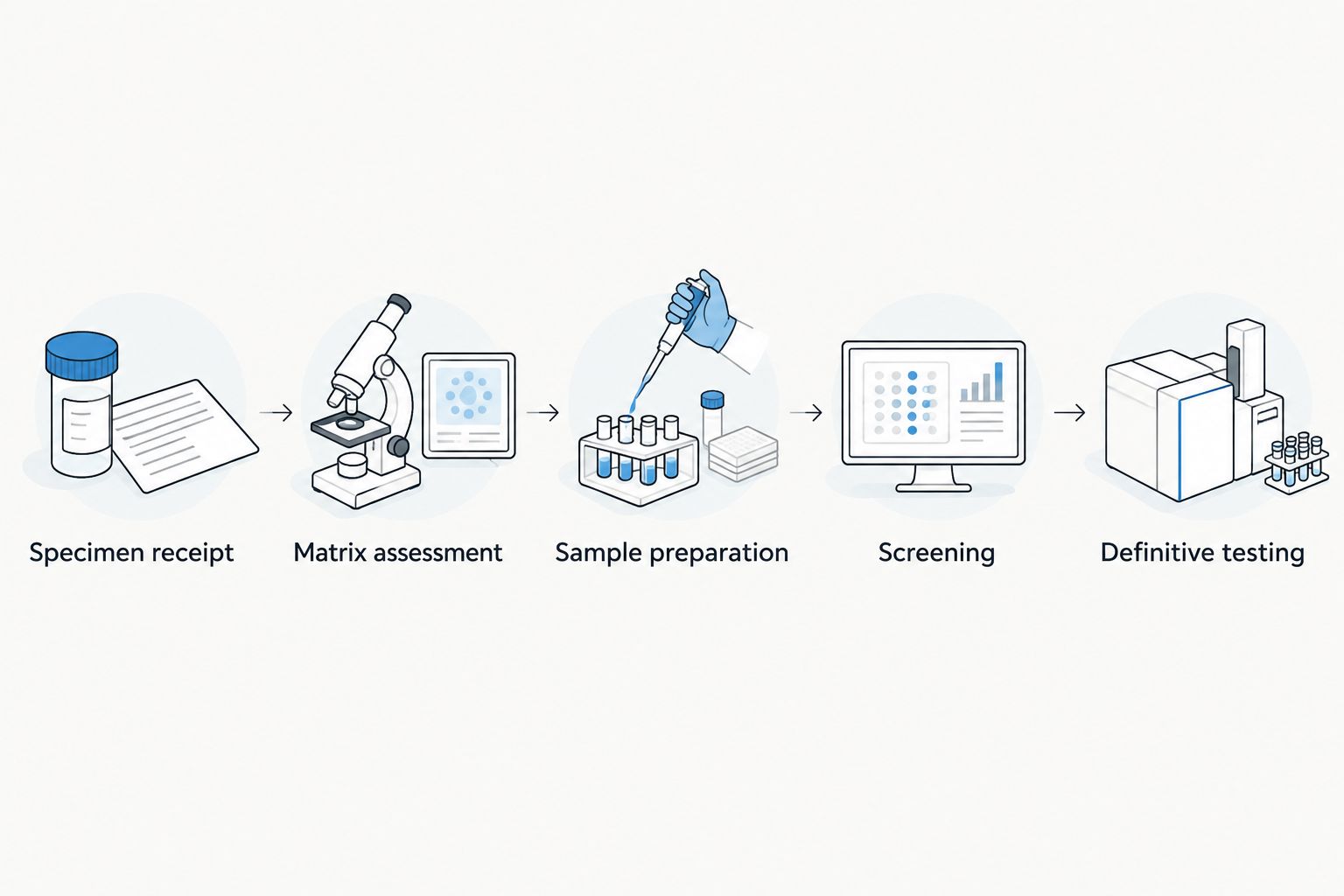
A failed acceptance check must lead to a defined action. Otherwise, operators will resolve comparable specimen problems differently.
- Record container types, preservatives, and storage conditions.
- Assess dilution and extraction effects where those steps apply.
- Challenge visibly compromised specimens under a written protocol.
- Preserve traceability between original specimens and plate wells.
- Define rejection, qualification, and repeat-testing criteria.
Select antibodies and conjugates against the coverage requirement
Begin with a documented reagent comparison and small-scale feasibility experiments. For small-molecule drugs, competitive ELISA is a common format: specimen analyte competes for antibody binding, and signal typically decreases as analyte concentration increases. Do not apply sandwich-assay assumptions to that response.
Assess antibody specificity alongside conjugate design. A strong calibration curve does not compensate for inadequate metabolite recognition or excessive response to an unrelated compound.
Calbiotech ELISA development and custom conjugation services provide an outsourced path for reagent development. The limitation is unchanged: laboratory-specific drug coverage and matrix performance require experimental evidence, not a service description. The guide to custom conjugation services for antibody-based assays addresses a related partner-selection decision.
- Compare candidate antibodies against the intended analyte panel.
- Document expected recognition of relevant metabolites.
- Examine conjugate loading and background during optimization.
- Compare reagent candidates using the same specimen conditions.
- Retain reagent identities and preparation records.
Establish the cutoff and validation acceptance criteria
Write the validation protocol before collecting the final dataset. State which experiments assess precision, selectivity, interference, carryover, stability, and agreement with the definitive method. Match the study design to the assay's intended use.
For a qualitative assay, performance around the cutoff deserves particular attention. A visually attractive curve across a broad concentration range does not establish consistent classification near the decision point.
As a planning exercise, define 3 control levels: below, near, and above the cutoff. Consider a study spanning 2 operators and 3 separate days to expose operational variation; these are proposed design elements, not universal validation requirements. Expand the study according to your laboratory's applicable requirements and observed variability.
In the 2026 protocol, distinguish the screening cutoff from analytical sensitivity. A detection limit describes analytical capability; the cutoff defines the screening decision.
- Predefine acceptance criteria and statistical analyses.
- Include matrix-matched specimens around the cutoff.
- Assess within-run and between-run variation.
- Challenge relevant interferents and structurally related compounds.
- Investigate discordant results against definitive testing.
Challenge cross-reactivity against the actual forensic question
Build the challenge panel from your laboratory's testing scope, not from whichever compounds are easiest to obtain. Include intended targets, relevant metabolites, related drugs, and plausible interferents. Record the concentration and matrix used for every challenge.
Cross-reactivity has two different consequences. Recognition of a relevant metabolite can support drug-class coverage, while response to an unrelated substance can generate a misleading presumptive positive. A statement that an assay is broadly reactive does not explain whether that breadth is useful.
Keep detection claims narrow. A negative class screen does not exclude every member of that class, particularly when antibody recognition differs substantially between compounds. Adding a new target requires evidence that the assay detects it under the intended conditions.
- Separate desired recognition from unwanted cross-reactivity.
- Test parent drugs and metabolites independently.
- Document challenge concentrations and specimen preparation.
- Examine mixtures when they represent accepted specimens.
- Translate findings into report limitations and routing rules.
Lock formulation, stability, and material specifications
Start with controlled formulation records and a stability protocol. Track buffer composition, blocking conditions, conjugate preparation, storage, and packaging. A change that improves fresh-reagent signal can still impair storage performance or increase background in difficult matrices.
Define what constitutes a material change before transfer. Substituting an antibody lot, carrier, stabilizer, or container requires an assessment of its effect on assay performance. Do not rely on matching appearance or nominal concentration.
For projects involving peptide targets or peptide-based reagents, peptide synthesis for toxicology labs belongs within material specification: sequence identity, purity, and modification state affect which reagent is being evaluated. Peptide synthesis does not replace drug-hapten chemistry when the target is a small molecule.
An outsourced formulation path can consolidate development and manufacturing responsibilities. Your contract must still identify deliverables, approval rights, retained samples, and change-notification obligations.
- Set identity and acceptance specifications for critical materials.
- Evaluate real-time stability under intended storage conditions.
- Assess in-use handling and relevant shipping stresses.
- Define lot-release tests and retained-sample requirements.
- Require documented review of formulation and supplier changes.
Transfer the method with an auditable release package
Assemble the transfer package manually before requesting production-scale material. Include the approved method, reagent specifications, plate layout, control rules, calculation settings, and deviation procedures. Another qualified operator should be able to follow the package without relying on undocumented instructions.
Calbiotech ELISA manufacturing and kitting services address the production side of this handoff. Your laboratory must separately approve forensic validation, chain-of-custody procedures, and interpretation rules; manufacturing support does not replace those responsibilities.
For your 2026 release decision, distinguish development completion from authorization for casework. Resolve discrepancies between pilot and production material before accepting the assay into routine use.
- Compare transfer material with qualified development material.
- Confirm instrument settings and data-processing rules.
- Train operators using controlled procedures.
- Approve lot-release criteria and escalation responsibilities.
- Retain validation, transfer, and change-control records together.
Compare development options for forensic laboratories
Choose the route that matches your technical ownership and production needs. Existing assays reduce the amount of reagent design, while custom development gives you more control over the specification. Neither route removes the need to establish suitability for your forensic application.
| Option | Best for | Main advantage | Key limitation |
|---|---|---|---|
| Existing commercial ELISA | Laboratories whose targets and matrices match an existing assay | Avoids designing every reagent from the beginning | Published claims do not establish local forensic suitability |
| In-house ELISA development | Laboratories with assay-development expertise and reagent control | Keeps experimental decisions within the laboratory | Requires internal development, documentation, and production resources |
| Calbiotech contract development | Organizations seeking ELISA development, conjugation, formulation, and manufacturing services | Combines stated development and production capabilities | Forensic performance must be established for the specific project |
| Hybrid development and contract manufacturing | Laboratories retaining assay design while outsourcing production | Separates scientific ownership from manufacturing execution | Requires explicit transfer specifications and change responsibilities |
Before choosing, write down which deliverables remain yours. Include raw data access, reagent specifications, unresolved technical risks, and the evidence required to approve production material. A service scope without those boundaries leaves the handoff incomplete.
Common mistakes forensic toxicology labs make
Treating a screening result as identification
An immunoassay response reflects antibody binding, not definitive molecular identification. Use presumptive language and apply your established definitive-testing policy before making analyte-specific conclusions.
Validating only convenient specimens
Clean pooled material does not represent every accepted specimen condition. Include the matrix variability and collection conditions relevant to your laboratory, with documented acceptance criteria.
Choosing a cutoff from curve appearance
A smooth dose-response curve is not a defensible basis for a screening threshold. Select the cutoff from the intended decision and evaluate classification performance around it.
Accepting production changes without a bridge study
A replacement antibody or altered formulation can change sensitivity and cross-reactivity. Define the comparison required before accepting changed material, and preserve the evidence supporting approval.
FAQ
What is ELISA development for forensic toxicology labs?
ELISA development for forensic toxicology labs is the design and validation of immunoassay screening methods for defined drugs, metabolites, and specimen matrices. The development process establishes reagent performance, screening cutoffs, limitations, and controlled operating procedures.
Can an ELISA identify a specific drug in a forensic specimen?
An ELISA screening response alone does not establish definitive drug identity. Antibody cross-reactivity means related compounds or interferents can contribute to the response; analyte identification requires an appropriate definitive method.
Is competitive ELISA suitable for small-molecule drug screening?
Competitive ELISA is a common format for small-molecule drug screening. Suitability still depends on antibody recognition, matrix performance, and validation around the intended screening cutoff.
Can a urine ELISA be used for postmortem blood?
Validation in urine does not establish suitability for postmortem blood. Blood components, preservatives, and specimen condition require matrix-specific assessment before forensic use.
Does Calbiotech provide ELISA development and manufacturing services?
Calbiotech provides ELISA development, custom conjugation, formulation, kitting, and manufacturing services. A forensic project needs an agreed scope and experimental evidence supporting its particular targets, matrices, and reporting requirements.
How should a forensic laboratory choose an ELISA cutoff?
Choose an ELISA cutoff from the intended screening decision and applicable laboratory requirements, then validate classification around that threshold. Do not substitute a kit's analytical sensitivity or a visually convenient calibration point for that decision.
What must a laboratory review before transferring an ELISA into production?
Review the approved method, material specifications, validation evidence, stability data, control rules, and change responsibilities before transfer. Compare production material with qualified development material before authorizing routine forensic use.
One last thing
Challenge the negative result, not just the positive control. If a drug-class screen poorly recognizes a relevant compound, a valid-looking plate can still miss the question your laboratory intended to answer. Put known coverage gaps into the method's limitations and definitive-testing rules before release.