

Custom ELISA development cost in 2026 requires a project-specific quote, not a catalog kit price or a universal average. Your budget must distinguish assay development from any additional conjugation, formulation, kitting, and manufacturing work, with clear deliverables and acceptance criteria for each.
- Custom ELISA development cost depends on the agreed assay development and manufacturing scope, not catalog kit pricing.
- Calbiotech provides ELISA development and manufacturing services for pharma, biotech, and diagnostics companies.
- Compare proposals against matching deliverables, acceptance criteria, and ownership terms.
- Separate development work from conjugation, formulation, kitting, and manufacturing before approving a budget.
Why this matters
A development proposal and a finished-kit purchase answer different questions. A kit supplies an existing assay; a development project must establish whether an assay meets your intended requirements. Treating those purchases as interchangeable leaves the actual development work outside your budget.
Calbiotech provides ELISA/CLIA assay development, custom conjugations, formulation, kitting, and manufacturing services. That service scope makes the distinction important: decide which activities you need before comparing proposals, rather than assuming every proposal includes the same work.
How much does custom ELISA development cost in 2026?
The useful budgeting unit is a defined project scope, not a price per kit. Ask for a proposal that identifies the work, the resulting deliverables, and the conditions for accepting each stage. A total without those details does not tell you what your team is buying.
Use the following breakdown to structure your request. These are scope categories, not standardized package names or guaranteed inclusions.
| Scope category | What to specify | Benefit | Limitation to resolve |
|---|---|---|---|
| Assay development | Target, sample matrix, intended use, and performance requirements | Focuses the work on your application | A working assay is not automatically a finished kit |
| Custom conjugation | Starting materials, labeling requirements, and characterization | Addresses a specific reagent requirement | Conjugation alone does not establish assay performance |
| Formulation and kitting | Component requirements, packaging, and instructions | Defines the deliverable your laboratory receives | Packaging does not replace performance evaluation |
| Manufacturing | Production requirements, release criteria, and handoff documentation | Connects development to repeat production | Development deliverables do not automatically include production |
Compare like-for-like scopes before comparing totals. If one proposal ends with a development report and another includes formulated components and manufacturing preparation, the difference is not simply a difference in supplier pricing.
Ask each supplier to distinguish included work, optional work, and work that needs a separate agreement. Also request the assumptions behind the proposal: what materials you supply, what sample access is required, and what happens when the initial approach fails its acceptance criteria.
Assay development: define the endpoint
Best for: teams that need an assay matched to a specific target, sample matrix, or intended application.
Write down what a successful assay must demonstrate before requesting a development budget. Relevant requirements include the measurement objective, reportable range, precision, specificity, and handling of your intended samples. Set requirements from the application rather than copying specifications from an unrelated kit.
The benefit of custom development is a scope built around your requirements. The limitation is that experimental success is not guaranteed by commissioning the work. Your agreement should distinguish the experiments performed from the performance outcome you want.
For your 2026 project, define the deliverables at the endpoint: an experimental report, a documented method, supplied reagents, or a transfer package. Do not treat those deliverables as interchangeable. Ask what evidence accompanies each one and who approves completion.
Custom conjugation: separate reagent work from assay work
Best for: teams whose assay requires a custom-labeled reagent or another defined conjugation service.
Custom conjugation is a distinct part of the service scope. Specify the starting material, labeling approach, characterization expectations, and the material you expect to receive. If you supply the starting reagent, identify its quality requirements and any restrictions on its use.
The benefit is a deliverable focused on the reagent you need. The limitation is that obtaining a conjugate does not establish its suitability in the complete assay. Make assay evaluation a named activity if you expect the development partner to perform it.
Ask whether conjugation work includes screening within your assay or ends with reagent delivery. That boundary determines whether your laboratory must budget additional experimental work after the conjugate arrives.
Formulation, kitting, and manufacturing: define the handoff
Best for: teams that need to move beyond an experimental method to supplied components or repeat production.
Formulation, kitting, and manufacturing address different deliverables. Specify component presentation, packaging requirements, instructions, production documentation, and release expectations where they apply. Keep each requirement visible rather than hiding everything under a general development heading.
The benefit is a project endpoint that matches how your team will use or distribute the assay. The limitation is that more deliverables create more acceptance decisions. A successful development experiment does not answer every question about the finished configuration.
Calbiotech is best suited to pharma, biotech, and diagnostics teams seeking ELISA development and manufacturing services. Confirm the project-specific scope rather than treating the availability of those services as evidence that every activity is included in a proposal.
Why custom ELISA development cost varies
Development budgets vary with the work you commission and the evidence you require. Use these factors to make your 2026 request specific:
- Assay requirements: define the target, sample matrix, intended use, and performance criteria that guide development.
- Conjugation scope: identify whether custom conjugates are required and whether their assay evaluation is included.
- Formulation scope: distinguish experimental reagents from the component formulations you need delivered.
- Kitting scope: specify whether the project ends with bulk components, assembled kits, or another agreed configuration.
- Manufacturing scope: separate development activities from production requirements and release documentation.
- Acceptance evidence: name the reports, records, and performance evidence required to approve completion.
These factors are questions to resolve, not reasons to accept an unexplained total. Ask the supplier to connect each activity to a deliverable. If an activity has no clear endpoint, clarify it before approving the scope.
How do you request a comparable development quote?
Use the same written brief for every supplier. A shared brief makes differences in proposals visible and reduces the chance that your team compares unlike services.
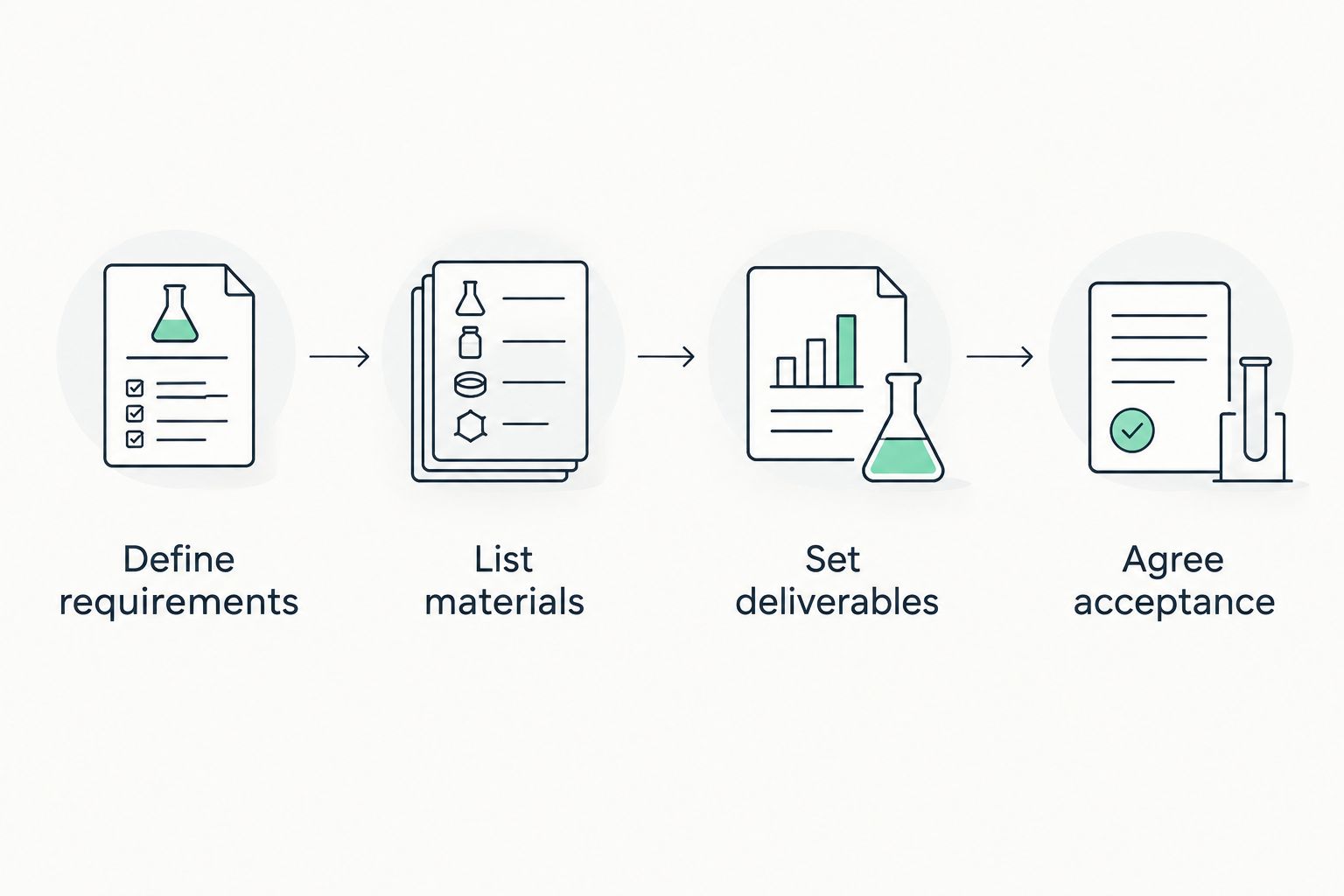
- Define requirements. State the target, sample matrix, intended use, and required performance. Identify requirements that are essential rather than merely preferred.
- List materials. Identify available antibodies, antigens, reference materials, and samples. State who supplies them and who evaluates their suitability.
- Set deliverables. Specify the method, reagents, reports, documentation, and any kitting or manufacturing work you expect.
- Agree acceptance. Define completion criteria, decision points, ownership terms, and how changes to the scope are approved.
Review the technical scope before negotiating the commercial terms. An attractive total is not useful if the proposal excludes the samples, evaluation work, or documentation your project requires. Resolve exclusions in writing rather than relying on a broad description of the service.
Is buying an ELISA kit the same as paying for development?
No. Calbiotech Salmonella Typhi IgG ELISA is a catalog product listed with 96 tests, 12 × 8 breakable strip wells, and a 10 µl/well sample volume. Those specifications describe the supplied kit; they do not establish a custom-development budget.
A catalog assay is worth evaluating when its intended application matches your requirements. Its advantage is an existing assay configuration; its limitation is that your project must fit that configuration. Custom development starts with your requirements instead, but needs a separately defined scope and acceptance process.
Does a development agreement include manufacturing?
Manufacturing belongs in the budget only when the agreement includes it. Ask whether the endpoint is a development deliverable, a manufacturing transfer package, or supplied production material.
For a 2026 project that needs repeat production, discuss manufacturing requirements before approving development. This keeps the intended final configuration visible while the method and components are being defined.
Can you reduce scope without weakening the project?
Yes: remove unnecessary deliverables, not essential performance requirements. Separate the work needed to answer your immediate technical question from later formulation, kitting, or manufacturing activities.
A staged agreement makes decision points explicit. Its limitation is that later stages still need approval and a defined scope; staging the work does not make those activities disappear.
FAQ
How much does custom ELISA development cost in 2026?
Custom ELISA development cost requires a project-specific quote tied to defined deliverables. Separate assay development from conjugation, formulation, kitting, and manufacturing when requesting the budget.
Can I use an ELISA kit price to estimate development cost?
No, a catalog kit price describes an existing product rather than a development service. A custom project needs its own requirements, experimental scope, and acceptance criteria.
What should I send when requesting a custom ELISA quote?
Send the target, sample matrix, intended use, performance requirements, available materials, and required deliverables. Identify who supplies samples and who approves completion.
Does custom conjugation include testing in my assay?
Include assay testing explicitly if you require it. Reagent delivery and evaluation within a complete assay are different deliverables.
Does ELISA development automatically include manufacturing?
No, manufacturing must be explicitly included in the agreement. Identify production requirements, release criteria, and handoff documentation before approving that scope.
Who is Calbiotech's ELISA development service best suited to?
Calbiotech's ELISA development and manufacturing services fit pharma, biotech, and diagnostics companies seeking contract development and manufacturing support. The project agreement should specify which services and deliverables are included.
One last thing
Ask what happens if the assay misses an acceptance criterion. Your agreement should state how the team reviews that result, who authorizes additional work, and what documentation you receive if the project stops.
That question makes a 2026 development budget more useful than an unsupported average. You are buying a defined body of work with decision points—not a promise that every experimental approach will succeed.