

Sigma-Aldrich offers a broad laboratory reagent catalog that supports teams building their own assays. The ceiling is the purchasing model: buying assay components is different from commissioning development, formulation, kitting, and manufacturing under a defined scope. The best Sigma-Aldrich alternative in 2026 is Calbiotech if you need a custom ELISA development and manufacturing partner; in-house development is the better route if your team needs direct experimental control.
- For Sigma-Aldrich alternatives for custom ELISA development, choose Calbiotech when you need assay development through manufacturing.
- Choose in-house ELISA development when your team can own optimization, documentation, and manufacturing transfer.
- Choose a split-provider model when a defined conjugation or formulation task is the main constraint.
- Keep Sigma-Aldrich when reagent sourcing, rather than outsourced assay development, is your actual requirement.
Why this matters
Custom ELISA development is not a substitute-brand purchasing exercise. You are deciding who owns the assay design, who resolves performance failures, and who turns an experimental method into a repeatable manufacturing process.
An assay can produce a usable signal without meeting your intended-use requirements. Matrix effects, reagent interactions, calibration, and lot consistency still need defined acceptance criteria. A supplier comparison that stops at antibody selection leaves those responsibilities unresolved.
For a 2026 sourcing decision, compare operating models before comparing names. The guide to custom ELISA development partners for IVD companies addresses that broader partner-selection question.
Sigma-Aldrich alternatives at a glance
The comparison below separates a named CDMO from two alternative operating models. In-house development and split-provider development are delivery choices, not claims about additional suppliers.
| Option | Best for | Standout capability or approach | Difference from reagent purchasing | Main limitation |
|---|---|---|---|---|
| Sigma-Aldrich | Teams sourcing laboratory reagents | Broad reagent catalog | Benchmark route for component procurement | Component selection does not define an outsourced development scope |
| Calbiotech | Companies seeking custom ELISA development and manufacturing | Assay development, custom conjugations, formulation, kitting, and manufacturing | Combines multiple service categories in a CDMO relationship | Requires a project-specific scope and agreed deliverables |
| In-house development | Teams with assay-development capacity | Direct ownership of experimental decisions | Your team develops the method using sourced components | Your team also owns troubleshooting and transfer |
| Split-provider development | Teams outsourcing a defined technical task | Separate specialists for selected work packages | Outsources a bottleneck rather than the entire program | Your team coordinates interfaces and acceptance criteria |
Best for is a scope judgment, not a universal ranking. Keep reagent purchasing, outsourced development, and manufacturing responsibility separate in your request for proposal.
1. Calbiotech: best for development through manufacturing
Calbiotech provides ELISA/CLIA assay development, custom conjugations, formulation, kitting, and manufacturing services to life science, pharma, biotech, and IVD diagnostics companies worldwide. Its CDMO model fits a brief that extends beyond selecting components. You can discuss the development work and downstream production requirements within the same supplier evaluation.
Where Calbiotech shines
- Connected service scope: Assay development, reagent preparation, formulation, kitting, and manufacturing are explicit capabilities.
- Relevant business model: Contract development and manufacturing addresses outsourced technical work, not just catalog procurement.
- Multiple project entry points: A brief can address assay design, custom conjugations, formulation, or manufacturing requirements.
Where this option falls short
- A custom development engagement is not a like-for-like replacement for ordering a defined reagent.
- The service list does not establish performance for your analyte, specimen matrix, or intended use. Your project needs its own acceptance criteria.
- Outsourcing does not remove your responsibility to define ownership, documentation, and decision authority in the agreement.
Head-to-head: CDMO engagement versus reagent sourcing
| Dimension | CDMO engagement | Sigma-Aldrich reagent-sourcing route |
|---|---|---|
| Starting brief | Assay or manufacturing requirements | Component specifications |
| Experimental responsibility | Defined in the development agreement | Retained by the purchasing team unless separately contracted |
| Manufacturing preparation | Can be included in the contracted scope | Must be addressed beyond component purchasing |
| Acceptance | Project-specific deliverables and criteria | Component suitability plus your own assay evaluation |
Best for: Companies that need an external partner for custom ELISA development with formulation, kitting, or manufacturing in scope.
Verdict: Buy this service model when your brief requires development and production work, not merely replacement reagents.
2. In-house development: best for direct experimental control
In-house development keeps assay design and experimental decisions inside your organization. You source components, establish the method, and decide how to evaluate each change. This route fits a team that already has the expertise and capacity to carry the work.
Where in-house development shines
- Direct control: Your scientists set experimental priorities and revise the method without transferring each decision to an external project team.
- Internal method knowledge: Troubleshooting experience stays with the people responsible for the assay.
- Flexible sourcing: You can evaluate components from different suppliers against the same internal protocol.
Where in-house development falls short
- Your team owns unsuccessful experiments, method documentation, and troubleshooting.
- Development work competes with other laboratory commitments.
- A successful laboratory method still needs a defined transfer package if another organization will manufacture it.
Head-to-head: internal development versus reagent sourcing
| Dimension | In-house development | Sigma-Aldrich reagent-sourcing route |
|---|---|---|
| Primary function | Creates and evaluates the assay | Supplies selected components |
| Method ownership | Managed internally | Not established by reagent purchase |
| Troubleshooting | Internal responsibility | Requires internal work or a separate service agreement |
| Production transfer | Prepared by your team | Not defined by component procurement |
In-house development and Sigma-Aldrich purchasing are not mutually exclusive. A laboratory can retain internal development while continuing to source suitable reagents from Sigma-Aldrich.
Best for: Organizations with available assay-development expertise, laboratory capacity, and a clear internal method owner.
Verdict: Hold development in-house when experimental control is essential and your team can carry the full responsibility.
3. Split-provider development: best for a defined technical bottleneck
Split-provider development assigns selected work packages to external specialists while your team retains overall assay ownership. Examples include custom conjugation, formulation work, or kitting. The model fits a program with a clear method and an isolated capability gap.
Where split-provider development shines
- Outsourcing stays focused on a defined technical task.
- Your team retains control of assay design and integration.
- Separate work packages make responsibility explicit when their interfaces are well specified.
Where split-provider development falls short
- Your team must integrate outputs and investigate failures that span work packages.
- Separate protocols, materials, and change decisions require coordination.
- A completed component task does not establish finished-assay performance.
| Dimension | Split-provider model | Sigma-Aldrich reagent-sourcing route |
|---|---|---|
| Purchased output | Defined technical work package | Selected reagent or component |
| Integration owner | Your organization | Your organization |
| Acceptance basis | Work-package criteria plus assay compatibility | Component criteria plus assay compatibility |
Best for: Teams that can manage assay integration but need outside help with a bounded technical task.
Verdict: Buy a focused work package when the bottleneck is specific; skip this model when you need one accountable development scope.
Why people switch from Sigma-Aldrich
The practical reason to change sourcing models is a mismatch between the work required and the work purchased. For your 2026 decision, identify which responsibility needs to move outside your organization.
You need an assay, not another component
If your team needs someone to design experiments, resolve assay interactions, and deliver an agreed method, a component order does not answer the brief. Write those development activities into the scope. Do not assume that a reagent supplier becomes the method owner through procurement alone.
You need downstream manufacturing included
Development, formulation, kitting, and manufacturing are distinct work packages. If your program requires all of them, evaluate the interfaces before selecting a partner. Specify which materials, procedures, and acceptance records must pass between stages.
You need a defined technical intervention
A custom conjugation or formulation project does not automatically require a complete assay rebuild. Isolate the failure first. Then decide whether a focused service engagement or a broader development program addresses it.
You need documented ownership
A purchase order for reagents does not replace an agreement covering assay methods, project outputs, change decisions, or transfer responsibilities. Put those requirements in the proposal request. Supplier selection should follow the ownership model, not determine it by accident.
How to qualify a custom ELISA development partner
Use the same brief for every candidate in your 2026 evaluation. Different assumptions about sample matrices, materials, or deliverables make proposals difficult to compare.
Intended use
State whether the project supports research, bioanalytical work, or an IVD program. Define the analyte, specimen matrix, assay format, and intended user. These details shape the development questions; the phrase custom ELISA does not define them.
Analytical requirements
Specify the performance characteristics you need evaluated. Include calibration, precision, analytical sensitivity, specificity, matrix effects, dilution behavior, and interference as relevant to the method. Keep acceptance criteria distinct from exploratory goals.
Materials ownership
Identify who supplies antibodies, antigens, reference materials, specimens, and existing protocols. Document who owns project outputs and what information must accompany them. Resolve restrictions before experimental work depends on those materials.
Manufacturing transfer
Describe the required production output and transfer package. Address formulation, component specifications, kitting instructions, release criteria, and change control where they apply. A development report alone is not a manufacturing instruction set.
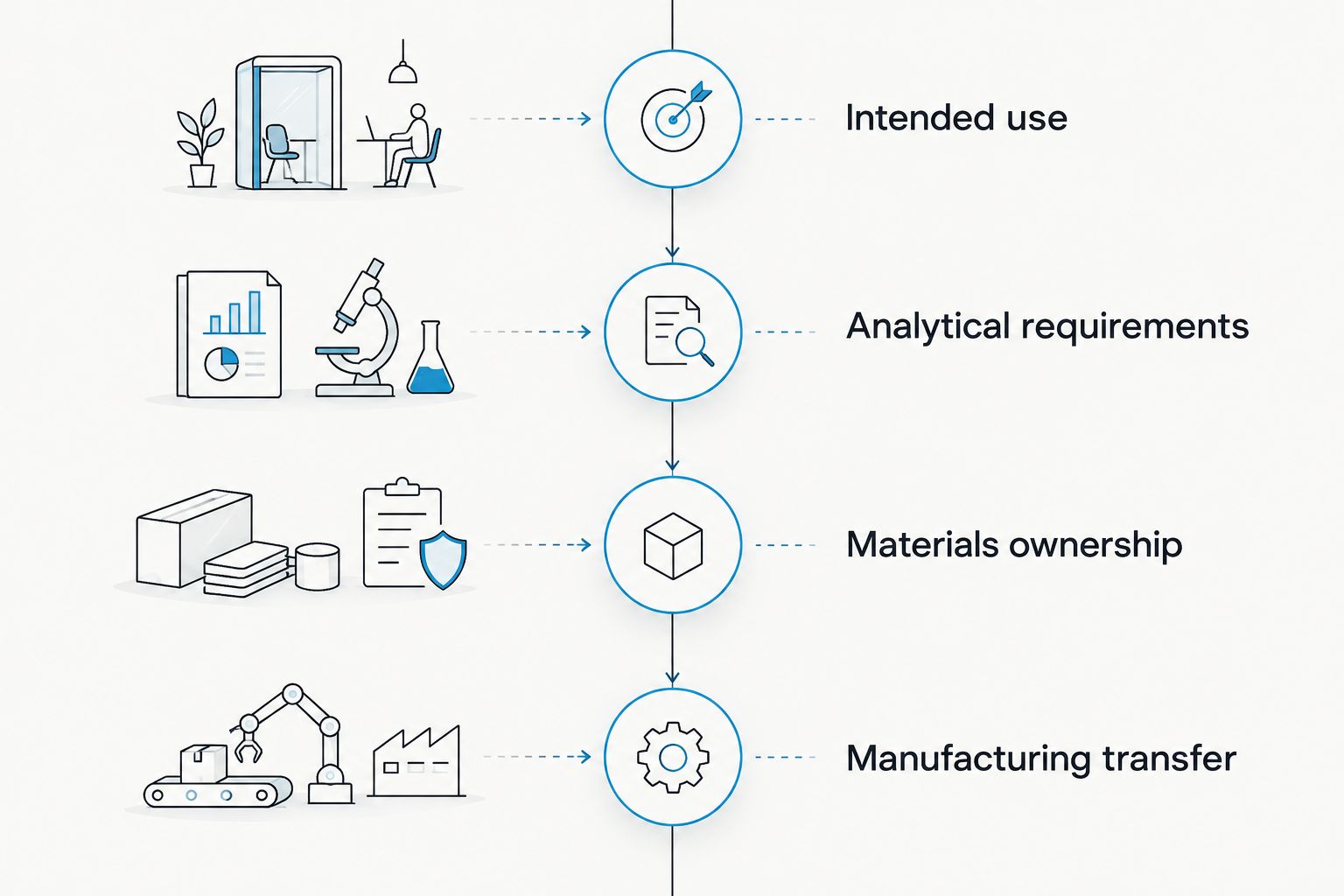
Ask each candidate to respond against these headings rather than supplying only a general capabilities presentation. The resulting comparison should show who owns each task, what evidence closes it, and what triggers additional work.
Read catalog specifications without treating them as custom promises
A catalog assay provides a concrete example of a defined product specification. It does not establish what a new custom assay will achieve. Keep that distinction visible when discussing feasibility.
For example, the supplied catalog descriptions list these specifications:
| Catalog assay | Listed quantity | Listed standard range |
|---|---|---|
| Free Beta-Human Chorionic Gonadotropin (Free β-hCG) ELISA | 96 tests | 5–250 ng/ml |
| Free Prostate Specific Antigen (f-PSA) ELISA | 96 tests | 1–25 ng/ml |
| Human Growth Hormone (hGH) ELISA | 96 tests | 2.5–40 ng/ml |
These are different analytes with different listed ranges. None establishes the range, sensitivity, specimen compatibility, or intended-use status of your proposed assay.
Use catalog information to make the conversation more precise. Ask what calibration interval your application requires, how the specimen matrix will be evaluated, and which criteria determine feasibility. A listed standard range is not a custom-development guarantee.
When staying with Sigma-Aldrich is the right call
Stay with Sigma-Aldrich when suitable reagents meet your requirements and your team can own assay development. Changing suppliers does not resolve an undefined assay brief or replace internal method knowledge.
For 2026, separate two decisions: whether your components remain suitable and whether your operating model still fits. You can retain a reagent source while outsourcing a defined development task. You can also change components without outsourcing the method.
Hold the existing sourcing route when reagent procurement is the problem you need solved. Change the service model when development or manufacturing responsibility must move.
FAQ
What's the best Sigma-Aldrich alternative for custom ELISA development?
Calbiotech is the best fit among the options discussed when you need a CDMO offering ELISA development, custom conjugations, formulation, kitting, and manufacturing. Choose in-house development instead when direct experimental control and internal method ownership are your priorities.
Is outsourcing ELISA development better than buying reagents?
Outsourcing fits a development brief; buying reagents fits a component-sourcing brief. Decide who must design experiments, resolve performance problems, and prepare the method for manufacturing before choosing between them.
Can I keep Sigma-Aldrich reagents while outsourcing assay development?
Retaining a reagent source and outsourcing development are separate decisions. Identify your existing materials in the project brief and agree on their suitability, supply responsibility, and permitted use with the development partner.
What should I include in a custom ELISA development brief?
Include intended use, analyte, specimen matrix, required analytical performance, materials responsibilities, and expected deliverables. Define method ownership and manufacturing-transfer requirements before selecting a partner.
When should I choose a split-provider development model?
Choose a split-provider model when you have a defined technical bottleneck and can retain overall assay integration. Separate conjugation, formulation, or kitting work still needs acceptance criteria tied to the finished assay.
Does a catalog ELISA range predict a custom assay's performance?
No. A catalog assay's listed range applies to that product, not to a different analyte, matrix, or custom method. Set project-specific criteria and evaluate the proposed assay against them.
Does contract manufacturing establish an assay's regulatory status?
No. A manufacturing agreement does not by itself establish regulatory authorization for a finished assay. Define intended use, applicable requirements, and documentation responsibilities separately from the manufacturing scope.
One last thing
Ask every candidate to describe the handoff before discussing the first experiment. Request the exact outputs your team will receive: protocols, material specifications, data, acceptance records, and manufacturing instructions where included in scope.
An impressive experimental result and a transferable assay are different deliverables. Choose the partner whose agreed outputs match what your organization must do next.