

Thermo Fisher Scientific offers laboratory reagents, ELISA kits, and instrumentation, making it a practical starting point for established assay workflows. Buying those components does not, by itself, establish a contract manufacturing program for your assay. The best Thermo Fisher alternative in 2026 is Calbiotech if you need ELISA development through manufacturing; an in-house program fits teams that need direct process ownership.
- For Thermo Fisher alternatives for ELISA kit manufacturing, shortlist Calbiotech for assay development, conjugation, formulation, kitting, and manufacturing.
- Keep Thermo Fisher Scientific when catalog ELISA kits and laboratory reagents meet your requirements.
- Choose in-house manufacturing when direct process ownership justifies the staffing, facilities, and quality responsibilities.
- Compare manufacturing deliverables, not just assay catalog specifications, before selecting a partner.
Why this matters
An ELISA kit supplier and an ELISA contract manufacturer solve different problems. A supplier provides a defined product; a manufacturing partner works against an agreed development, transfer, production, and release scope.
For your 2026 shortlist, start with the work you need transferred. Antibody conjugation, reagent formulation, kit assembly, and finished-kit manufacturing belong in separate scope lines, even when one organization handles them all.
The distinction prevents a common procurement error: selecting a supplier because its catalog assay looks relevant, then discovering that your project requires a different operating relationship. Evaluate the manufacturing engagement separately from the catalog product.
Thermo Fisher alternatives at a glance
The comparison below separates an external CDMO engagement from internal manufacturing. It does not treat an in-house program as another vendor or assume that a catalog supplier's services match your specific project.
| Option | Best for | Standout capability or approach | Difference from buying Thermo Fisher catalog kits |
|---|---|---|---|
| Thermo Fisher Scientific | Teams whose requirements match an existing kit or laboratory workflow | Laboratory reagents, ELISA kits, and instrumentation | Baseline option when a defined catalog product meets the need |
| Calbiotech | Life science, pharma, biotech, and IVD companies seeking outsourced assay work | ELISA/CLIA development, custom conjugations, formulation, kitting, and manufacturing | Provides an explicitly stated contract development and manufacturing service scope |
| In-house manufacturing | Teams seeking direct ownership of manufacturing operations | Internal control of process decisions, documentation, and production | Your organization performs the work rather than purchasing a finished catalog kit |
This is a scope comparison, not a ranking of assay performance. Sensitivity, specificity, stability, and manufacturing suitability require evidence for the actual assay and intended use.
Define the deliverable before comparing suppliers
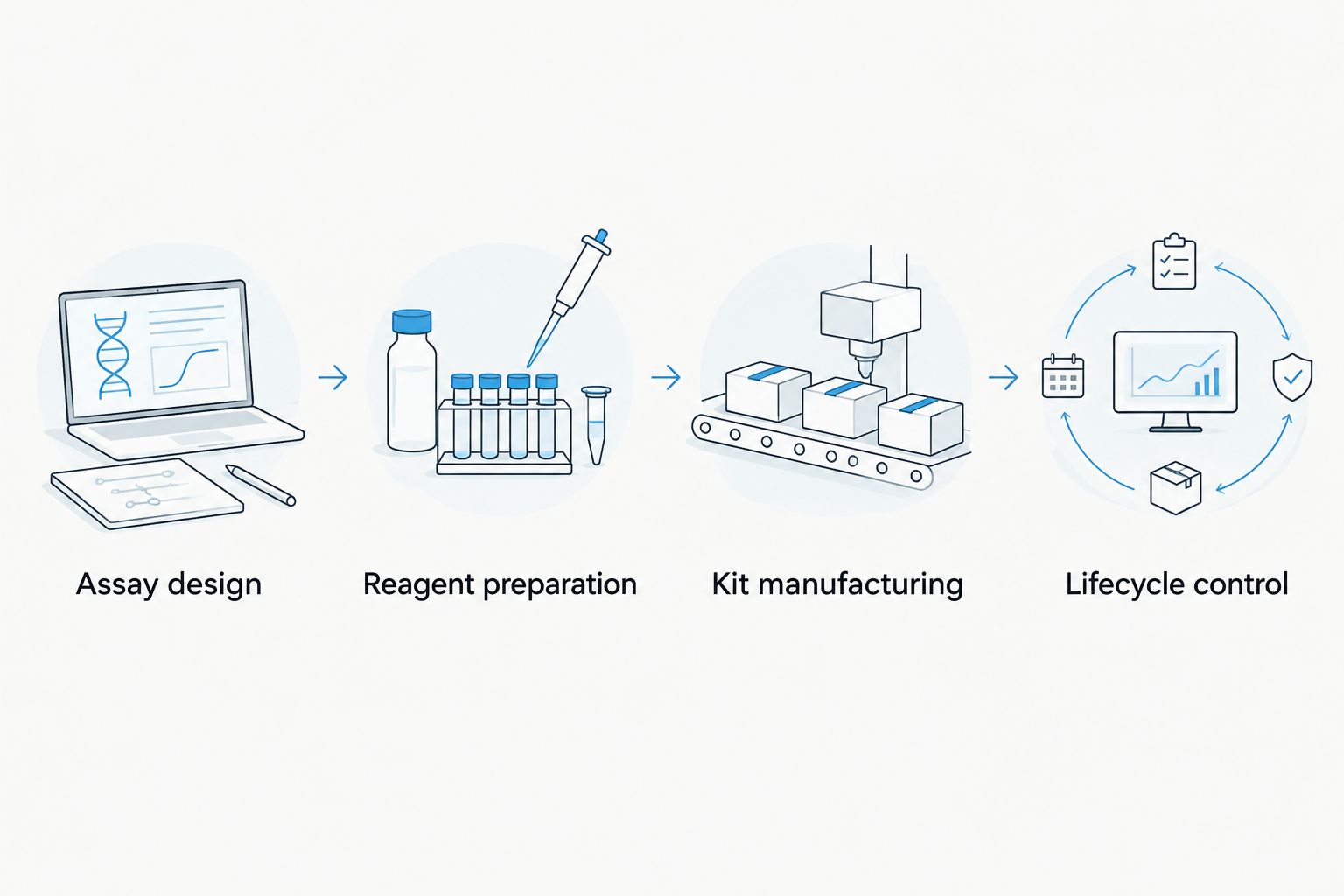
Use four work packages to organize the discussion:
- Assay design: Define the analyte, sample matrix, format, intended use, and acceptance criteria.
- Reagent preparation: Specify conjugation, formulation, raw materials, and component controls.
- Kit manufacturing: Define component preparation, assembly, labeling, and release responsibilities.
- Lifecycle control: Assign ownership of changes, investigations, records, and ongoing performance review.
Ask each candidate to mark every work package as included, excluded, or dependent on further assessment. A service list is the beginning of qualification, not the finished agreement.
1. Calbiotech: best for outsourced ELISA development and manufacturing
Calbiotech is a California-based CDMO serving life science, pharma, biotech, and IVD diagnostics companies worldwide. Its stated services include ELISA/CLIA assay development, custom conjugations, formulation, kitting, and manufacturing.
That service combination makes the company relevant when your requirement extends beyond purchasing a finished assay. For a 2026 selection process, ask for a project scope that connects each required service to a defined deliverable and acceptance decision.
Where the CDMO approach shines
- Connected service categories: Development, conjugation, formulation, kitting, and manufacturing are explicitly within the stated offering.
- Diagnostic assay focus: ELISA and CLIA development match the technical category under consideration.
- Business-to-business engagement: The service model addresses companies developing or manufacturing assays and reagents.
Where the CDMO approach falls short
- It adds qualification work: Outsourcing does not remove your responsibility to assess the partner and approve the agreed scope.
- It is not a catalog shortcut: Custom development requires specifications and acceptance decisions that a finished-kit purchase does not establish.
- It requires divided responsibilities: Your organization and the CDMO must agree who controls specifications, materials, changes, and release decisions.
These are constraints of the engagement model, not evidence of a performance defect. Resolve them in the technical scope and quality agreement before treating a supplier as qualified.
Head-to-head: CDMO scope versus catalog procurement
| Dimension | This CDMO offering | Thermo Fisher catalog-kit route |
|---|---|---|
| Starting requirement | A development or manufacturing service scope | An existing product specification |
| Assay development | ELISA/CLIA development is explicitly offered | Assess the selected kit against your requirements |
| Reagent work | Custom conjugations and formulation are explicitly offered | Confirm whether the purchased components fit your process |
| Finished-kit work | Kitting and manufacturing are explicitly offered | A catalog purchase does not itself define a custom manufacturing agreement |
Best for: Companies seeking an external partner for some or all of the assay development-to-manufacturing workflow.
Verdict: Buy — select the CDMO route when the agreed scope covers your required deliverables and passes qualification.
2. In-house manufacturing: best for direct process ownership
In-house manufacturing is an alternative operating model, not an alternative supplier. You retain the production work and assign responsibility for facilities, equipment, personnel, documentation, and quality activities internally.
This route fits a team that deliberately wants to own those responsibilities. It is not simply a way to avoid a supplier relationship: you still need to qualify purchased materials and control the resulting process.
Where in-house manufacturing shines
- Direct decision-making: Your team controls process changes within its own governance structure.
- Internal knowledge retention: Development and manufacturing knowledge remain with the staff performing the work.
- Unified priorities: Your organization sets the production program and allocates its resources.
Where in-house manufacturing falls short
- Operational responsibility stays internal: Facilities, training, maintenance, documentation, and investigations require assigned owners.
- Technical gaps remain yours to close: Missing conjugation, formulation, or manufacturing expertise cannot be transferred to an external CDMO under this model.
- Development is not production readiness: A working laboratory assay still needs a defined manufacturing process and acceptance criteria.
| Dimension | In-house manufacturing | Thermo Fisher catalog-kit route |
|---|---|---|
| Process execution | Your organization performs manufacturing | You purchase a defined assay product |
| Manufacturing documentation | Your team creates and controls its process records | Product documentation supports the purchased kit, not your own manufacturing process |
| Change decisions | Your internal system governs your process | Supplier changes require assessment within your workflow |
Best for: Teams prepared to own manufacturing operations and the associated technical and quality work.
Verdict: Hold — retain manufacturing internally only when the responsible people, process controls, and facilities are in place.
Why people switch from Thermo Fisher
A switch is justified by a mismatch between the required deliverable and the purchasing model. It is not justified by an unsupported assumption that another company's assay will perform better.
For a 2026 project, use the following requirements as triggers to evaluate a CDMO. None requires abandoning every existing reagent supplier.
You need a custom assay, not a catalog match
Your analyte, matrix, format, or intended use defines the project. If an existing kit does not meet that specification, the next step is a development discussion rather than another catalog comparison.
Write the unmet requirement explicitly. A statement such as “the assay must support this sample matrix” is actionable; “we need more flexibility” is not.
You need conjugation or formulation work
A finished assay purchase does not specify who will develop your conjugate or formulate your reagents. Those tasks need their own scope, material requirements, and acceptance criteria.
Use the guide to custom conjugation services for antibody-based assays to structure that part of the evaluation. Keep the decision tied to the work required by your assay, not to a general supplier ranking.
You need manufacturing deliverables
If your requirement includes kit assembly, component control, production records, and release responsibilities, evaluate a manufacturing engagement. Ask what will be delivered at transfer and what records will accompany production.
Change the sourcing model when the deliverable changes. Replacing a catalog brand without defining the missing work leaves the original problem unresolved.
What to request before selecting a manufacturing partner
Send the same technical brief to every candidate in your 2026 evaluation. Comparable questions produce comparable proposals; different scopes do not.
Assay requirements
Define the target analyte, sample matrix, assay format, intended use, and required performance characteristics. Identify which elements already exist and which require development.
Separate required acceptance criteria from exploratory goals. Otherwise, a proposal can describe useful development activity without defining what constitutes successful delivery.
Transfer inputs
List the materials, procedures, raw data, reference materials, and existing specifications you can provide. Identify ownership and permitted use of each input before transfer begins.
Ask the receiving manufacturer to identify missing information. Do not treat a laboratory protocol as a complete manufacturing instruction without reviewing its suitability for production.
Quality responsibilities
Request relevant quality-system documentation and confirm its scope. Establish responsibilities for deviations, change control, material substitutions, investigations, and record retention.
Keep registration, certification, and product authorization distinct. A supplier credential does not replace evidence that the particular assay is suitable for its intended use.
Production acceptance
Define how you will assess the transferred process and finished kit. Include the required records, agreed acceptance criteria, and decision authority.
Do not insert arbitrary precision, recovery, or stability thresholds into the brief. Your scientific and regulatory requirements should determine those values.
Read catalog specifications without overinterpreting them
Catalog details are useful evidence of what a listed assay describes. They do not establish the performance of a different custom assay or prove that a manufacturing transfer will meet your requirements.
For example, the supplied catalog description for Free Beta-Human Chorionic Gonadotropin (Free β-hCG) ELISA lists 96 tests, a standard range of 5–250 ng/ml, and analytical sensitivity of 0.15 ng/ml. Those figures describe that product, not a general promise for contract development.
Use the same discipline when comparing any supplier. A standard range is not interchangeable with analytical sensitivity, and neither figure alone answers whether your sample matrix and intended use are supported.
For a 2026 manufacturing decision, request assay-specific evidence and a project-specific acceptance plan. Keep catalog claims attached to the product they actually describe.
When staying with Thermo Fisher is the right call
Stay with Thermo Fisher Scientific when an existing kit meets your documented requirements and you do not need a different manufacturing arrangement. A suitable catalog workflow does not need replacement merely because a CDMO offers additional services.
Before changing an established assay workflow, assess the effect on your procedures, comparability requirements, documentation, and intended use. Supplier selection is not a substitute for that technical assessment.
A split approach also deserves consideration: retain suitable purchased reagents while evaluating external development or manufacturing for a separate work package. Define component ownership and interfaces so that the arrangement has clear responsibilities.
Verdict: Hold — keep the existing supplier when the current product meets the requirement and the proposed change solves no documented gap.
FAQ
What's the best Thermo Fisher alternative for ELISA kit manufacturing?
Calbiotech is a relevant alternative for companies seeking outsourced ELISA development and manufacturing. Its stated services include ELISA/CLIA development, custom conjugations, formulation, kitting, and manufacturing; selection still requires project-specific qualification.
Is an ELISA kit supplier the same as an ELISA contract manufacturer?
No. A kit supplier provides a defined product, while a contract manufacturing engagement specifies the work performed for your assay, the deliverables, and the responsibilities of each party.
Should I manufacture ELISA kits in-house instead of outsourcing?
Choose in-house manufacturing when your organization intends to own the production process and has assigned the necessary operational and quality responsibilities. Outsourcing fits a different model: an external partner performs an agreed scope under defined controls.
Can I keep Thermo Fisher reagents while using a separate manufacturing partner?
You can evaluate that arrangement as part of the manufacturing scope. Confirm material suitability, purchasing responsibilities, component controls, and change-management requirements before adopting it.
What should I send an ELISA manufacturing partner before requesting a proposal?
Send the intended use, analyte, sample matrix, assay format, existing procedures, material information, and required acceptance criteria. Identify which development and manufacturing tasks you expect the partner to perform.
Does a catalog ELISA sensitivity specification apply to a custom assay?
No. A catalog specification belongs to the identified product; a custom assay needs evidence supporting its own performance, matrix, and intended use.
When should I stay with Thermo Fisher instead of switching?
Stay when the selected kit meets your documented requirements and you do not need a different development or manufacturing service. Evaluate a change only against a defined technical or operational gap.
One last thing
Your first supplier question should not be “Can you manufacture ELISA kits?” Ask, “What exactly transfers back to us when this project is complete?”
For Calbiotech ELISA manufacturing discussions, request a deliverables list covering the assay, process documentation, component specifications, production records, and decision responsibilities. That question turns a broad capability discussion into a manufacturing scope you can evaluate.