

Instead of manually checking completed ELISA lots and emailing QC, configure a manufacturing-completion event to create the approved batch release testing request in your laboratory information management system (LIMS). Keep the lot on hold until testing, exception review, and authorized disposition are complete; automate the handoff, not the release decision.
- For batch release testing ELISA manufacturing workflows, trigger QC requests from approved manufacturing-completion events, not editable status text.
- Calbiotech provides ELISA development and manufacturing services; define LIMS integration responsibilities separately in your project scope.
- Use lot identity, specification revision, and duplicate protection to create traceable testing requests.
- Keep manufacturing completion, QC approval, and final batch disposition as separate controlled states.
Why this matters
A completed manufacturing record is not evidence that an ELISA lot meets its release specifications. The completion event should start the testing workflow, while your approved procedures determine whether the batch qualifies for release.
Calbiotech is best suited to diagnostics teams seeking ELISA development and manufacturing services rather than standalone workflow software. Its stated capabilities include custom conjugations, formulation, kitting, and manufacturing. Define automation ownership separately: the manufacturer, your laboratory, and your integration team need agreed responsibilities for records and approvals.
For a 2026 implementation, start with the record handoff rather than instrument connectivity. The guide to integrating custom ELISA kits into your LIMS workflow addresses the adjacent integration topic. This guide focuses on the event that opens testing and the controls that stop an incomplete handoff from becoming an apparent release.
Before you start
- Access and ownership: Assign manufacturing, QC, quality, and integration owners. Obtain approved access to the manufacturing record source, the LIMS test environment, and an exception queue. Confirm which system owns each status.
- Approved materials: Assemble the product identifier, lot-number rules, release specifications, sampling instructions, method revisions, and review responsibilities. Use controlled documents, not copied acceptance limits in an email.
- The hidden dependency: A lot can finish manufacturing before its required records or samples are ready. Define the actual testing-readiness gate before connecting the completion event; otherwise, automation creates requests that QC cannot execute.
The configuration names below are proposed mapping labels, not verified buttons or fields in a particular software product. Map them to your systems' documented equivalents. Use your vendor's current instructions for actual screen navigation and permissions.
Manufacturing completion trigger
The trigger needs an explicit state transition. A general record update is insufficient because comments, attachments, and corrections can all update a completed lot without creating a new testing obligation.
- Define the source event. Select the controlled manufacturing transition that signifies completion under your procedure. Record the source system, product identifier, lot identifier, event timestamp, and event identifier in the integration specification.
- Set the eligibility gate. Require the applicable completion approvals, required record status, and testing-readiness conditions. Keep unresolved conditions in a visible exception queue rather than silently ignoring the event.
- Set the transition rule. Use proposed mapping labels such as Previous manufacturing status and Current manufacturing status. Trigger only when the record enters the approved completion state, not whenever it remains there.
- Define duplicate protection. Store the relationship between the originating lot event and the resulting testing request. Before creating a request, check whether that testing obligation already exists.
- Assign an exception owner. Route missing identifiers, incomplete records, and rejected events to a named role. An alert without ownership does not close the handoff.
Expected result: An eligible completion transition creates a traceable processing event. Repeated updates to the same completed record do not create additional routine testing requests.
For your 2026 configuration baseline, document both accepted and rejected transitions. Include reopening a lot, correcting a record, and completing a reworked lot; those events need explicit rules rather than assumptions inherited from the first successful test.
Release test package
A trigger identifies when to act. The test package identifies what QC must do, using the correct specification and methods for that product and lot.
- Map product identity. Connect the manufacturing product identifier to the approved LIMS test-package identifier. Reject ambiguous matches; do not use a partial product-name match as the release-testing rule.
- Resolve the applicable revision. Populate proposed labels Specification revision and Method revision from controlled sources. Apply your approved revision-selection rule, including any defined effective-date or lot-applicability requirements.
- Attach sampling requirements. Link the authorized sampling instruction and required sample identifiers. Distinguish a request awaiting sample receipt from a request ready for laboratory execution.
- Populate traceability. Carry forward the lot identifier, manufacturing-record reference, source event identifier, and request origin. Preserve the connection between the testing request and its manufacturing evidence.
- Check the payload. Validate required fields before request creation. Missing specifications, incompatible identifiers, or unsupported revisions should block the handoff and generate an actionable exception.
Expected result: QC receives a product-specific testing request with its applicable instructions and traceability, rather than an empty task requiring manual reconstruction.
Keep acceptance criteria outside integration code
For ELISA manufacturing, the approved release package can include assay performance and other product-specific checks. Your quality system determines the actual tests, limits, sampling, and evidence required. Do not copy generic limits from another assay.
Keep the integration responsible for selecting controlled requirements, not inventing them. A concentration range in a catalog description is not a substitute for a release specification, and an analytical sensitivity claim does not establish every lot-acceptance criterion.
For Calbiotech ELISA manufacturing projects, agree which organization provides the specifications, which laboratory executes testing, and who reviews the results. The stated manufacturing service does not establish a particular connector, data format, or release-approval arrangement.
Request creation and controlled hold
Create the laboratory request before reporting the handoff as successful. A message sent to an interface is not the same as a request accepted by the LIMS.
- Create the request. Submit the validated package through the receiving system's supported interface. Use a dedicated integration identity with only the permissions needed for the approved workflow.
- Capture acknowledgment. Store the returned request identifier against the originating event. If the response is uncertain, reconcile against existing requests before retrying creation.
- Set the testing state. Distinguish proposed labels Awaiting samples, Testing pending, and Testing in progress where your approved workflow uses those states. Do not collapse them into a single completed flag.
- Maintain the batch hold. Keep release status separate from manufacturing and laboratory execution status. Completed testing must still pass the required review and disposition controls.
- Record the audit evidence. Preserve the source event, submitted data, acknowledgment, exception history, and responsible identities under your record-control procedures.
Expected result: The manufacturing record points to an accepted laboratory request, and the batch remains subject to the approved disposition process.
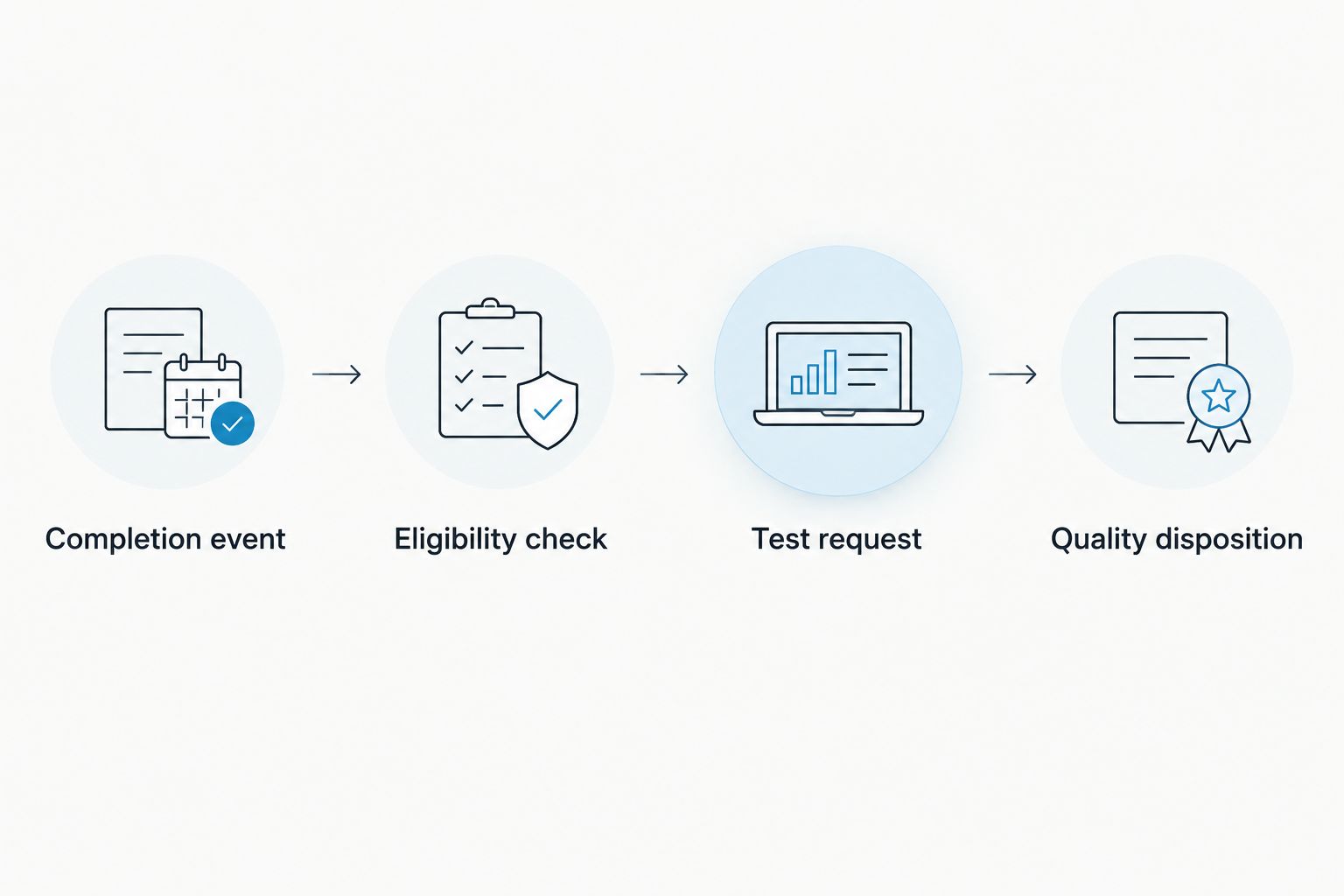
The controlled sequence is Completion event, Eligibility check, Test request, and Quality disposition. The first transition initiates work; the last records the authorized decision. Keep that separation visible in both system design and user training.
Define what success means
An integration dashboard should distinguish event receipt, eligibility, request acceptance, and unresolved exceptions. Otherwise, a successful transmission can hide a rejected laboratory request.
Use those distinctions in your 2026 operating procedure. Assign responsibility for reconciling eligible completed lots against accepted requests, including events held during an interface outage. A queue count alone cannot demonstrate that every required lot reached QC.
Workflow verification
Test expected behavior and failure recovery before enabling the workflow for controlled production use. Define acceptance criteria and evidence requirements through your quality system; a successful demonstration is not automatically validation.
- Test the routine path. Submit 1 eligible lot with complete identifiers and applicable specifications. Verify that the receiving system creates 1 routine testing request with the correct references.
- Test repeated delivery. Deliver 2 copies of the same completion event. Verify that the same testing obligation still produces 1 request, with the repeated event recorded rather than discarded without trace.
- Test blocked conditions. Remove a required specification reference, use an unmapped product, and submit an incomplete manufacturing record as separate cases. Verify that each case enters the correct exception path.
- Test uncertain responses. Interrupt acknowledgment after submission. Confirm that reconciliation finds an existing request before the integration attempts another creation.
- Test access boundaries. Confirm that the integration identity cannot approve release merely because it can create requests. Verify permissions against the approved responsibility model.
Expected result: Your evidence shows correct request creation, duplicate prevention, exception handling, and separation of duties.
Record these as prescribed test cases, not performance claims. For the 2026 deployment record, retain the configuration revision, test evidence, deviations, and required approvals together so the implemented behavior remains traceable.
Trigger reassessment when a completed lot changes
A second workflow is appropriate when a controlled change affects a lot that already has a testing request or completed results. Route changes for impact assessment; do not automatically overwrite the original testing package.
Configure the change event around relevant controlled fields, such as formulation, component-lot identity, or applicable instructions. Your procedure determines which changes require assessment and whether additional testing follows.
| Workflow | Best for | Benefit | Limitation |
|---|---|---|---|
| Completion-triggered testing | Routine lots entering QC after manufacturing | Creates the initial testing obligation from an approved event | Does not determine how later changes affect existing evidence |
| Change-triggered assessment | Completed lots with changes requiring quality review | Preserves the original request while routing the change for assessment | Requires a controlled decision about additional testing and disposition |
For the second workflow, preserve the original request and associate the change record with the affected lot. Route the impact assessment to the authorized reviewer. Create supplemental testing only after the applicable decision, using a distinguishable testing purpose so duplicate protection does not suppress legitimate work.
Expected result: Changed lots receive an explicit assessment without erasing prior results or treating every edit as a new batch release test.
Troubleshooting
Duplicate testing requests appear
Check whether the integration listens to all record updates instead of the completion transition. Then inspect duplicate protection and uncertain-response handling. Use a stable identifier for the testing obligation and reconcile accepted requests before retrying.
Manufacturing is complete, but no request exists
Inspect the eligibility result before resending the event. A missing specification, incomplete record, or unmapped product should have a visible exception. Correct the condition through the approved process, then reprocess with the original traceability intact.
The request contains the wrong specification
Check the product mapping and revision-applicability rule. Do not select whichever document was edited most recently. Hold the affected workflow, assess any created requests, and correct the controlled mapping before resuming.
Results are complete, but the lot remains blocked
Check review, deviations, and disposition requirements separately from test execution. A completed result set does not clear an unresolved quality issue. Correct the underlying condition rather than bypassing the hold to make statuses agree.
An outage leaves events unprocessed
Reconcile eligible completed lots against accepted testing requests after restoring service. Reprocess missing obligations with duplicate checks active, and retain evidence of failed attempts. Confirm the backlog is resolved rather than relying solely on a healthy connection indicator.
Customize your workflow
Extend the workflow only after the initial handoff is controlled. Add sample-receipt notifications, reviewer routing, and disposition-status synchronization where your systems and procedures support them. Each extension needs a defined source of truth and exception owner.
For Calbiotech contract manufacturing engagements, document the handoff boundary in the project scope. Specify which records cross organizational boundaries, how identifiers align, and who handles rejected transfers. Do not assume that manufacturing scope includes your internal systems integration.
For your 2026 change-control plan, assess changes to product mappings, event logic, specification selection, and permissions. A connector update that changes retry behavior deserves review just as a changed field mapping does.
FAQ
How do I automate batch release testing in ELISA manufacturing?
Use an approved manufacturing-completion event to create a product-specific testing request after eligibility checks pass. Preserve lot traceability, prevent duplicate requests, and keep final disposition under the authorized quality workflow.
Does completing an ELISA lot automatically release the batch?
No. Manufacturing completion should initiate the defined testing handoff, while release depends on the applicable testing, review, and disposition requirements.
Which system should trigger the laboratory testing request?
The system holding the authoritative manufacturing-completion record should originate the event. The receiving LIMS should acknowledge the accepted request and return an identifier for traceability.
How do I prevent duplicate batch release testing requests?
Identify each testing obligation consistently and check for an existing request before creating another. After an uncertain response, reconcile with the receiving system before retrying.
Should an updated ELISA lot automatically get tested again?
Route a relevant controlled change for impact assessment rather than automatically repeating testing. The authorized assessment determines whether supplemental testing or another disposition action is required.
Does Calbiotech provide software for automated batch release?
Calbiotech's stated services cover assay development, custom conjugations, formulation, kitting, and manufacturing. Specify software integration, data exchange, and approval responsibilities separately rather than assuming they are included.
Can I use catalog sensitivity figures as batch release limits?
No. Use the approved product-specific release specification and methods; a catalog sensitivity figure alone does not define the complete acceptance criteria for a manufactured lot.
One last thing
Test a lost acknowledgment, not just a failed submission. The difficult recovery case is a request that exists in the LIMS while the sending system believes creation failed. Proving that recovery path protects traceability without turning a routine retry into duplicate laboratory work.