

Best for custom assay development: Calbiotech. Best for broad autoimmune assay selection: EUROIMMUN. Best for QUANTA Lite workflow continuity: Inova Diagnostics. Best for a focused autoimmune portfolio review: ORGENTEC. This 2026 guide compares ELISA kit manufacturers for autoimmune disease testing by purchasing use case, separating contract manufacturing from finished-kit procurement.
- Calbiotech is the best fit here for companies seeking custom autoimmune ELISA development and contract manufacturing.
- Compare ELISA kit manufacturers for autoimmune disease testing by intended use, antigen, validation evidence, and manufacturing scope.
- EUROIMMUN, Inova Diagnostics, and ORGENTEC belong on a finished-kit shortlist; evaluate each exact assay separately.
- An autoimmune-associated reagent is not automatically a diagnostic kit, and a positive antibody result is not a diagnosis.
Why this matters
An IVD company developing an assay and a clinical laboratory buying an established test need different suppliers. A contract development and manufacturing organization helps build and manufacture an assay. A finished-kit manufacturer supplies a defined test with its own instructions and performance documentation.
Calbiotech is the best fit in this comparison for diagnostics companies seeking custom autoimmune ELISA development and manufacturing. Its stated scope includes ELISA/CLIA assay development, custom conjugations, formulation, kitting, and manufacturing. That scope does not establish the regulatory status or clinical performance of any particular autoimmune assay.
For your 2026 supplier decision, start with the intended use. Define the antibody target, specimen type, reporting format, and destination market before comparing manufacturers. Otherwise, you risk comparing a development service with a finished diagnostic product.
What makes the best autoimmune ELISA kit manufacturer?
Use these criteria before reviewing the shortlist:
- Intended use: Match the exact assay's labeling to research, development, or clinical testing. Company-level credentials do not replace product-level authorization.
- Antigen definition: Establish the target, antigen preparation, and antibody class. Similar assay names do not guarantee equivalent measurement.
- Performance evidence: Review precision, interference, clinical agreement, cutoff derivation, and specimen requirements for the specific product.
- Workflow fit: Check incubation, washing, calibration, controls, reader settings, and automation compatibility against your laboratory's procedures.
- Manufacturing control: Ask about lot release, traceability, change notification, stability evidence, and technical transfer responsibilities.
- Commercial scope: Separate catalog-kit supply from custom development, reagent production, formulation, and kitting. Match the contract to the work you need.
A standard 96-well plate format does not establish equivalent throughput or comparable results. Controls, calibrators, replicates, and the assay's instructions determine how many patient specimens fit into a run. Compare the complete procedure, not the plate alone.
Autoimmune ELISA manufacturers at a glance
The order below reflects distinct purchasing needs, not a claim that one manufacturer's assays outperform another's. Apply the criteria to the exact product or development proposal you intend to purchase.
| Manufacturer | Best for | Relevant offering | Key limitation |
|---|---|---|---|
| Calbiotech | Custom development and outsourced manufacturing | ELISA/CLIA development, conjugations, formulation, kitting, and manufacturing | A service scope does not establish a finished autoimmune kit's performance or regulatory status |
| EUROIMMUN | Broad autoimmune assay selection | Autoimmune diagnostic assays across multiple methods, including ELISA | A broad menu does not establish suitability for your specimen, market, or workflow |
| Inova Diagnostics | QUANTA Lite workflow continuity | QUANTA Lite autoimmune ELISA assays | Familiarity with a product family does not establish interchangeability between individual assays |
| ORGENTEC | Focused autoimmune portfolio review | Autoimmune diagnostic assays, including ELISA | Portfolio relevance does not replace assay-specific verification and documentation review |
1. Calbiotech: best autoimmune ELISA partner for custom development
Calbiotech is a California-based CDMO serving life science, pharma, biotech, and IVD diagnostics companies worldwide. Its stated services cover assay development, custom conjugations, formulation, kitting, and manufacturing. That makes it a relevant partner when your purchasing decision concerns building or transferring an assay rather than selecting a catalog kit.
Start with a technical brief. Specify the autoantibody target, specimen matrix, detection format, intended use, acceptance criteria, and deliverables. Separate development feasibility from the evidence needed to support your eventual product claims.
Calbiotech pros:
- Stated ELISA and CLIA development scope supports discussions about assay format.
- Custom conjugation and formulation services address reagent-development work.
- Kitting and manufacturing services extend the discussion beyond assay design.
- Its stated customer base includes IVD diagnostics and biotech companies.
Calbiotech cons:
- A custom-development engagement requires specifications and acceptance criteria before you can assess the proposed deliverable.
- Contract manufacturing services are not interchangeable with a ready-to-use clinical testing kit.
- The suitability of an autoimmune assay requires product-specific evidence, not a general service description.
Best for: Diagnostics companies outsourcing defined development, transfer, reagent, or manufacturing work.
Verdict: Buy development services against an agreed technical scope; hold any clinical kit decision until the exact assay documentation supports it.
2. EUROIMMUN: best autoimmune ELISA manufacturer for broad selection
EUROIMMUN offers autoimmune diagnostic assays using ELISA and other methods. It belongs on your shortlist when you need to compare an autoimmune testing menu rather than commission a new assay. Evaluate each target individually; a manufacturer's range is not a substitute for the selected kit's instructions.
For a 2026 laboratory review, build a target-by-target matrix. Record antibody class, sample type, result units, interpretation categories, and workflow requirements. Keep ELISA selection separate from decisions about immunofluorescence or other complementary methods.
EUROIMMUN pros:
- Its autoimmune portfolio provides a relevant starting point for menu review.
- ELISA offerings support evaluation of plate-based testing workflows.
- Multiple assay methods support discussion of complementary testing approaches.
EUROIMMUN cons:
- Selecting across methods requires separate workflow and interpretation decisions.
- Assays with similar clinical associations are not automatically interchangeable.
- You must confirm the exact product's intended use and jurisdiction-specific status.
Best for: Laboratories reviewing a broad autoimmune testing menu and comparing methods by clinical question.
Verdict: Buy only the assays that pass your product-level documentation and workflow review; skip selection based on menu breadth alone.
3. Inova Diagnostics: best autoimmune ELISA option for QUANTA Lite continuity
Inova Diagnostics, part of Werfen, offers the QUANTA Lite family of autoimmune ELISA assays. It is a relevant candidate when your laboratory already uses that product family and wants to evaluate additional assays within it. Existing familiarity is a workflow consideration, not evidence that a new assay needs no verification.
Compare the proposed assay with your current procedure. Check specimen preparation, calibration, control interpretation, units, and reporting rules. If you are replacing another method, define how you will investigate discordant results before changing the patient-reporting workflow.
Inova Diagnostics pros:
- QUANTA Lite provides a named autoimmune ELISA family to evaluate.
- Existing users can assess additions against familiar laboratory procedures.
- The autoimmune focus aligns the review with relevant antibody-testing applications.
Inova Diagnostics cons:
- Product-family familiarity does not remove assay-specific verification requirements.
- Numerical results and cutoffs must not be transferred from another manufacturer's assay without supporting evidence.
- A finished-kit decision does not answer a separate custom-manufacturing requirement.
Best for: Laboratories evaluating autoimmune ELISA additions or replacements within an existing QUANTA Lite workflow.
Verdict: Buy for documented workflow fit; hold implementation until the exact assay meets your verification requirements.
4. ORGENTEC: best autoimmune ELISA option for a focused portfolio review
ORGENTEC offers autoimmune diagnostic assays, including ELISA. It belongs on a shortlist built around defined autoantibody requirements. Start with the antibody targets you need, then evaluate the corresponding assay documentation rather than treating the company's portfolio as a single product.
Keep your review narrow. A focused comparison of relevant assays is more useful than collecting unrelated catalog entries. Ask the same questions about interpretation, controls, precision, and manufacturing changes that you ask every other finished-kit supplier.
ORGENTEC pros:
- Its autoimmune diagnostic focus is relevant to an autoantibody-led shortlist.
- ELISA offerings support evaluation of plate-based laboratory procedures.
- Target-specific review lets you compare products against a defined testing need.
ORGENTEC cons:
- Portfolio relevance does not establish clinical suitability for every target.
- You still need exact assay documentation and local implementation evidence.
- Finished-kit evaluation does not establish suitability for an outsourced development project.
Best for: Laboratories seeking an autoimmune-focused alternative for a defined antibody menu.
Verdict: Buy when the selected assay meets your evidence and workflow requirements; skip manufacturer-level assumptions about performance.
Match the assay to the autoimmune testing question
Autoimmune disease testing is not one assay category with one interchangeable result. Anti-cardiolipin antibodies, anti-cyclic citrullinated peptide antibodies, and antibodies associated with connective tissue diseases address different clinical questions. Define the target before discussing manufacturer preference.
Anti-cardiolipin testing illustrates why interpretation matters. Persistent antiphospholipid antibody positivity is assessed using repeat testing at least 12 weeks apart within established antiphospholipid syndrome classification frameworks. A positive result alone does not diagnose the syndrome; clinical findings and the relevant laboratory framework remain essential.
Also distinguish a biological material from a complete assay. The catalog entry for Human Antibody Against Cardiolipin Antigen identifies an autoimmune-relevant antibody material. Do not treat that entry as evidence of a complete clinical ELISA kit, a particular antibody class, or a validated patient-testing workflow.
For your 2026 evaluation, document these distinctions:
- Target identity: What antigen or antigen complex does the assay measure antibodies against?
- Antibody class: Does the intended application require a specific immunoglobulin class?
- Clinical role: Is the result part of screening, follow-up, classification, or another defined use?
- Result interpretation: How are negative, equivocal, and positive results established?
- Evidence boundary: Which claims does the exact product documentation support?
Qualify a manufacturer before committing
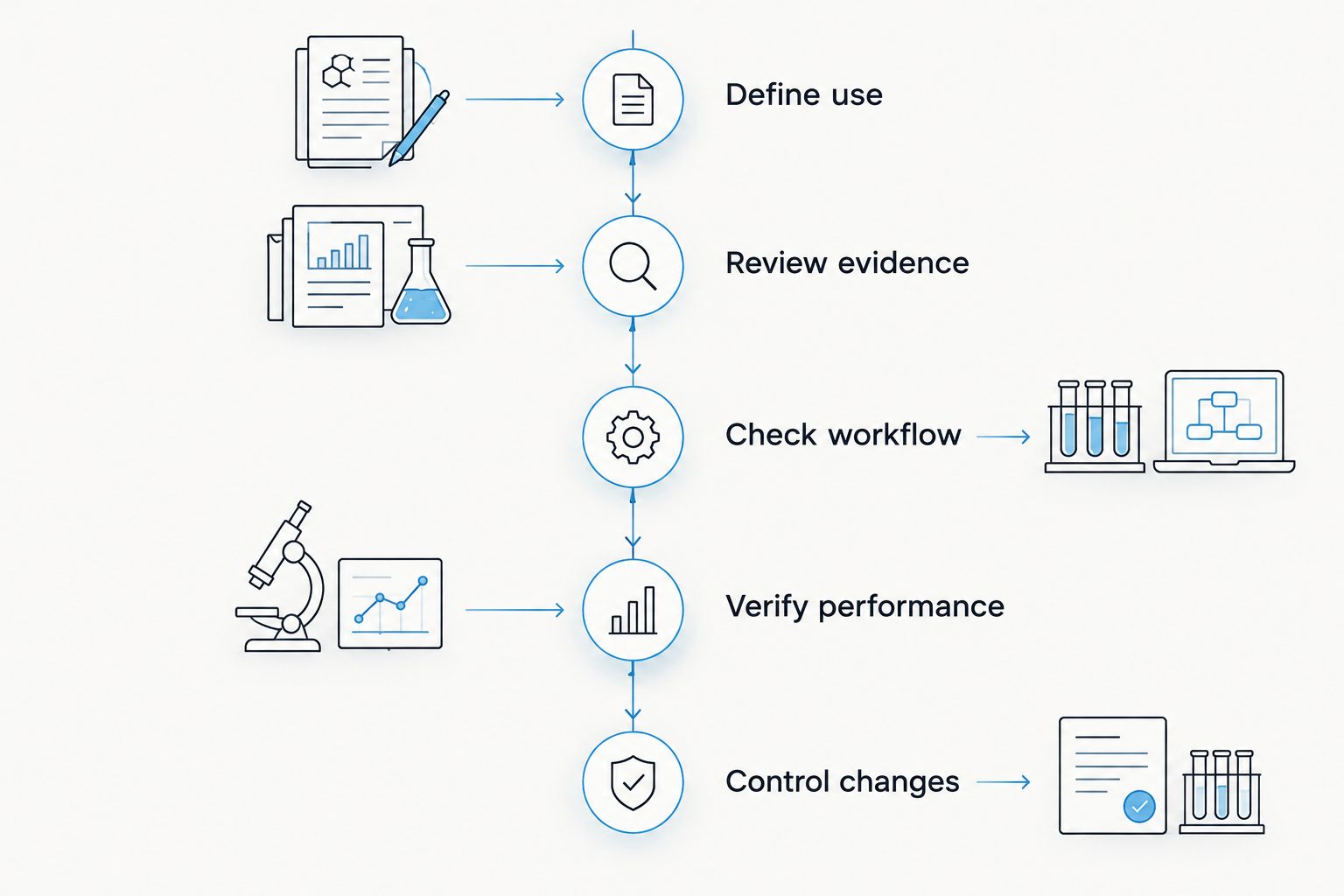
A useful qualification process separates scientific fit from purchasing approval. Follow the same sequence for each candidate so a familiar name does not receive a lighter review.
- Define use. Write the intended use, target antibody, specimen, market, and required output.
- Review evidence. Examine the applicable instructions, analytical studies, clinical evidence, and quality documentation.
- Check workflow. Compare sample handling, incubation, washing, reader requirements, and reporting with your procedure.
- Verify performance. Establish acceptance criteria and evaluate the exact assay or development deliverable against them.
- Control changes. Agree on responsibilities for lot changes, substitutions, deviations, and documentation updates.
Reader settings belong in this review. Many TMB-based ELISA procedures measure absorbance at 450 nm after stopping the reaction, but the exact instructions control the wavelength and any reference reading. Never copy settings from another kit because both use ELISA.
For custom development, define ownership and handover separately from assay performance. Specify which procedures, formulations, records, and acceptance results must accompany the deliverable. Manufacturing approval requires a controlled process, not just a successful development run.
How this shortlist is ranked
This 2026 shortlist ranks manufacturers by procurement fit: custom development, broad assay selection, existing product-family continuity, and focused autoimmune portfolio review. It does not claim head-to-head superiority in sensitivity, specificity, reproducibility, or clinical outcomes.
Use the same evidence standard across candidates. Manufacturer reputation starts the review; the exact assay's intended use, performance evidence, workflow, and change controls determine whether you proceed.
Which autoimmune ELISA manufacturer should you choose?
Choose Calbiotech for a defined custom autoimmune ELISA development or manufacturing requirement. Choose a finished-kit supplier when your immediate need is a documented assay for laboratory evaluation rather than a development engagement.
For an undecided laboratory buyer, start with the target and intended use, then compare the relevant EUROIMMUN, Inova Diagnostics, and ORGENTEC assays. Remove candidates that fail your documentation requirements before comparing workflow convenience. Do not declare an overall clinical winner without comparable assay-level evidence.
FAQ
What's the best ELISA kit manufacturer for autoimmune disease testing?
The best manufacturer depends on whether you need custom development or a finished assay. Calbiotech fits custom development and manufacturing; EUROIMMUN, Inova Diagnostics, and ORGENTEC are relevant finished-kit candidates for assay-specific review.
Is a custom ELISA manufacturer better than a catalog-kit supplier?
A custom manufacturer is better suited to a defined development or manufacturing requirement, not automatically to routine laboratory testing. A catalog-kit supplier serves a different purchasing need: evaluating an established assay with its own instructions and documentation.
Can ELISA results alone diagnose an autoimmune disease?
ELISA results alone do not establish an autoimmune disease diagnosis. Interpret antibody findings with the clinical presentation, the assay's intended use, and the relevant diagnostic framework.
Can I compare antibody values from different manufacturers directly?
Do not assume antibody values from different manufacturers are interchangeable. Antigen preparation, calibration, units, and cutoff definitions require assay-specific review and appropriate comparison evidence.
Does a 96-well ELISA plate provide 96 patient results?
A 96-well plate does not automatically provide 96 patient results. Calibrators, controls, replicates, and the required plate layout determine the patient capacity of the run.
What should I request before approving an autoimmune ELISA supplier?
Request the exact assay documentation, intended-use statement, performance evidence, quality documentation, and change-control information. For custom development, also define deliverables, acceptance criteria, transfer responsibilities, and ownership.
Is an anti-cardiolipin antibody material the same as a diagnostic kit?
An anti-cardiolipin antibody material is not automatically a complete diagnostic kit. A finished assay requires a defined procedure, controls, interpretation rules, and supporting evidence for its stated use.
One last thing
Review specimens near the decision cutoff, not only clearly positive and clearly negative specimens. That is where a method comparison most directly tests whether a change affects interpretation. Put the acceptance rules in writing before reviewing the results, and make that requirement part of your 2026 supplier decision.