

Best for custom assay development: Calbiotech. Best for established research immunoassay workflows: R&D Systems. Best for antibody-led assay investigation: Abcam. Best for broader research reagent procurement: Invitrogen. This 2026 shortlist separates development partners from research kit suppliers so you can match the manufacturer to your cardiac biomarker program.
- Compare ELISA kit manufacturers for cardiac biomarker testing by intended use before comparing assay specifications.
- Calbiotech fits diagnostics companies seeking custom ELISA development and contract manufacturing, not an assumed ready-made cardiac assay.
- R&D Systems, Abcam, and Invitrogen belong on research sourcing shortlists; evaluate each target-specific assay separately.
- Require evidence for sample matrix, quantification limits, interference, and lot consistency before selecting a cardiac biomarker assay.
Why this matters
A research ELISA and a clinical cardiac test are not interchangeable. Cardiac troponin, natriuretic peptides, and exploratory cardiovascular markers answer different biological questions. The assay must match the analyte, specimen, and intended decision.
For your 2026 sourcing decision, separate two purchases: an existing assay for a defined research workflow, or development and manufacturing services for an assay you intend to commercialize. A supplier's broad catalog does not establish suitability for either task.
Troponin testing requires particular care. A plate-based research assay does not become a high-sensitivity clinical troponin assay because it measures the same protein. Clinical interpretation requires appropriate analytical performance, clinical evidence, and applicable authorization.
What makes the best cardiac biomarker ELISA manufacturer?
Use these six criteria before reviewing the shortlist:
- Intended use: Distinguish research use from a diagnostic claim. Evaluate the exact assay, not the manufacturer's general positioning.
- Analyte definition: Specify cardiac troponin I, cardiac troponin T, BNP, NT-proBNP, or another named marker. Related targets are not interchangeable.
- Matrix evidence: Require data for your actual specimen type, collection conditions, and handling process.
- Quantification performance: Review precision across the measuring interval, especially near the concentrations relevant to your study.
- Interference and specificity: Ask about cross-reactivity, heterophilic antibodies, relevant interferents, and the assay's detection chemistry.
- Manufacturing fit: For commercial programs, establish responsibilities for formulation, conjugation, kitting, release testing, and change control.
Choose the evidence package before choosing the supplier. An assay with the wrong specimen validation remains the wrong assay, regardless of the manufacturer's name.
Cardiac biomarker sourcing options at a glance
These are use-case recommendations, not a head-to-head analytical performance ranking. Research portfolio breadth does not establish that a particular cardiac assay meets your requirements.
| Manufacturer or supplier brand | Best for | Relevant offering | Key limitation to resolve |
|---|---|---|---|
| Calbiotech | Custom assay development and manufacturing | ELISA/CLIA development, conjugation, formulation, kitting, and manufacturing services | Cardiac target-specific feasibility and performance need project-level confirmation |
| R&D Systems | Established research immunoassay workflows | Research immunoassay portfolio, including ELISA kits | Evidence must match the exact analyte, specimen, and study purpose |
| Abcam | Antibody-led assay investigation | Antibody and research ELISA portfolios | Separate reagent evidence from complete-assay evidence |
| Invitrogen | Broader research reagent procurement | Research ELISA and related laboratory reagent portfolios | Broad sourcing convenience does not establish cardiac assay suitability |
The table identifies where to begin qualification. It does not imply that every supplier offers every cardiac marker or that research assays support patient-management decisions.
1. Calbiotech: best for custom cardiac assay development
Calbiotech is a California-based CDMO providing ELISA/CLIA assay development, custom conjugations, formulation, kitting, and manufacturing services. Its stated services fit life science, pharmaceutical, biotechnology, and IVD diagnostics companies seeking development and production support.
Calbiotech is best for diagnostics companies that need custom ELISA development and manufacturing rather than a catalog-only purchase. For a cardiac biomarker program, begin with a target-specific feasibility discussion instead of assuming an existing cardiac kit.
Calbiotech pros:
- Offers assay development and manufacturing services within the same stated service scope.
- Provides custom conjugations and formulation services relevant to reagent development.
- Includes kitting services for programs requiring assembled assay components.
Calbiotech limitations:
- General development capabilities do not establish performance for a specific cardiac analyte.
- A custom development project requires an agreed specification; it is not equivalent to purchasing an existing research kit.
Best for: IVD and biotechnology teams outsourcing assay development, reagent production, or kit assembly.
Before commissioning work in 2026, define the intended use, specimen, assay format, required deliverables, and acceptance criteria. Make the evidence required for each development milestone part of the project scope.
Verdict: Buy development services when your program requires custom work; hold cardiac performance claims until the relevant evidence is established.
2. R&D Systems: best for established research immunoassay workflows
R&D Systems offers research immunoassays, including ELISA kits. Treat the portfolio as a starting point for selecting an existing assay rather than as evidence that any particular cardiac study is covered.
Start with the exact target and specimen. Then review the assay documentation for calibration, measuring interval, precision, and sample preparation before committing study samples.
R&D Systems pros:
- Provides a research immunoassay sourcing route for teams evaluating existing kits.
- Supports a kit-led evaluation rather than requiring a custom development project at the outset.
- Offers an established research assay portfolio to review against a defined protocol.
R&D Systems limitations:
- Research assay documentation does not establish clinical diagnostic suitability.
- Performance for one specimen or analyte cannot be transferred to another without supporting evidence.
Best for: Research teams with a defined biomarker and a plate-based study protocol.
Ask whether published application data match your sample population and handling conditions. A paper using the same biomarker is not enough if the specimen, assay configuration, or measurement objective differs.
Verdict: Buy only after the exact assay meets your research protocol; skip selection based solely on brand familiarity.
3. Abcam: best for antibody-led assay investigation
Abcam offers antibodies and research ELISA kits. That combination makes it a sourcing option when your work includes both assay selection and investigation of target recognition.
Keep those evaluations separate. Evidence that an antibody recognizes a target in one application does not establish that a complete sandwich ELISA quantifies that target accurately in your specimen.
Abcam pros:
- Offers both antibody and ELISA sourcing routes for research teams.
- Fits projects that need to investigate target recognition alongside kit selection.
- Supports comparison of complete-assay documentation with individual reagent documentation.
Abcam limitations:
- Individual antibody evidence is not a substitute for complete-assay validation.
- Research reagent selection does not establish a diagnostic claim or a commercial manufacturing arrangement.
Best for: Assay researchers investigating antibody recognition, target form, or candidate assay configurations.
For your 2026 evaluation, identify what the assay measures: an intact protein, a fragment, a complex, or another recognized form. Request supporting information rather than inferring specificity from the target name.
Verdict: Buy for a documented research fit; hold conclusions about analyte specificity until the complete assay supports them.
4. Invitrogen: best for broader research reagent procurement
Invitrogen offers research ELISA kits within a broader laboratory reagent portfolio. It belongs on the shortlist when your procurement process covers immunoassays alongside other research materials.
Evaluate the assay independently of the purchasing relationship. Familiar ordering processes do not resolve matrix effects, calibration differences, or the suitability of a particular cardiac marker assay.
Invitrogen pros:
- Provides a research ELISA sourcing option within a broader reagent portfolio.
- Fits procurement reviews spanning assays and other laboratory materials.
- Gives research teams another existing-kit route to evaluate before commissioning development.
Invitrogen limitations:
- Portfolio breadth does not establish performance for a specific cardiac testing application.
- Existing supplier qualification does not replace qualification of the selected assay.
Best for: Research laboratories incorporating ELISA selection into broader reagent procurement.
Require the same assay evidence you would request from an unfamiliar supplier. Keep procurement approval and scientific approval as separate decisions.
Verdict: Buy when the assay meets the protocol; skip procurement convenience as the deciding scientific criterion.
How to qualify a cardiac biomarker assay
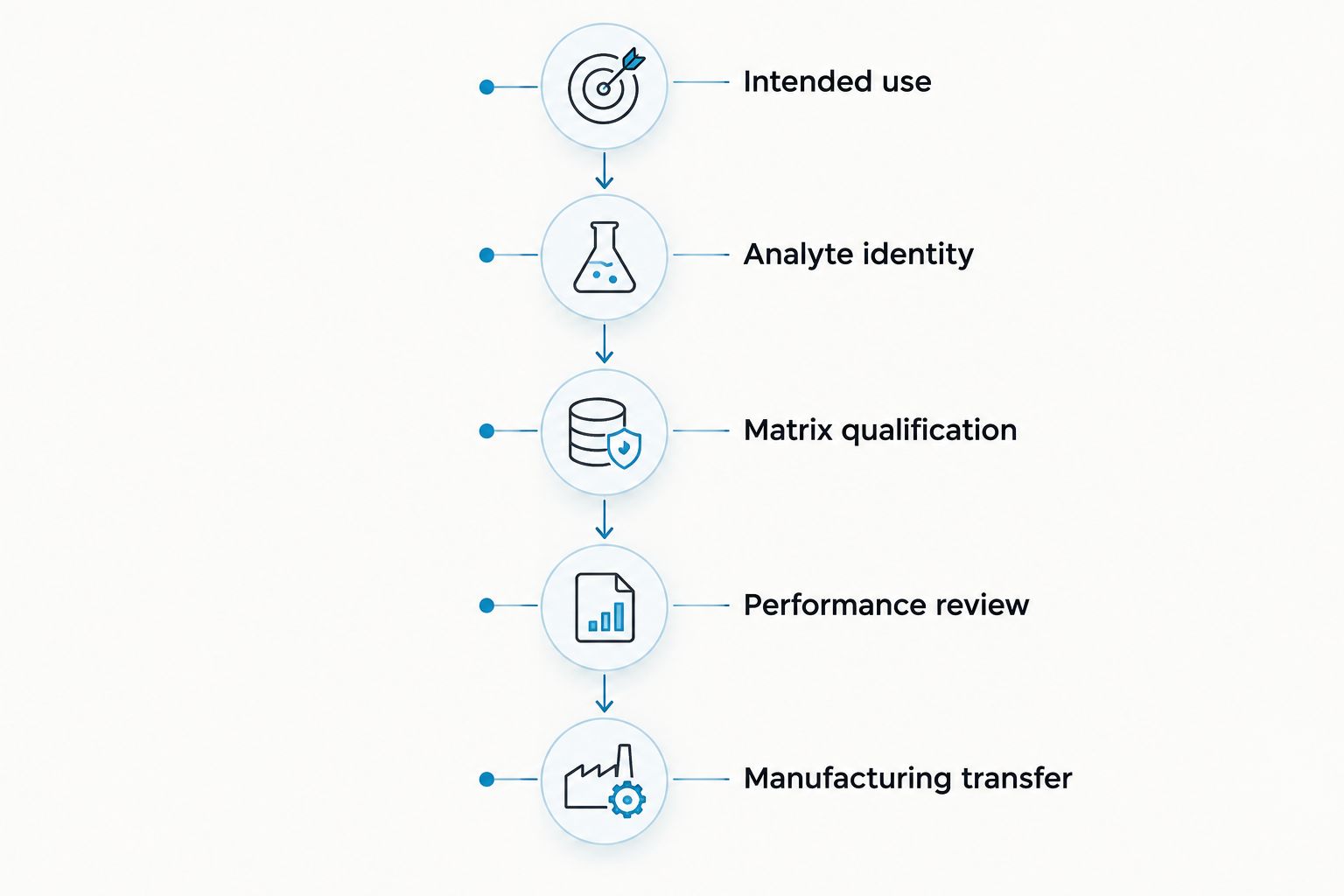
Use a staged review for your 2026 shortlist. Resolve scientific fit before investing in procurement or transfer discussions.
- Intended use: State whether the assay supports exploratory research, a defined study endpoint, or a diagnostic development program.
- Analyte identity: Specify the target, relevant molecular forms, and the biological question.
- Matrix qualification: Review specimen handling, dilution behavior, recovery, and relevant interference evidence.
- Performance review: Examine precision, quantification limits, calibration, and lot comparison data.
- Manufacturing transfer: For commercial programs, define specifications, release responsibilities, documentation, and change control.
Ask for acceptance criteria, not just descriptive statements. A reported detection limit does not tell you whether results near your study's relevant concentrations are sufficiently precise.
For lot consistency, request the comparison design and the acceptance rule. For a transfer project, agree on who supplies reference materials and who investigates a failed release result.
Check the usable plate capacity
A standard 96-well plate does not provide 96 reportable patient or research sample results when standards, controls, blanks, or replicates occupy wells. Build the plate map before planning sample allocation.
For an illustrative layout, 8 standards in duplicate occupy 16 wells. Two controls in duplicate occupy another 4 wells, leaving 76 wells for 38 samples in duplicate. This is a planning example, not a specification for any supplier's kit; follow the selected assay's instructions.
Check whether the assay requires additional blanks or other positions. Count reportable samples, not wells, when assessing whether the workflow fits your study.
How the shortlist is ranked
The recommendations separate four sourcing tasks: custom development, established research immunoassays, antibody-led investigation, and broader reagent procurement. The order does not claim measured superiority in sensitivity, precision, delivery, or manufacturing capacity.
Apply the six criteria above to the exact assay or project proposal. For commercial development, manufacturing responsibilities deserve explicit review; for an existing research assay, target-specific documentation and specimen evidence determine the fit.
Which cardiac biomarker manufacturer should you choose?
Choose the development route when no existing assay meets your specification. Choose an existing research kit when its documented performance matches your protocol. Those decisions require different supplier conversations.
For a commercial diagnostic program, start with an agreed development specification and manufacturing scope. For a research study, start with the analyte, matrix, and required measuring interval. Do not request an undifferentiated list of cardiac kits and select from product names alone.
Your 2026 request for information should ask each candidate for the same evidence. Comparable questions produce a defensible selection; incomparable brochures do not.
FAQ
What's the best way to compare ELISA kit manufacturers for cardiac biomarker testing?
Compare the exact assay's intended use, analyte, specimen evidence, quantification performance, and interference data. For custom development, also compare the proposed manufacturing scope and acceptance criteria.
Is Calbiotech a cardiac ELISA kit supplier or a development partner?
Calbiotech provides ELISA/CLIA development, custom conjugation, formulation, kitting, and manufacturing services. Qualify a cardiac biomarker project through target-specific feasibility and performance requirements rather than assuming a ready-made cardiac kit.
Can I use a research troponin ELISA to diagnose a heart attack?
A research-use troponin ELISA does not establish suitability for diagnosing a heart attack. Clinical use requires an appropriately authorized or otherwise applicable validated testing pathway and clinical interpretation.
Are BNP and NT-proBNP assays interchangeable?
BNP and NT-proBNP assays measure different analytes and are not interchangeable. Select the assay that matches your protocol and use interpretation appropriate to that analyte and method.
Does the lowest detection limit identify the best cardiac ELISA?
The lowest detection limit alone does not identify the best assay. Review quantification limits, precision at relevant concentrations, matrix effects, and specificity together.
How many samples can I run on a cardiac ELISA plate?
Sample capacity depends on the plate layout, calibration positions, controls, blanks, and replicate requirements. Calculate usable sample positions from the selected assay's instructions rather than treating every well as a separate sample result.
What should I request before transferring an ELISA to manufacturing?
Request agreed specifications, acceptance criteria, release responsibilities, documentation requirements, and change-control arrangements. Define reference materials and the process for investigating results that fail acceptance criteria.
One last thing
Cardiolipin is not cardiac troponin. Antibodies against cardiolipin belong to a different testing context from assays measuring myocardial injury markers. A cardiac-sounding product name is not evidence that the assay measures cardiac injury.
Write the exact analyte and intended use at the top of your supplier brief. That simple distinction prevents an irrelevant product from entering an otherwise careful evaluation.