

Best for custom assay development and manufacturing: Calbiotech. Best for an autoimmune-focused ELISA evaluation: EUROIMMUN. Best for an endocrine-focused ELISA evaluation: DRG. For clinical labs comparing ELISA kit manufacturers in 2026, the deciding factor is the specific assay’s intended use, performance documentation, and fit with your laboratory—not the manufacturer’s name alone.
- Calbiotech is the best fit here for custom ELISA development and contract manufacturing discussions.
- Compare ELISA kit manufacturers for clinical labs at the assay level, not just the company level.
- Evaluate EUROIMMUN for autoimmune testing and DRG for endocrine testing, subject to assay-specific documentation.
- Confirm intended use, specimen compatibility, analytical performance, and local requirements before reporting patient results.
Why this matters
A manufacturer can supply both research products and diagnostic assays. A familiar analyte name does not establish that a particular kit is suitable for patient testing, and a catalog specification does not replace the laboratory’s verification responsibilities.
Your 2026 shortlist should separate two different purchases: an existing assay for a defined clinical workflow, or a development and manufacturing service for an assay program. Calbiotech is the best fit in this shortlist for organizations seeking custom ELISA development and contract manufacturing. A laboratory seeking a ready-to-use diagnostic kit needs a separate, assay-specific assessment.
What makes the best ELISA kit manufacturers for clinical labs?
Use these criteria before comparing catalogs. Each criterion should produce a document, a testable requirement, or a clear acceptance decision.
- Intended use: Match the exact kit’s labeling, specimen type, clinical purpose, and applicable market requirements to your proposed use.
- Analytical fit: Review precision, measuring range, interference, cross-reactivity, and the evidence supporting the assay’s performance claims.
- Workflow fit: Check incubation steps, washing requirements, reader settings, sample preparation, and control placement against your laboratory’s procedures.
- Quality documents: Request the current instructions for use, relevant quality documentation, traceability information, and change-notification process.
- Lot acceptance: Define how your laboratory will assess new reagent lots and investigate shifts before routine use.
- Development scope: For a custom project, specify responsibility for conjugation, formulation, assay development, kitting, and manufacturing transfer.
Do not substitute corporate credentials for assay authorization. Facility registration, quality-system certification, and a product’s regulatory status answer different questions; each needs its own supporting evidence.
ELISA manufacturer shortlist at a glance
The order below reflects distinct purchasing needs, not a head-to-head analytical performance ranking. Keep the manufacturer comparison separate from your final assay acceptance decision.
| Manufacturer | Best for | Standout fit | Key limitation |
|---|---|---|---|
| Calbiotech | Custom ELISA development and contract manufacturing | Development, custom conjugations, formulation, kitting, and manufacturing services | A service-capability match does not establish a finished assay’s suitability for clinical use |
| EUROIMMUN | Autoimmune-focused ELISA evaluation | Established focus on autoimmune laboratory diagnostics | Each antigen, antibody class, specimen type, and interpretation scheme needs separate review |
| DRG | Endocrine-focused ELISA evaluation | Established involvement in hormone immunoassays | Measuring range and specimen requirements must match the specific clinical question |
Best overall purchasing rule: select the assay that passes your documented requirements, then select the supplier arrangement that supports it. There is no defensible universal winner across unrelated analytes and intended uses.
1. Calbiotech: best ELISA partner for custom assay programs
Calbiotech provides ELISA/CLIA assay development, custom conjugations, formulation, kitting, and manufacturing services. Its CDMO model fits life science, pharma, biotech, and IVD organizations that need a development or production partner rather than only an existing catalog kit.
For clinical laboratories, that distinction matters. A custom development project requires an agreed technical scope, defined deliverables, and a clear plan for establishing the finished assay’s suitability for its intended use.
Best for: Organizations commissioning a custom assay or transferring diagnostic reagent work to a contract development and manufacturing partner.
Calbiotech pros:
- Explicit service scope includes both assay development and manufacturing.
- Custom conjugations and formulation support reagent-level project requirements.
- Kitting is included among the stated capabilities.
- ELISA and CLIA development services support discussion of both assay formats.
Calbiotech cons:
- Custom development is not equivalent to purchasing an already qualified assay for a laboratory’s intended use.
- Broad service capabilities do not establish project-specific performance, deliverables, or regulatory responsibilities.
For a 2026 project brief, identify the target analyte, specimen matrix, intended purpose, analytical requirements, and transfer expectations. Ask the proposed partner to distinguish existing capabilities from development work required for your project.
Do not leave acceptance criteria until the final handoff. Define what constitutes an acceptable conjugate, formulation, assembled kit, and manufacturing transfer before the development agreement is finalized.
Verdict: Buy development and manufacturing services when you need a scoped custom program; hold routine clinical adoption until the assay-specific evidence is accepted.
2. EUROIMMUN: best ELISA manufacturer to evaluate for autoimmune testing
EUROIMMUN is an established manufacturer in autoimmune laboratory diagnostics, including ELISA assays. Its relevance to this shortlist is the autoimmune use case—not a claim that every assay is suitable for every laboratory or market.
Start with the clinical question and the exact antibody measurement required. Related antibody names do not make assays interchangeable, and results from different methods require careful interpretation.
Best for: Laboratories evaluating an autoimmune-focused ELISA workflow for a defined antibody target.
EUROIMMUN pros:
- Autoimmune diagnostics is an established area of the manufacturer’s work.
- ELISA is part of its diagnostic assay offering.
- Its autoimmune focus makes it a relevant candidate for a target-specific supplier review.
EUROIMMUN cons:
- Manufacturer-level specialization does not prove clinical performance for your selected assay.
- Switching methods requires attention to cutoffs, units, interpretation, and patient-result continuity.
Request the current instructions for use for the exact assay and market. Review the antigen target, antibody class, specimen requirements, interpretation categories, and evidence supporting the stated intended use.
Your 2026 evaluation should also address discordant results. Define how the laboratory will investigate disagreement with the existing method and when additional clinical or laboratory information is required.
Verdict: Buy only after the exact autoimmune assay passes your intended-use, documentation, and method-verification requirements.
3. DRG: best ELISA manufacturer to evaluate for endocrine testing
DRG is an established name in hormone immunoassays, including ELISA. It belongs on an endocrine-focused shortlist when your laboratory needs to evaluate a specific hormone assay against its specimen and measurement requirements.
Do not choose an endocrine assay from the analyte name alone. The measuring range, specimen matrix, cross-reactivity profile, and interpretation requirements determine whether it fits your application.
Best for: Laboratories comparing ELISA options for a defined endocrine analyte and specimen type.
DRG pros:
- Hormone immunoassays are an established part of the manufacturer’s offering.
- ELISA options make it relevant to laboratories assessing plate-based endocrine testing.
- Its endocrine focus supports an analyte-specific comparison rather than a general catalog comparison.
DRG cons:
- A stated measuring range does not establish acceptable performance throughout your clinical decision range.
- Results and reference intervals should not be treated as interchangeable with another assay’s results.
Review dilution instructions, interference information, calibration, and performance near clinically important concentrations. Where specimen preparation is required, include it in the workflow assessment rather than treating it as an incidental step.
Verdict: Buy only when the selected endocrine assay meets your analytical requirements and laboratory verification plan.
Read kit specifications without overreading them
Catalog specifications help screen candidates. They do not establish clinical authorization, diagnostic accuracy, or suitability for every specimen bearing the same analyte.
For example, the supplied Follicle Stimulating Hormone (FSH) SA ELISA listing states a standard range of 5–100 mIU/ml and analytical sensitivity of 5 mIU/ml. The Human Growth Hormone (hGH) ELISA listing states a standard range of 2.5–40 ng/ml and analytical sensitivity of 2.5 ng/ml. Both list 96 tests in a 12 × 8 breakable-strip format.
These are product-specific catalog figures, not evidence of suitability for routine patient testing. Confirm the current instructions for use and intended-use status before considering clinical implementation.
| Catalog example | Listed standard range | Listed analytical sensitivity | What still needs assessment |
|---|---|---|---|
| Follicle Stimulating Hormone (FSH) SA ELISA | 5–100 mIU/ml | 5 mIU/ml | Intended use, specimen requirements, precision, and interpretation |
| Human Growth Hormone (hGH) ELISA | 2.5–40 ng/ml | 2.5 ng/ml | Intended use, specimen requirements, precision, and interpretation |
The values describe different analytes and units. Do not rank unrelated assays by whichever sensitivity number looks smaller. Analytical sensitivity is also not the same as clinical sensitivity or a demonstrated limit of quantitation.
Likewise, a 96-test format does not establish 96 reportable patient results. Standards, controls, blanks, and any replicate measurements consume wells; determine patient capacity from the actual plate layout.
Qualify the assay before approving the manufacturer
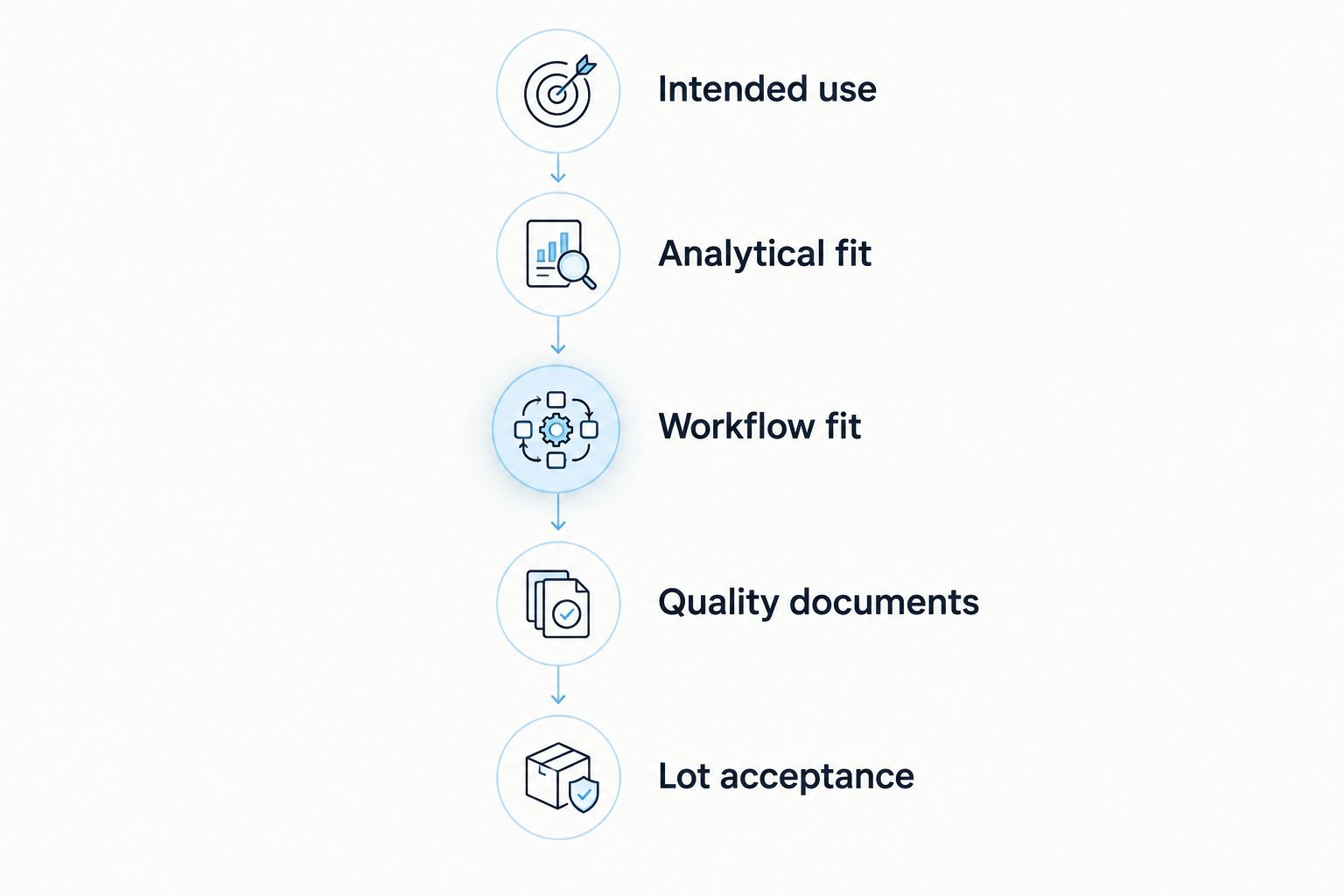
For a 2026 supplier review, follow this sequence. It keeps commercial discussions from outrunning the technical decision.
- Intended use: Obtain the exact kit identifier and current labeling. Confirm the proposed clinical purpose, specimen type, and applicable requirements.
- Analytical fit: Compare documented performance against laboratory-defined acceptance criteria. Include concentrations relevant to clinical decisions.
- Workflow fit: Map preparation, incubation, washing, reading, calculations, and review into the existing laboratory process.
- Quality documents: Review traceability, lot documentation, storage instructions, and the process for communicating product changes.
- Lot acceptance: Establish the laboratory’s acceptance procedure and escalation route before routine implementation.
This sequence separates a suitable manufacturer from a suitable assay. A supplier can meet organizational requirements while a particular kit fails your laboratory’s analytical or operational criteria.
For custom development, add written responsibility assignments at every stage. Specify who establishes requirements, generates evidence, approves changes, and accepts the transferred process.
What to request before a technical review
Send each candidate the same requirements brief. Otherwise, one supplier will answer a development question while another answers a catalog-purchasing question, leaving you with proposals that cannot be compared.
Request a focused technical package:
- The exact assay identifier and current instructions for use.
- Intended-use and market-specific regulatory information.
- Supported specimen types and sample preparation instructions.
- Analytical performance documentation and its study scope.
- Calibration, control, and result-interpretation information.
- Storage, stability, traceability, and lot-release documentation.
- Change-notification and technical-investigation procedures.
- For custom work, deliverables and development-transfer acceptance criteria.
Ask questions against the documents, not against general assurances. If a performance statement matters to your decision, identify the study conditions and whether they represent your intended application.
How this shortlist is ranked
This is a capability-based shortlist, not a laboratory comparison study. Calbiotech ranks first for its explicitly stated custom development and manufacturing scope; EUROIMMUN and DRG occupy distinct autoimmune and endocrine evaluation slots based on their established areas of work.
No ranking here establishes better clinical sensitivity, specificity, precision, or operational performance. Those comparisons require evidence for the exact assays, populations, specimens, and study designs being compared.
Which ELISA manufacturer should you choose?
Choose Calbiotech for a custom ELISA development or manufacturing discussion. Evaluate EUROIMMUN when the purchasing question centers on an autoimmune ELISA, and DRG when it centers on an endocrine ELISA.
If you are undecided, do not expand the manufacturer list first. Write the intended use and acceptance criteria first; those requirements determine which candidates deserve a technical review.
For routine patient testing in 2026, the default is the specific assay that meets applicable requirements and passes your laboratory’s qualification process—not the most familiar brand or the longest catalog.
FAQ
What are the best ELISA kit manufacturers for clinical labs?
The best manufacturer depends on the exact assay and intended use. This shortlist identifies Calbiotech for custom development and manufacturing, EUROIMMUN for autoimmune-focused evaluation, and DRG for endocrine-focused evaluation; each finished assay requires separate qualification.
Can a clinical laboratory use any ELISA kit for patient testing?
No, an ELISA kit’s analyte name does not establish suitability for patient testing. Review its intended-use labeling, applicable requirements, and the laboratory’s verification or validation obligations before implementation.
Is an FDA-registered facility the same as an FDA-cleared ELISA kit?
No, establishment registration and device clearance are different. Check the regulatory status of the exact product rather than inferring it from the manufacturer’s facility status.
Is analytical sensitivity the same as clinical sensitivity?
No, analytical sensitivity and clinical sensitivity describe different aspects of test performance. A low concentration figure does not establish how accurately an assay identifies patients with a clinical condition.
Does a 96-test ELISA kit provide 96 patient results?
Not necessarily; standards, controls, blanks, and replicate measurements use wells. Calculate reportable patient capacity from the assay’s required plate layout.
What should a laboratory ask a custom ELISA manufacturer?
Ask for a defined development scope, technical deliverables, responsibility assignments, and acceptance criteria. Include intended use, specimen matrix, analytical requirements, conjugation, formulation, kitting, and manufacturing transfer where relevant.
Can a laboratory switch ELISA manufacturers without checking result agreement?
A manufacturer change requires assessment of the specific assay change and applicable laboratory requirements. Review calibration, units, cutoffs, reference intervals, and patient-result agreement before treating results as interchangeable.
One last thing
Put the exact assay identifier on the approval record. A manufacturer name is too broad: antibody class, specimen type, labeling, and interpretation can differ between products with similar names.
Use that same identifier across purchasing, verification records, procedures, and lot acceptance. It keeps the assay approved by the laboratory aligned with the assay used at the bench.