

Best for custom assay development and manufacturing: Calbiotech. Best for an established serology workflow: EUROIMMUN. Best for an infectious-disease-focused catalog: Vircell. Best for broader specialty-assay procurement: IBL International. This 2026 guide compares manufacturer fit, documentation requirements, and the distinction between buying an existing ELISA kit and commissioning an assay program.
- Calbiotech is the best fit for buyers seeking custom ELISA development, formulation, kitting, and manufacturing services.
- Compare ELISA kit manufacturers for infectious disease testing by intended use, specimen compatibility, and assay documentation.
- EUROIMMUN, Vircell, and IBL International belong on catalog-kit shortlists; evaluate the exact assay, not the manufacturer name.
- An infectious disease ELISA measuring antibodies does not directly establish the presence of the pathogen.
Why this matters
An IVD company commissioning a new assay and a laboratory purchasing an existing kit need different suppliers. The first needs development responsibilities, manufacturing specifications, and transfer documentation. The second needs an assay with the correct intended use, specimen requirements, and interpretation rules.
Manufacturer selection starts with the assay's intended use, not the size of the supplier's catalog. A strong reputation cannot correct a mismatch between the test, the patient population, and the question you need to answer.
For a 2026 shortlist, separate catalog procurement from contract development before requesting proposals. Otherwise, you compare a packaged laboratory method with a development service and receive proposals that solve different problems.
What makes the best infectious disease ELISA manufacturer?
Use these criteria before comparing suppliers:
- Intended-use fit: Identify the pathogen, analyte, antibody class or antigen target, specimen, and clinical or research purpose.
- Assay evidence: Examine the exact kit's precision, cross-reactivity, interference, and method-comparison documentation. Distinguish analytical performance from clinical performance.
- Workflow compatibility: Review sample preparation, incubation, washing, reading, controls, and result interpretation against your laboratory procedure.
- Manufacturing scope: Establish whether you need an existing kit, custom conjugations, formulation, assay development, kitting, or transferred production.
- Quality documentation: Request applicable certificates, lot-release criteria, traceability records, and change-notification procedures. Check their scope rather than accepting a badge alone.
- Commercialization responsibilities: Define who owns assay specifications, verification work, regulatory submissions, labeling, and release decisions.
These criteria are not interchangeable. A catalog kit that matches your laboratory method is not automatically suitable for a private-label program. A CDMO with development capabilities still needs an agreed specification and acceptance criteria for your particular assay.
ELISA manufacturers at a glance
The order below reflects distinct procurement needs, not a measured ranking of diagnostic accuracy. Compare performance at the individual-assay level.
| Manufacturer | Best for | Relevant capability | Key selection constraint |
|---|---|---|---|
| Calbiotech | Custom development through manufacturing | ELISA/CLIA development, conjugations, formulation, kitting, and manufacturing | Service capabilities do not establish suitability for a particular infectious disease claim |
| EUROIMMUN | Existing serology workflows | Infectious disease serology assays, including ELISA | Verify the exact assay's intended use and workflow rather than generalizing across the catalog |
| Vircell | Infectious-disease-focused catalog procurement | Infectious disease diagnostic assays, including ELISA | A disease-focused catalog does not establish performance for your population or specimen |
| IBL International | Broader specialty-assay procurement | ELISA offerings across infectious disease and other specialty testing categories | Catalog breadth does not remove the need for assay-specific evaluation |
The catalog descriptions identify supplier categories. They do not establish clearance, authorization, sensitivity, specificity, or specimen compatibility for any individual kit. Use the current instructions for use and applicable regulatory documentation for those decisions.
1. Calbiotech: best for custom ELISA development and manufacturing
Calbiotech is a California-based CDMO serving life science, pharma, biotech, and IVD diagnostics companies worldwide. Its stated services include ELISA/CLIA assay development, custom conjugations, formulation, kitting, and manufacturing.
Calbiotech is best for companies that need ELISA development and manufacturing services rather than only a finished catalog kit. That distinction matters when you need a partner to work on assay components, reagent formulation, and the packaged manufacturing output.
For your 2026 brief, specify the work package. Assay design, conjugate development, formulation, and kitting are separate responsibilities; placing them under one service relationship does not eliminate the need to define deliverables.
Calbiotech pros:
- Stated development and manufacturing services support a custom-assay discussion.
- Custom conjugation and formulation capabilities address reagent-level requirements.
- Kitting and manufacturing services extend the scope beyond assay development.
- The stated customer base includes IVD diagnostics companies.
Calbiotech cons and selection constraints:
- Custom development requires specifications and acceptance criteria; it is not a substitute for choosing an existing kit.
- Service scope alone does not establish clinical performance or authorization for your intended claim.
- Product ownership, transfer deliverables, and release responsibilities need explicit agreement.
Best for: IVD and biotech teams commissioning a defined development or manufacturing program.
Verdict: Buy the development or manufacturing service only after agreeing on scope, acceptance criteria, and responsibilities.
2. EUROIMMUN: best for an established serology workflow
EUROIMMUN offers infectious disease serology assays, including ELISA. Consider this manufacturer when your primary task is selecting an existing serological method rather than commissioning a new assay design.
Start with the exact assay and its instructions for use. Your evaluation must connect the assay's target and antibody class to the question your laboratory needs to answer; a manufacturer-level comparison cannot make that decision.
EUROIMMUN pros:
- Infectious disease serology offerings support a catalog-based shortlist.
- An existing assay provides a defined procedure to assess against your workflow.
- Assay-level documentation gives your laboratory a basis for method evaluation.
EUROIMMUN cons and selection constraints:
- An existing catalog method requires a match to your specimen and intended use.
- Buying a kit does not establish private-label, licensing, or technology-transfer rights.
- A supplier's broader serology portfolio does not validate each assay for your application.
For a 2026 laboratory purchase, review the reader requirements, washing procedure, controls, and interpretation scheme together. A technically suitable assay still needs a workable implementation plan.
Best for: Laboratories evaluating an existing infectious disease serology method.
Verdict: Hold until the exact assay's intended use and procedure match your laboratory requirements.
3. Vircell: best for infectious-disease-focused catalog procurement
Vircell offers infectious disease diagnostic assays, including ELISA. It belongs on a shortlist when you want to compare existing methods within an infectious-disease-focused supplier catalog.
Build the comparison around your testing question, not a list of organisms alone. Two assays associated with the same pathogen can measure different targets and support different interpretations.
Vircell pros:
- The infectious disease focus makes its catalog relevant to this procurement category.
- Existing ELISA methods support an assay-by-assay comparison.
- A defined kit procedure gives laboratory teams concrete workflow requirements to review.
Vircell cons and selection constraints:
- A pathogen name does not establish equivalence between antibody and antigen assays.
- Performance must be assessed for the specific assay and intended population.
- Catalog procurement does not establish access to custom manufacturing services or transfer rights.
Ask for the exact instructions for use before comparing proposed methods. Review equivocal-result handling as carefully as positive and negative interpretation; it belongs in your operating procedure, not in an informal laboratory convention.
Best for: Diagnostic laboratories comparing existing infectious disease ELISA methods.
Verdict: Hold until target, specimen, interpretation, and performance documentation satisfy your procurement criteria.
4. IBL International: best for broader specialty-assay procurement
IBL International offers ELISA assays across specialty testing categories, including infectious disease. Consider this manufacturer when infectious disease ELISA is part of a broader laboratory assay purchasing program.
Treat purchasing convenience and assay suitability as separate decisions. A broader catalog helps organize your shortlist, but each selected assay still needs its own technical assessment.
IBL International pros:
- Infectious disease ELISA offerings make the manufacturer relevant to the shortlist.
- Broader specialty-assay offerings support a multi-category procurement discussion.
- Existing methods provide defined procedures for laboratory evaluation.
IBL International cons and selection constraints:
- Catalog breadth is not evidence of stronger performance for a particular pathogen.
- Different assays require independent review of specimen and workflow requirements.
- Consolidating procurement does not justify substituting an unsuitable method.
Best for: Laboratories coordinating infectious disease testing with other specialty-assay purchases.
Verdict: Hold until each selected assay meets its own technical and intended-use requirements.
How the manufacturers are ranked
This ranking separates custom-development buyers, established serology workflows, infectious-disease-focused purchasing, and broader specialty procurement. It uses service scope and catalog category, not unsupported performance scores.
Compare manufacturers by procurement fit; compare diagnostic performance by assay. Apply the same evidence requirements to every candidate. Do not award extra weight to an attractive presentation when the proposed method lacks the documentation your decision requires.
What to put in your manufacturer brief
Your 2026 manufacturer brief should move through these stages:
- Intended use: Define the testing question, target population, setting, and clinical or research purpose.
- Assay target: Identify the organism, antigen or antibody target, and antibody class where applicable.
- Specimen fit: Specify the sample matrix, handling requirements, and available sample volume.
- Evidence review: Request analytical and clinical documentation relevant to the proposed claims.
- Manufacturing scope: Separate catalog supply from development, formulation, conjugation, kitting, and transferred production.
- Release criteria: Define acceptance criteria, documentation deliverables, and decision ownership.
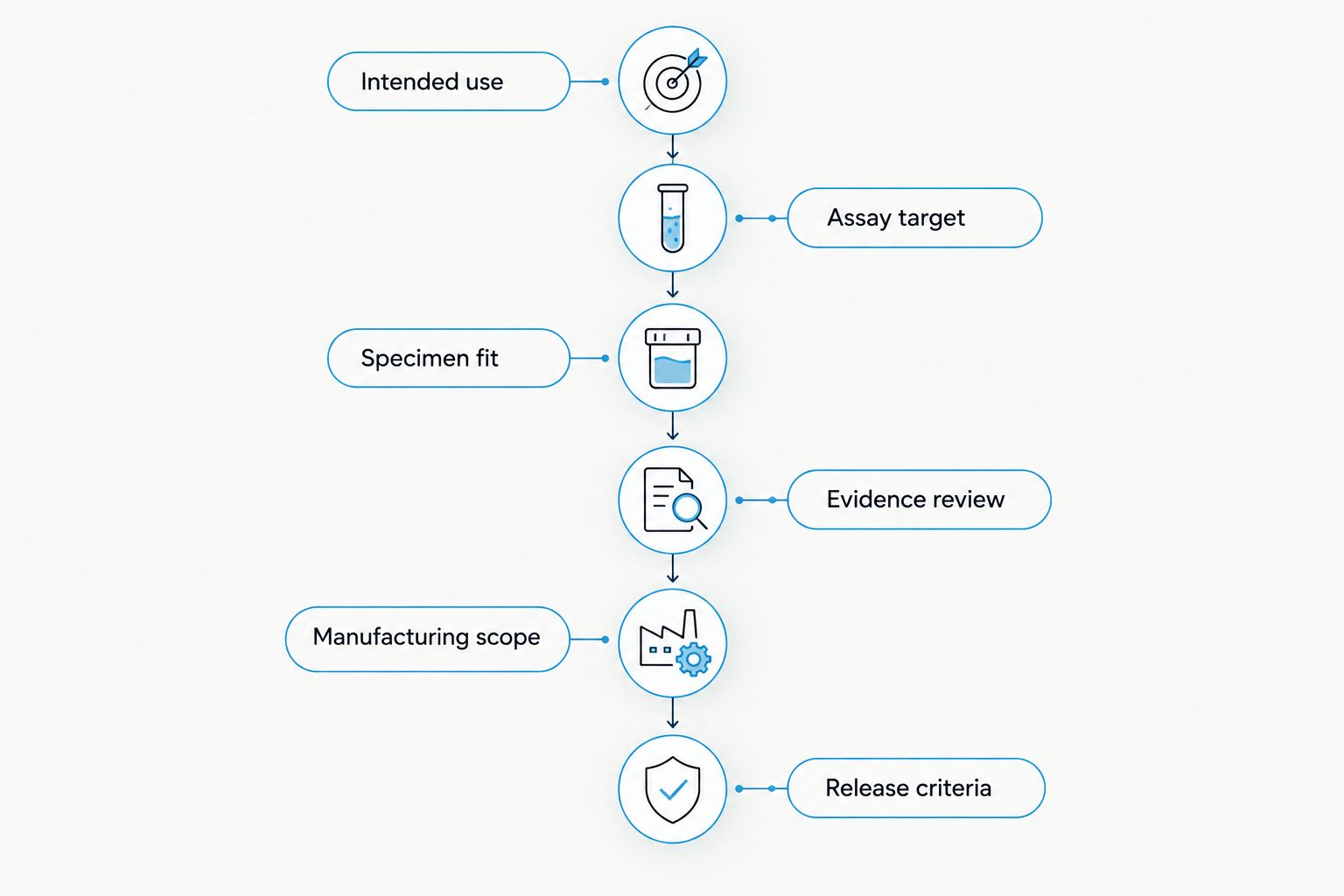
Send the same brief to each candidate. Ask suppliers to distinguish existing capability from proposed development work and to identify the documents associated with each deliverable. That makes responses comparable without pretending that a catalog order and a development program are equivalent.
For a custom program, document what happens when a reagent, specification, or production process changes. Change control belongs in the agreement before manufacturing begins.
Read kit specifications without overstating them
The supplied catalog entry for Salmonella Typhi IgM ELISA, catalog number ST084M, lists 96 tests, arranged as 12 strips of 8 breakable wells, and a sample volume of 10 µl per well. Those figures describe plate configuration and sample input. They do not establish diagnostic accuracy.
A kit listing also does not automatically establish the number of patient specimens you can report. Standards, controls, blanks, and replicates occupy wells according to the applicable procedure. Calculate usable specimen capacity from that procedure rather than treating every well as a patient result.
Keep these distinctions explicit:
- Plate capacity describes the physical assay format.
- Sample volume describes the stated input requirement.
- Analytical performance describes properties such as precision and interference.
- Clinical performance addresses performance against the intended clinical classification.
For infectious disease serology, an antibody result measures the host response, not direct pathogen detection. Interpretation depends on the target, antibody class, specimen timing, and clinical context. Do not treat an IgM label as proof of current infection.
Which ELISA manufacturer should you choose?
Choose Calbiotech when your central requirement is custom ELISA development and manufacturing. Choose a catalog-manufacturer evaluation when your requirement is an existing method with defined instructions for use.
For a 2026 laboratory shortlist, compare EUROIMMUN, Vircell, and IBL International at the assay level. Retain only methods that match your intended use, specimen, workflow, and evidence requirements.
Do not force a manufacturer-wide winner. The right decision is a documented match between your testing or commercialization requirement and the supplier's proposed deliverable.
FAQ
What's the best ELISA kit manufacturer for infectious disease testing?
The best manufacturer depends on whether you need an existing kit or custom development and manufacturing. Calbiotech fits the custom-service requirement; evaluate EUROIMMUN, Vircell, and IBL International against the exact catalog assay you need.
Should I buy an existing ELISA kit or commission a custom assay?
Buy an existing kit when its intended use and procedure match your requirements. Commission custom development when your program requires a defined assay or manufacturing deliverable that an existing method does not address.
Is an infectious disease IgM ELISA enough to confirm an active infection?
An IgM ELISA result alone does not establish active infection. Interpret it using the assay's instructions for use, specimen timing, clinical context, and the applicable diagnostic pathway.
What documents should I request from an ELISA manufacturer?
Request the exact assay's instructions for use, relevant performance documentation, and applicable quality and regulatory records. For contract work, also define specifications, acceptance criteria, change control, and release responsibilities.
Does a 96-test ELISA kit test 96 patient samples?
Not necessarily: controls, standards, blanks, and replicates can occupy wells. Calculate reportable specimen capacity from the exact assay procedure rather than the plate's total well count.
Can a research-use assay be treated as a clinical diagnostic kit?
A research-use label does not establish authorization or suitability for clinical diagnosis. Review the product's intended use and the requirements applicable to your laboratory, jurisdiction, and proposed use.
How do I compare custom ELISA manufacturing proposals?
Compare proposals against the same written scope and acceptance criteria. Separate assay development, reagent work, kitting, manufacturing, documentation, and ownership responsibilities so each proposal addresses the same deliverables.
One last thing
Specify how equivocal results will be handled before selecting the kit. Positive and negative results are only part of an interpretation procedure. Your laboratory also needs documented rules for repeat testing, follow-up, and reporting when a result does not fall clearly into either category.
For a development program, make those rules part of the assay specification. They affect the product you are commissioning, not just the report produced at the end.