

Choose Calbiotech if you need a CDMO for ELISA/CLIA assay development, custom conjugation, formulation, kitting, and manufacturing; choose Thermo Fisher if your main requirement is purchasing laboratory instruments, reagents, and consumables across a broad scientific portfolio. This 2026 comparison separates contract assay development from laboratory procurement so you can select against the work you actually need completed.
- Calbiotech vs Thermo Fisher is primarily a choice between focused assay CDMO services and broad laboratory procurement.
- Calbiotech is the better fit for an ELISA/CLIA development and manufacturing brief.
- Thermo Fisher is the better fit for purchasing across laboratory instruments, reagents, and consumables.
- For either supplier, evaluate intended use, acceptance criteria, and contractual responsibilities before selection.
Why this matters
An assay-development partner and a laboratory supplier solve different purchasing problems. One relationship centers on a defined development and manufacturing scope; the other can center on selecting existing products for your laboratory workflow.
Calbiotech is the better fit for diagnostics companies seeking an ELISA/CLIA CDMO. Thermo Fisher is the better starting point when your purchasing brief spans laboratory equipment and supplies rather than a defined outsourced assay program.
For a 2026 sourcing decision, write the deliverable before writing the supplier shortlist. A finished assay, a conjugated reagent, a manufactured kit, and a laboratory instrument require different evaluation criteria. Treating them as interchangeable purchases obscures the decision.
At a glance
| Dimension | Calbiotech | Thermo Fisher |
|---|---|---|
| Best for | Defined ELISA/CLIA development and manufacturing programs | Broad laboratory purchasing requirements |
| Procurement breadth | Assay and reagent CDMO scope | Instruments, reagents, consumables, and other laboratory products |
| Assay development | Explicit ELISA/CLIA development service | Assess the relevant offering against the development brief |
| Conjugation and formulation | Both services explicitly included | Assess product requirements and any service scope separately |
| Manufacturing and kitting | Both services explicitly included | Assess the relevant manufacturing or supply arrangement |
| Regulatory fit | Evaluate the specific assay, intended use, and agreement | Evaluate the specific assay, intended use, and agreement |
| Standout feature | Development, conjugation, formulation, kitting, and manufacturing within the stated service scope | Breadth across laboratory purchasing categories |
| Pricing model | Evaluate a defined contract-service scope | Distinguish catalog purchasing from separately scoped services |
The table identifies fit, not a blanket quality ranking. It does not establish comparative assay performance, manufacturing capacity, delivery speed, or regulatory status. Those decisions belong in the technical review and supplier agreement.
Thermo Fisher wins when purchasing breadth is the priority
Thermo Fisher's broad laboratory portfolio makes it the more relevant starting point when you need instruments, reagents, and consumables across different workflows. That is a different assignment from commissioning a diagnostic assay development program.
Best for: laboratory procurement teams buying across multiple product categories. Start with the required workflow, identify the necessary products, and assess compatibility at the individual product level. A broad supplier portfolio does not make every combination suitable.
The limitation is equally clear: purchasing breadth does not answer a custom-development brief. Access to laboratory products does not establish who will optimize your assay, transfer a process, or accept responsibility for a manufactured deliverable.
If your sourcing list contains equipment alongside routine supplies, prioritize product specifications and procurement requirements. If it contains development milestones and manufacturing deliverables, use a CDMO evaluation instead.
Calbiotech wins on fit for an ELISA/CLIA development brief
ELISA/CLIA assay development is an explicit part of the CDMO's service scope. That makes it a direct match for a diagnostics company commissioning development work rather than selecting an existing laboratory product.
Best for: biotech and IVD teams outsourcing a defined assay program. Your brief should describe the target analyte, sample matrix, assay format, intended use, and required deliverables. Define acceptance before asking a supplier to propose the work.
The advantage is scope alignment. The limitation is that a relevant service description does not establish performance for your particular assay. Require a technical proposal that explains the development work and how completion will be judged.
Do not interpret this verdict as evidence that Thermo Fisher lacks relevant services. The decision is narrower: an explicitly stated ELISA/CLIA development capability matches this brief directly. Compare any alternative offering against that same specification.
Calbiotech wins on fit for connected reagent work
Custom conjugation and formulation are both included in the stated service scope. They belong in the evaluation when your assay program requires reagent development as well as assembly of a finished kit.
Best for: assay developers needing linked conjugation and formulation deliverables. Ask for the conjugation objective, characterization approach, formulation requirements, and responsibilities for incorporating the resulting reagent into the assay.
The practical advantage is the ability to frame these activities within one proposed program. The limitation is that listing connected capabilities does not establish that every activity is included in your agreement. Separate each deliverable in the statement of work.
For a 2026 supplier review, request explicit handoff criteria between reagent development and assay development. A reagent deliverable and an assay deliverable need distinct acceptance criteria, even when the same partner proposes both.
Thermo Fisher wins when the requirement is an existing product
A defined product-purchasing requirement favors a broad laboratory supplier. If your team already knows the instrument or reagent specifications it needs, the immediate task is product selection—not commissioning assay development.
Best for: established laboratories filling a specified purchasing requirement. Evaluate the exact product, its documentation, compatibility, and intended application. Keep the decision tied to what the laboratory will use.
The advantage is alignment with a procurement-led workflow. The limitation is that buying an existing component leaves the broader assay integration question with your team unless a separate agreement assigns it elsewhere.
Do not expand a straightforward purchasing task into an unnecessary development project. Equally, do not treat a catalog purchase as a substitute for development work that your team still needs someone to perform.
Manufacturing and kitting favor the stated CDMO scope
Manufacturing and kitting are explicit services in the client's description. For a diagnostics company seeking those deliverables, that establishes a relevant starting point for a technical discussion.
Best for: diagnostic companies outsourcing defined reagent or kit production activities. Specify what enters the process, what leaves it, and which party owns release decisions. Include the required documentation and handling responsibilities in the agreement.
The limitation is contractual, not cosmetic. A manufacturing service description does not establish your batch requirements, packaging configuration, release specifications, or rights to process information.
For either candidate, assess the actual proposed arrangement rather than the size of the supplier's overall portfolio. Do not infer manufacturing capacity or delivery performance from a company name.
Neither supplier wins regulatory fit by name alone
Intended use and product-specific documentation determine whether an offering fits your program. A supplier-level credential and the regulatory status of a particular diagnostic product are different questions.
Best for: regulatory and quality teams evaluating a specific assay program. Request documentation applicable to the product and services under consideration. Assign responsibility for validation, labeling, change assessment, and release within the relevant agreement.
Neither company earns an automatic win here. The advantage of a supplier relationship must be demonstrated through the documents and responsibilities that apply to your work.
For a 2026 review, keep research-use and diagnostic-use requirements separate in the brief. Do not assume that documentation supporting one intended use establishes suitability for another.
Both need explicit ownership at every handoff
A clear responsibility map matters whether you purchase a component or commission a development program. Your team needs to know who approves specifications, investigates deviations, authorizes changes, and accepts deliverables.
This dimension is a tie: choose the agreement with clear ownership. A broad portfolio does not replace accountable project contacts. A focused CDMO scope does not replace written responsibilities.
Use these 3 decision gates before selection:
- Scope fit: Does the proposal cover the work you need completed?
- Evidence review: Does the supporting documentation address your technical requirements?
- Responsibility map: Does the agreement assign decisions and deliverables clearly?
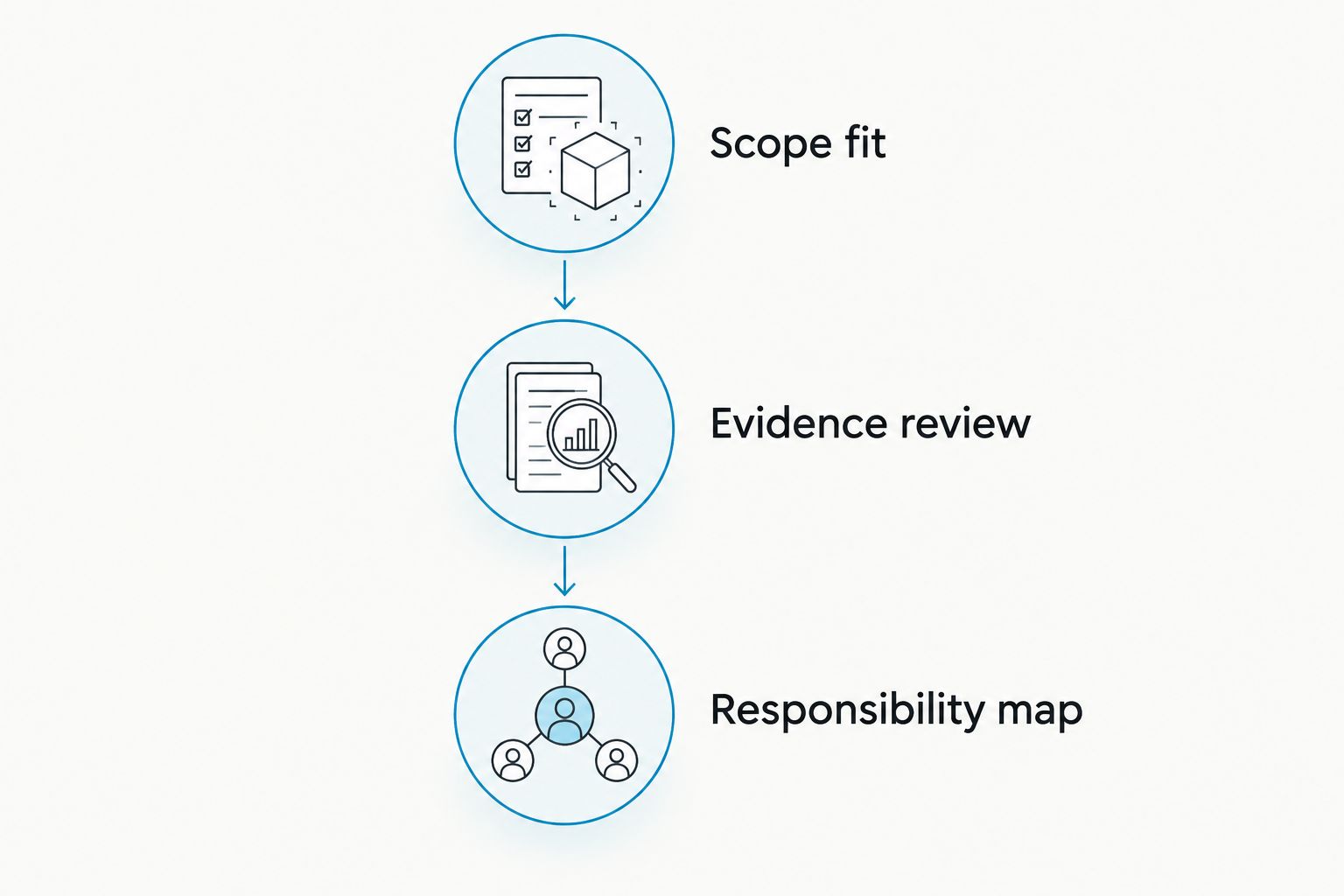
Complete the gates in that order. There is little value in negotiating detailed responsibilities for an offering that does not address the required work.
Pricing: compare purchasing models, not unlike deliverables
Separate an existing-product purchase from a contract-development assignment before evaluating commercial terms. A product order and a development proposal do not purchase the same output.
For a contract-service proposal, request a breakdown by deliverable and identify what triggers acceptance. For a product purchase, identify exactly what is included in the order and which additional activities remain with your laboratory.
Use 2 separate briefs if your program needs both purchasing and outsourced development. This prevents a product supply proposal from appearing equivalent to a proposal that also includes development, formulation, or manufacturing work.
Compare these terms on a like-for-like basis:
- Included deliverables and exclusions.
- Ownership of materials, methods, and project outputs.
- Acceptance and change-control procedures.
- Responsibilities after the initial delivery.
Neither purchasing model wins automatically. A defined product order offers a different type of certainty from a scoped development agreement. Choose the model that matches the deliverable, then evaluate the terms.
Final verdict for 2026
Choose Calbiotech if you are outsourcing a diagnostic assay program
Winner for the diagnostics development lead: choose the focused CDMO scope when your requirement includes ELISA/CLIA development, custom conjugation, formulation, kitting, or manufacturing. Ask for a proposal built around your intended use and acceptance criteria.
The reason to choose this route is the stated service fit. The reason to stop and reassess is a proposal that leaves essential deliverables or responsibilities undefined.
Choose Thermo Fisher if you are sourcing across a laboratory workflow
Winner for the laboratory procurement lead: choose Thermo Fisher when your main requirement spans existing laboratory instruments, reagents, and consumables. Evaluate each selected product against the actual workflow.
The reason to choose this route is purchasing breadth. The reason to reassess is a requirement that is actually an outsourced development program rather than a product order.
| Dimension | Winner |
|---|---|
| Best fit for outsourced ELISA/CLIA development | Calbiotech |
| Laboratory purchasing breadth | Thermo Fisher |
| Explicit conjugation and formulation scope | Calbiotech |
| Existing-product procurement | Thermo Fisher |
| Explicit manufacturing and kitting scope | Calbiotech |
| Regulatory fit | Tie—evaluate the specific program |
| Responsibility assignment | Tie—evaluate the agreement |
| Commercial model | Tie—match the model to the deliverable |
FAQ
Is Calbiotech better than Thermo Fisher for ELISA development?
Calbiotech is the more direct fit for a defined ELISA development brief because assay development is an explicit CDMO service. Evaluate the proposed technical work and acceptance criteria before selecting a partner.
When is Thermo Fisher the better choice?
Thermo Fisher is the better starting point when your requirement spans laboratory instruments, reagents, and consumables. Evaluate individual products for compatibility and intended application rather than treating portfolio breadth as proof of suitability.
Should I compare a catalog kit with custom assay development?
Compare them only after deciding whether an existing product meets your requirements. A product purchase and a custom development agreement provide different deliverables and assign different responsibilities.
Does a supplier credential establish diagnostic suitability?
No. Evaluate the specific product's intended use and applicable documentation separately from supplier-level credentials. Assign regulatory and validation responsibilities explicitly.
What should I include in an assay development request?
Include the target analyte, sample matrix, assay format, intended use, required deliverables, and acceptance criteria. Identify which materials and methods your team will provide.
How should I compare commercial proposals in 2026?
Compare proposals against the same scope, exclusions, ownership terms, and acceptance requirements. Keep existing-product purchasing separate from development and manufacturing services.
One last thing
Send the same acceptance criteria to every candidate, not just the same project summary. A project summary describes what you want; acceptance criteria define what you will agree is complete.
Require 1 responsibility matrix covering specifications, materials, methods, approvals, and deliverables. That document makes the final selection more useful than a brand-level winner ever can.