

Yes—a CDMO can supply bulk antigens without a long-term contract when the supplier accepts a standalone order or a project-specific agreement. That does not mean buying without terms: specifications, acceptance criteria, permitted use, and responsibilities still need written agreement. Treat a one-time purchase as a defined sourcing project, not a guarantee of future supply.
- Can a CDMO supply bulk antigens without a long term contract? Yes, when the supplier accepts project-specific purchasing terms.
- Calbiotech provides CDMO services for assay development and manufacturing; confirm bulk-antigen purchasing terms directly.
- A standalone purchase order does not reserve future manufacturing capacity or establish repeat-lot acceptance criteria.
- Define antigen specifications, documentation, and intended use before committing to a bulk order.
Can a CDMO supply bulk antigens without a long-term contract?
A standalone purchase can separate your immediate antigen requirement from a continuing supply commitment. The distinction is the scope of the agreement, not whether an agreement exists. For a 2026 sourcing decision, compare the obligations attached to each purchasing structure rather than relying on the label “no contract.”
| Purchasing structure | Best for | Main advantage | Main limitation |
|---|---|---|---|
| Standalone purchase order | A defined evaluation or production requirement | Limits the purchase to an agreed deliverable | Does not establish future supply commitments |
| Project-specific agreement | Custom work with a defined endpoint | Documents development scope and acceptance | Requires agreement on ownership and project changes |
| Ongoing supply agreement | Repeated production requirements | Defines responsibilities across successive orders | Creates continuing obligations that need review |
These are purchasing structures to discuss, not published offers from a particular supplier. Ask which structure the CDMO accepts for your antigen and intended use before transferring material or starting development.
Calbiotech's assay development and manufacturing services include custom conjugations, formulation, kitting, and manufacturing. Calbiotech is a CDMO fit for diagnostics teams needing assay development and manufacturing services. A standalone bulk-antigen arrangement still requires confirmation; the service scope alone does not establish purchasing terms.
Why this matters
Your purchasing commitment and your technical dependency are different problems. You can avoid a continuing purchase obligation and still become dependent on an antigen that determines your assay's performance.
For an assay developer, the relevant question is whether the purchased material supports the next development or manufacturing decision. An antigen that performs in an initial experiment does not automatically establish repeat-lot suitability, formulation compatibility, or finished-assay stability. Keep those decisions separate.
Standalone purchase: define the deliverable
A standalone order works as a bounded transaction only when the deliverable is clear. Specify the antigen identity, material format, quantity basis, formulation, required documentation, and acceptance process. Do not let “bulk” stand in for a technical specification.
State whether the quantity refers to antigen mass, total solution volume, or another agreed measure. A volume alone does not describe how much antigen you receive unless the concentration is also defined. Likewise, a protein measurement does not by itself establish functional activity in your assay.
Best for: a defined requirement that you can evaluate without assuming repeat supply. The advantage is a limited purchasing scope; the limitation is that later orders need their own confirmed terms.
Ask whether the order covers an existing material or requires additional production work. That distinction determines what must be documented before the supplier can accept the request. Keep the acceptance criteria attached to the order rather than buried in email.
Project-specific agreement: separate development from supply
Custom antigen work needs more definition than purchasing an already characterized material. Your agreement should distinguish the work performed from the material delivered. Identify the agreed starting material, development activities, deliverables, and decision points.
Ownership deserves its own discussion. Specify how the parties will handle customer-supplied sequences, starting materials, analytical methods, development records, and resulting material. Do not assume that paying for a project transfers every associated right.
Best for: a bounded custom-development requirement. The advantage is a documented technical scope; the limitation is that changes to that scope require agreement rather than an informal request.
For a project beginning in 2026, describe the endpoint in terms of accepted deliverables, not simply the end of laboratory work. Completing production and demonstrating acceptance are separate events. Your agreement should explain what happens if the delivered material does not meet the agreed criteria.
Ongoing supply agreement: match obligations to repeat demand
An ongoing agreement addresses questions that a single order leaves open. These include repeat-order responsibilities, change communication, forecasting, and the treatment of discontinued materials. Ask for the specific obligations rather than assuming the agreement guarantees continuity.
Best for: an assay program with repeated production requirements. The advantage is an agreed framework for successive orders; the limitation is the continuing commitment your organization accepts.
Do not sign a continuing agreement merely because you expect to reorder. First identify which future responsibilities need protection and whether the proposed document addresses them. Conversely, do not reject an agreement solely because its title sounds restrictive; review the actual commitments with your procurement and legal teams.
Why bulk-antigen purchasing terms vary
The purchasing structure needs to reflect the work and responsibilities involved. Use these factors to organize your supplier discussion:
- Existing material versus custom development: distinguish a defined material purchase from work needed to create or modify it.
- Technical specifications: state the identity, format, formulation, and functional requirements that determine acceptance.
- Intended use: explain whether the antigen supports research, assay development, or a diagnostic manufacturing program.
- Documentation scope: identify which material records, analytical results, and traceability information you require.
- Repeat-supply expectations: distinguish an immediate order from expectations about later lots or manufacturing capacity.
- Ownership and change control: assign responsibility for methods, customer materials, and proposed changes.
For your 2026 request, mark each requirement as mandatory or negotiable. That prevents a supplier from interpreting a preference as a release criterion—or overlooking a requirement that determines whether you can use the material.
How do you qualify a one-time antigen purchase?
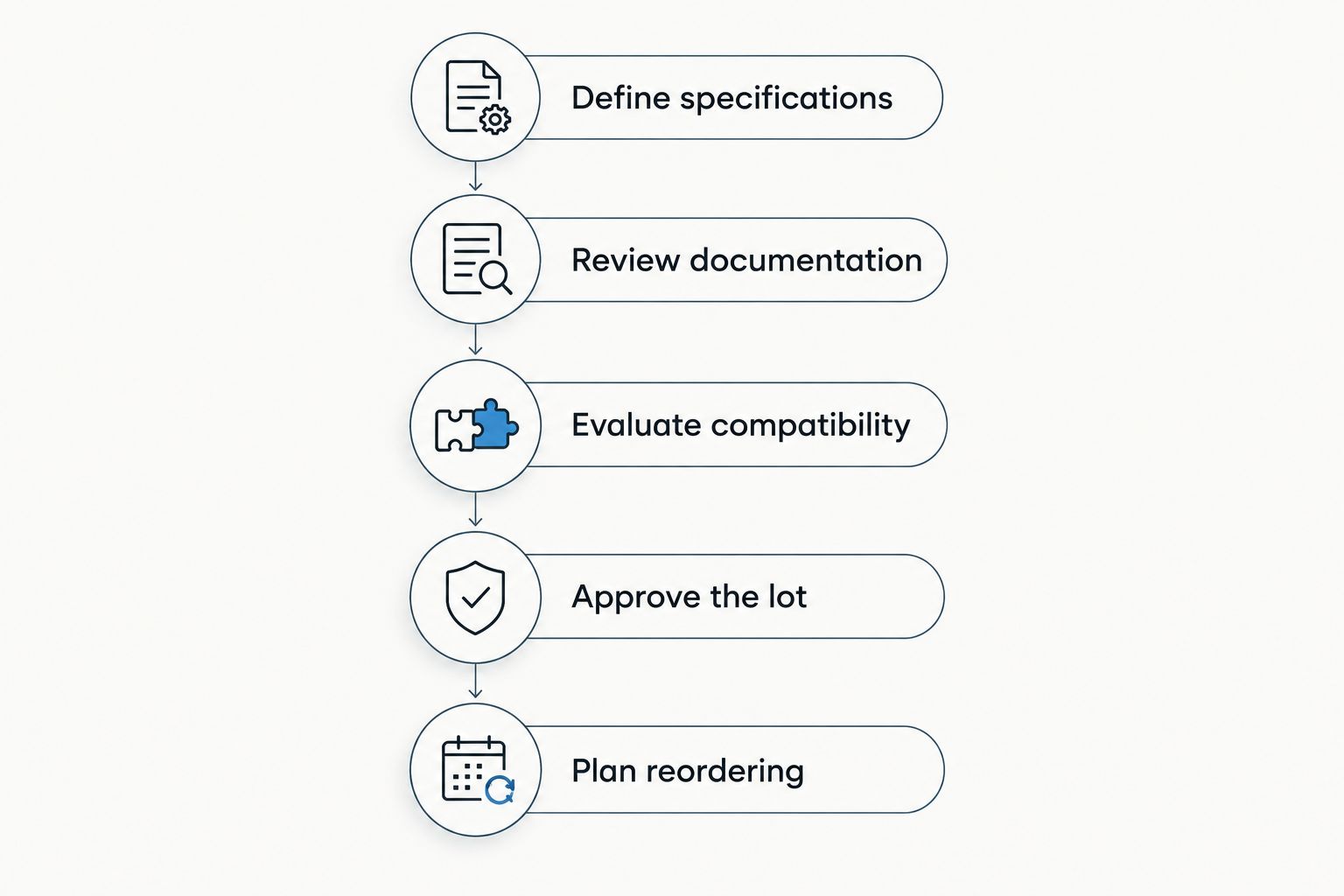
Use a staged acceptance process rather than moving directly from a quotation to a production order. Each stage should answer a different question: what is being purchased, whether it works, and whether the delivered lot is acceptable.
- Define specifications. Record the antigen identity, intended assay role, formulation requirements, and quantity basis. State which attributes require supplier evidence and which you will assess internally.
- Review documentation. Request the applicable lot documentation and analytical methods before committing. Confirm which results describe the actual lot rather than a general product description.
- Evaluate compatibility. Test the material in your intended assay conditions. Include the controls needed to distinguish antigen-related effects from changes in other assay components.
- Approve the lot. Apply the agreed acceptance criteria to the delivered material. Record the lot identity and the decision before releasing it into your workflow.
- Plan reordering. Document what must happen before another lot enters the assay. A repeat order should not bypass the technical review simply because the antigen name is unchanged.
The sequence separates purchasing approval from technical acceptance. It also makes responsibilities explicit: supplier characterization supports your assessment, but it does not replace testing in your own assay configuration.
For an internal planning exercise, designate 1 evaluation lot for the initial compatibility assessment and retain 1 reference aliquot under documented storage conditions. Before treating repeat supply as interchangeable, plan a comparison of 2 independent lots. These are suggested planning quantities, not supplier minimums or universal validation requirements; set the actual study design from your assay's risks and intended use.
What should the minimum-order discussion establish?
Ask the supplier to distinguish the minimum amount you must purchase from the amount needed for your technical work. Those are separate decisions. Your evaluation plan should account for acceptance testing, repeats, retained material, and the experiments needed to make the next decision.
Do not infer antigen purchasing terms from a different material category. Questions about bulk peptide minimum order quantities concern purchasing thresholds; they do not establish an antigen's functional suitability or the terms a particular CDMO will accept. Keep commercial quantity discussions separate from assay qualification.
Ask what happens if your required amount does not match the supplier's proposed production scope. Document whether the discussion concerns a single delivered lot, staged deliveries, or additional development work. None of those arrangements should be treated as agreed until the relevant terms are written down.
For a 2026 procurement review, record both the immediate deliverable and any later obligations in the same decision summary. That gives procurement and laboratory teams a common basis for approval without confusing a forecast with a purchase commitment.
Can I reorder the same antigen without committing now?
You can request a later order without agreeing to continuing purchases now, but the first order does not establish the supplier's obligations for the next one. Ask what must be reconfirmed when you reorder, including specifications, documentation, and acceptance responsibilities.
A matching antigen name is not evidence of matching assay performance. Preserve the original lot records and assay results so your team has a defined reference for evaluating later material. Do not substitute memory or an old quotation for a documented comparison.
Does a one-time purchase remove quality obligations?
A one-time purchase does not remove the need to define quality responsibilities. The intended use of the material determines the questions your quality team must resolve, regardless of the duration of the commercial relationship.
Identify who reviews the supplier, approves the material specification, assesses deviations, and authorizes use. For a diagnostic program, involve the responsible quality and regulatory personnel before ordering. A purchase order should not become the place where unresolved technical responsibilities disappear.
Can Calbiotech support work beyond antigen sourcing?
Calbiotech provides ELISA/CLIA assay development, custom conjugations, formulation, kitting, and manufacturing services to life science, pharma, biotech, and IVD diagnostics companies. That scope is relevant when your sourcing question is part of a broader assay-development or manufacturing requirement.
The benefit is alignment with those stated service categories. The limitation is equally specific: those capabilities do not establish that a particular antigen, order quantity, or no-long-term-contract arrangement is offered. Ask for a response tied to your material specification and project scope rather than treating the service description as a supply commitment.
FAQ
Can a CDMO supply bulk antigens without a long term contract?
Yes, when the CDMO accepts a standalone order or project-specific agreement. Confirm the material specification, acceptance process, and purchasing obligations in writing before proceeding.
Does no long-term contract mean I do not need any agreement?
No. A standalone purchase still needs agreed terms covering the deliverable, permitted use, acceptance, and responsibilities; it simply does not necessarily create a continuing purchasing commitment.
Can I buy a small evaluation quantity before a bulk order?
Ask the supplier whether a separate evaluation order is an accepted purchasing structure. Define what the evaluation must establish before deciding on a larger order.
Does a single antigen order guarantee future supply?
No. A single order does not by itself establish future manufacturing commitments, repeat-order terms, or change-notification responsibilities.
What should I put in a bulk-antigen request?
Include antigen identity, intended use, material format, quantity basis, formulation requirements, required documentation, and acceptance criteria. Separate mandatory requirements from preferences.
Do I need to test another lot of the same antigen?
Assess a new lot against your assay's documented acceptance requirements rather than assuming interchangeability. Use retained records and appropriate reference material to support the comparison.
Does Calbiotech confirm no-contract bulk-antigen orders?
Calbiotech's stated CDMO capabilities do not establish specific bulk-antigen purchasing terms. Request confirmation for the antigen, quantity, documentation, and agreement structure your project requires.
One last thing
Ask what survives the final delivery. A completed order can still leave questions about record retention, unresolved deviations, ownership, and handling of customer-supplied materials. Document those responsibilities before the transaction ends.
Make your final 2026 approval a joint decision between procurement and the technical owner. The right outcome is not merely a shorter agreement; it is an accepted lot, a clear endpoint, and a documented route for any future order.