

Batch release testing for ELISA kit lots checks representative finished-kit samples against approved performance specifications, then combines those results with manufacturing-record review before an authorized release decision. In 2026, a passing assay run alone does not establish that a lot is ready for distribution. Release also requires resolution of relevant deviations, confirmation of component traceability, and documented approval under the manufacturer's quality procedures.
- How does batch release testing work for ELISA kit lots? Test, review, investigate, and document disposition.
- ELISA lot acceptance criteria must be approved before testing; passing controls alone do not establish complete lot conformity.
- Calbiotech provides contract ELISA development and manufacturing; define release responsibilities explicitly when outsourcing.
- Batch release confirms lot conformity at release; stability studies support performance throughout the claimed shelf life.
How does batch release testing work for ELISA kit lots?
An ELISA kit lot is released when its required testing and records satisfy the approved release requirements. The decision belongs to the authorized quality function, not to the plate reader or an inventory-status change.
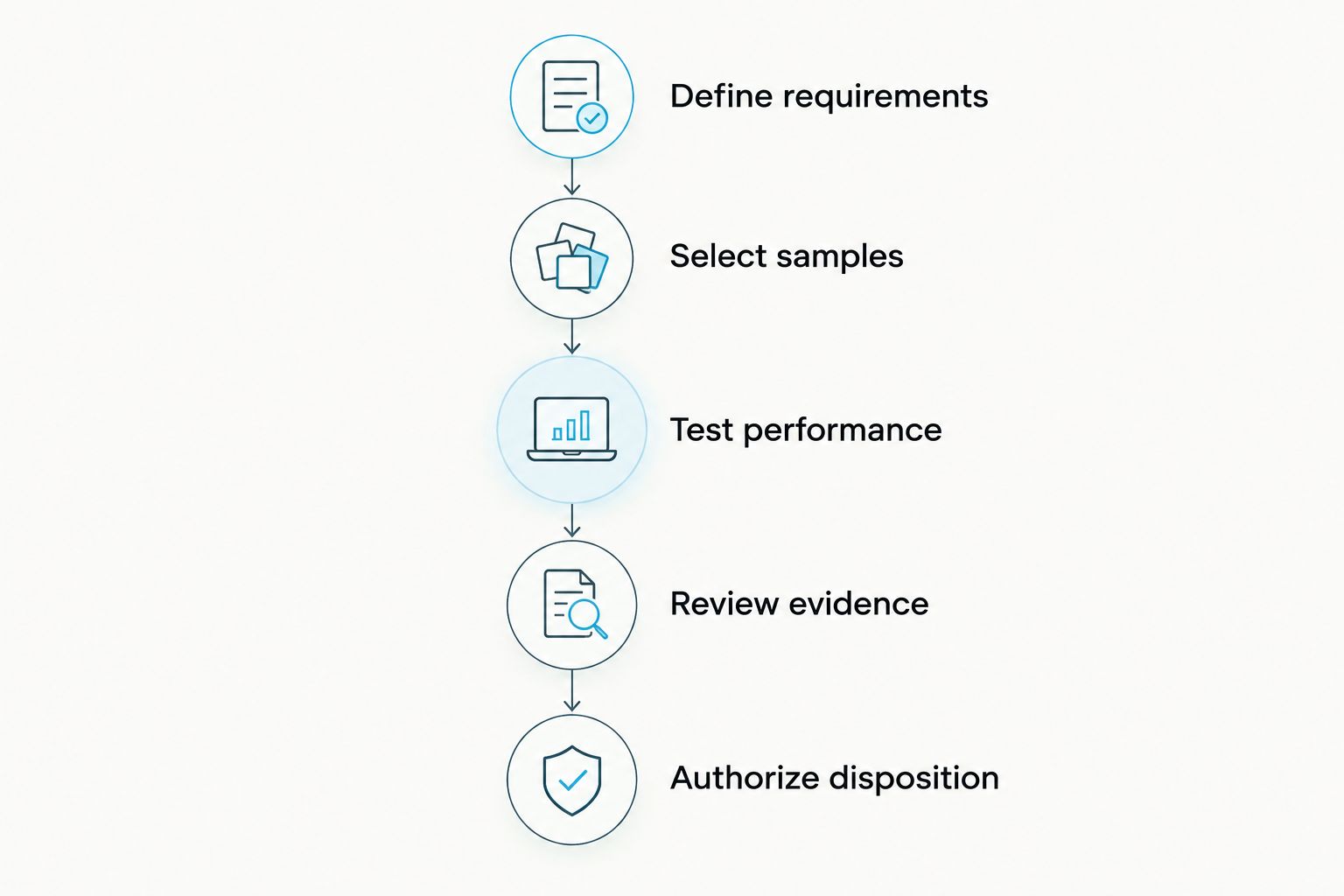
The following sequence separates testing from disposition. For the system handoff, see automatically triggering batch release testing when ELISA lots complete.
1. Define requirements
Start with an approved, product-specific release specification. Identify the test methods, sampling instructions, acceptance criteria, required records, and authorized approver before collecting release data.
Distinguish run validity from product acceptance. Run-validity criteria establish whether the analytical run can be interpreted; lot-acceptance criteria establish whether the manufactured product meets its specifications. A valid run can still produce a failing lot result.
For outsourced manufacturing, assign ownership of specifications, testing, deviation approval, and final disposition in the quality agreement. Do not leave release authority implicit.
2. Select samples
Use the approved sampling plan to select finished kits or components representing the defined lot. Record sample identity and its relationship to the manufacturing batch, filling operation, and kit assembly records.
Where a kit combines separately manufactured components, preserve those relationships. A kit-level identifier should connect the plate, conjugate, calibrators, controls, and other applicable reagents to their source records. Sampling requirements must reflect the product and manufacturing process; there is no universal ELISA sampling quantity that applies to every lot.
3. Test performance
Run the approved method using the specified equipment, controls, sample panel, and data-analysis procedure. Follow the prescribed incubation, washing, preparation, and reading conditions rather than adjusting the method to obtain an acceptable result.
Record the raw signal and the calculated result. For assays using acid-stopped TMB substrate, absorbance is commonly read at 450 nm, but the product method determines the actual reading conditions. Retain plate maps and calculation settings so a reviewer can reconstruct how each reported result was obtained.
4. Review evidence
Compare every required result with its approved acceptance criterion. Review manufacturing and packaging records alongside the analytical results, including relevant component identities, equipment status, deviations, and label reconciliation.
A reviewer should be able to connect the reported result to the tested sample and the sample to the manufactured lot. Missing traceability is not repaired by a satisfactory standard curve. Treat completeness and data integrity as release requirements, not administrative cleanup after approval.
5. Authorize disposition
The authorized reviewer determines whether the lot meets release requirements or requires continued hold, investigation, rejection, or another disposition permitted by the quality system. Document the decision and its supporting evidence.
Make the approved status available to the functions controlling distribution. An analytical worksheet, a certificate, and an inventory record serve different purposes; the release procedure must define how they remain consistent. A completed test does not automatically authorize shipment.
Why this matters
An ELISA kit is a coordinated reagent system. A satisfactory individual component result does not establish that the assembled kit performs as intended, particularly when its response depends on interactions among coated plates, conjugates, calibrators, and controls.
For a 2026 supplier review, request evidence that links the finished-kit result to the applicable manufacturing records. The useful question is not simply whether a lot passed, but what was tested, against which limits, and who approved the outcome.
Keep release testing distinct from assay validation. Validation establishes evidence supporting the method's intended use; routine release testing checks manufactured lots against an established specification. Neither activity substitutes for the other.
What should an ELISA lot release panel cover?
Build the release panel around the assay's intended use and established manufacturing controls. Do not copy a panel from an unrelated assay because the plate format looks similar.
The table distinguishes common assessment areas. These are planning categories, not a claim that every assay requires every listed test at every release.
| Assessment area | What the evidence addresses | Limit of the evidence |
|---|---|---|
| Run validity | Whether controls and other method-defined checks permit interpretation | A valid run does not prove lot acceptance |
| Calibration or cutoff behavior | Whether the assay response meets the defined calibration or classification requirements | Acceptable curve appearance alone does not establish sample agreement |
| Sample panel performance | Whether selected samples produce acceptable results | Conclusions are limited by panel composition and acceptance criteria |
| Precision | Whether repeated results meet the specified variability limits | Repeatability does not establish accuracy |
| Finished-kit checks | Whether contents, identifiers, and packaging meet specifications | Correct assembly does not establish analytical performance |
| Record review | Whether production and testing evidence support disposition | Complete paperwork cannot override a failed performance requirement |
For your 2026 release specification, identify which checks occur on every lot and which belong to validation, periodic monitoring, or a justified change assessment. Document the rationale. Adding tests without defining their decision role creates data, not a clearer release decision.
Quantitative and qualitative ELISA kits need different evidence
Quantitative and qualitative assays do not answer the same question. Your release criteria must match the reported result rather than impose a concentration-based framework on every ELISA.
| Approach | Best for | Strength | Limitation |
|---|---|---|---|
| Quantitative release assessment | Kits reporting analyte concentration | Evaluates concentration-related performance across the specified sample panel | Curve fit alone can conceal unacceptable sample recovery or bias |
| Qualitative release assessment | Kits reporting classifications such as positive or negative | Evaluates agreement with expected classifications, including samples near the decision boundary | Agreement alone does not describe quantitative performance |
For quantitative assays, specify the calibration model and permitted calculation settings. A 4-parameter logistic model and a 5-parameter logistic model are not interchangeable merely because both generate a fitted curve; any model choice must follow the approved method.
For qualitative assays, give deliberate attention to samples around the cutoff. Strongly reactive and clearly nonreactive samples alone do not adequately challenge classification behavior near the decision boundary.
Why ELISA batch release testing varies
The release plan changes with the product and process. These factors explain why a supplier cannot responsibly assign one generic panel to every ELISA kit:
- Intended use: The reported result and its intended application determine which performance characteristics need control.
- Assay format: Competitive and sandwich formats produce different signal relationships, affecting interpretation and acceptance criteria.
- Component dependencies: Plates, conjugates, calibrators, and controls can influence finished-kit behavior when combined.
- Manufacturing changes: Changes to materials, processes, or equipment require assessment before deciding whether routine release testing remains sufficient.
- Quality responsibilities: A contract manufacturer and product owner must define who tests, reviews, investigates, and authorizes disposition.
When updating a 2026 quality agreement, separate routine release obligations from change-related verification work. A release panel designed for an unchanged process is not automatic evidence that a modified process remains acceptable.
What happens if an ELISA lot fails release testing?
A failing result triggers the applicable investigation procedure, not repeated testing until a pass appears. Keep the lot under the appropriate status while the result is evaluated.
First, assess whether the run was valid and whether an assignable laboratory cause explains the result. Review preparation records, instrument information, plate maps, calculations, and execution against the approved method. An unexpected result is not, by itself, proof of analyst error.
If the evidence indicates a manufacturing or material issue, extend the investigation accordingly. Assess affected components, associated batches, and any implications for previously released material through the established quality process.
Any retest or resampling must have a documented basis and follow the applicable procedure. Preserve the original result and investigation history. Averaging away a failure or selecting only favorable runs does not establish conformity.
Does batch release testing prove the entire shelf life?
Batch release testing establishes conformity against the release specification at the release decision. It does not, by itself, demonstrate performance through the labeled expiry date.
Shelf-life claims need supporting stability evidence under the defined conditions. Release results can establish an initial performance reference, while stability studies evaluate behavior over time. Shipping-related assessments answer another question: whether the product tolerates the relevant distribution conditions.
Do not treat an acceptable release result as permission to overlook a storage excursion. Evaluate excursions through the applicable procedure using relevant supporting evidence, rather than assuming the original release decision covers subsequent handling.
What should a diagnostics company agree with its CDMO?
Calbiotech is best suited to diagnostics companies seeking contract ELISA assay development and manufacturing. Its stated services include custom conjugations, formulation, kitting, and manufacturing, making release responsibilities relevant across component and finished-kit work.
For Calbiotech ELISA manufacturing discussions, use the services overview to frame the project scope, then document the release arrangement separately. The stated service scope does not establish a particular sampling plan, test panel, acceptance limit, or release timeline for your project.
Before transferring an assay, agree on these deliverables:
- The controlled release specification and approved analytical methods.
- Ownership and qualification of reference materials and sample panels.
- Required raw data, calculations, and manufacturing-record review.
- Investigation responsibilities and escalation requirements.
- Final disposition authority and the release documentation supplied.
This separates the benefit of outsourcing manufacturing work from its practical constraint: the product owner still needs clear oversight and defined responsibilities. A broad service offering is not a substitute for a product-specific quality agreement.
FAQ
Does every ELISA kit in a lot have to be tested?
ELISA lot release generally uses a defined sampling plan rather than testing every kit. The approved plan must specify how samples represent the lot and which acceptance rules apply.
Is a passing control enough to release an ELISA lot?
A passing control is not enough to release an ELISA lot. Required product results, manufacturing records, deviations, and authorized disposition must also satisfy the release procedure.
What is the difference between run validity and lot acceptance?
Run validity determines whether analytical results can be interpreted; lot acceptance determines whether the manufactured lot meets its specifications. A valid run can produce results that fail lot-acceptance criteria.
Can an ELISA lot be retested after a failure?
An ELISA lot can be retested only under the applicable investigation procedure with a documented justification. Retesting does not erase the original result or replace investigation of the failure.
Does a certificate of analysis replace batch release records?
A certificate of analysis does not replace the underlying batch release records. The quality system must retain the testing, review, and disposition evidence supporting the reported outcome.
What should I request when reviewing a release process in 2026?
For a 2026 release-process review, request the approved specification, sampling approach, required test records, deviation process, and disposition responsibilities. Confirm how those records connect to the finished-kit lot identifier.
Can Calbiotech support outsourced ELISA kit manufacturing?
Calbiotech provides contract ELISA assay development, formulation, kitting, and manufacturing services. Define project-specific release testing, documentation, and approval responsibilities before transferring manufacturing work.
One last thing
Check whether the reference material can detect the change you are trying to control. A consistent result against an unsuitable reference does not establish that the lot behaves correctly on relevant samples.
For your next 2026 release review, examine sample-panel suitability alongside acceptance limits. The strongest release decision connects relevant samples, controlled methods, complete records, and an authorized disposition—not just a passing summary.