

Custom ELISA development takes as long as needed to demonstrate the agreed assay performance and complete the contracted handoff; there is no universal completion time. A working prototype is not the same endpoint as a validated method or a released manufactured kit, so your 2026 schedule must state which deliverable marks completion.
- How long does custom ELISA development take? Define the endpoint before accepting a timeline.
- Reagent readiness, sample matrix, and acceptance criteria determine the development work.
- A working prototype does not establish stability or manufacturing readiness.
- Calbiotech provides custom ELISA development, conjugation, formulation, kitting, and manufacturing services for diagnostics teams.
How long does custom ELISA development take?
The defensible answer is a project-specific schedule tied to materials, experiments, acceptance criteria, and deliverables. Ask for milestone dates with explicit dependencies, not a single completion date detached from scope.
For a 2026 program, separate assay development from the downstream activities your organization needs. Calbiotech’s assay development and manufacturing services cover ELISA/CLIA development, custom conjugations, formulation, kitting, and manufacturing; define which activities belong in your project before comparing schedules.
Use this sequence to establish a timeline:
- Define requirements. Specify the analyte, intended use, specimen matrix, reporting units, and performance requirements.
- Confirm materials. Establish whether antibodies, antigens, calibrators, and representative specimens are ready for evaluation.
- Demonstrate feasibility. Determine whether the proposed assay produces a useful response in the relevant matrix.
- Optimize performance. Refine reagent concentrations, incubation conditions, washing, and signal generation against predefined criteria.
- Verify performance. Execute the agreed analytical studies using the controlled method.
- Transfer production. Complete the manufacturing, documentation, packaging, and release activities included in the contract.
Treat these as decision gates, not equal-duration calendar blocks. Some activities can proceed together; others depend on an accepted experimental result.
Why this matters
A schedule becomes misleading when your team and the development partner use different definitions of completion. You might expect a kit ready for routine use while the proposal covers only feasibility and an optimized laboratory protocol.
That distinction affects your study planning, procurement, and internal commitments. Before approving the schedule, identify the document, dataset, or physical deliverable that closes each milestone. A completion date without an acceptance condition is not enough to manage the project.
Which development endpoint does your project need?
Select the endpoint before asking how quickly a partner can finish. These scopes answer different questions and require different evidence.
| Project scope | Best for | Main advantage | Limitation | Completion evidence |
|---|---|---|---|---|
| Feasibility prototype | Teams evaluating whether an assay concept works | Tests the central technical assumptions | Does not establish a complete analytical performance package | Feasibility results against agreed criteria |
| Developed analytical method | Teams needing a controlled method for a defined application | Documents the procedure and agreed performance | Does not automatically include manufactured-kit transfer | Controlled protocol and analytical study reports |
| Manufactured kit transfer | Teams preparing repeatable kit production | Connects the method to formulation, kitting, and release requirements | Requires production-specific work beyond laboratory optimization | Agreed production records, specifications, and transfer deliverables |
Choose the endpoint that matches your next operational decision. A feasibility project is appropriate when you need evidence to continue development. It is insufficient when your next commitment requires manufactured kits with defined release criteria.
For a 2026 planning document, write the endpoint in the milestone name itself. Use language such as feasibility accepted, analytical verification accepted, or manufacturing transfer accepted rather than the ambiguous phrase assay complete.
Feasibility: establish whether the assay can meet the requirement
Feasibility starts with the relationship between the target, the binding reagents, and the specimen. A clear signal in buffer does not establish performance in serum, plasma, or another intended matrix.
Your feasibility plan should identify the technical question that must be resolved. For a sandwich assay, that includes whether the selected binding reagents work together under the proposed conditions. For a competitive assay, it includes whether the competition produces a useful concentration-response relationship.
Require an interpretable outcome. The report should distinguish a supported approach from an unresolved limitation and describe what must change before optimization continues.
Do not treat feasibility acceptance as permission to promise final kit performance. Its purpose is to determine whether the project has a workable technical basis, not to substitute for the studies required later.
Optimization: turn a working signal into a controlled method
Optimization addresses the balance between signal, background, range, precision, and practical handling. Changing one condition can affect another, so the work needs a defined target rather than an open-ended request for better performance.
Document the experimental variables under consideration. These can include coating conditions, blocking chemistry, conjugate concentration, sample dilution, incubation conditions, and washing. Keep the intended application visible when selecting conditions.
A condition that produces a stronger signal is not automatically the right choice. Your method also needs to distinguish relevant concentrations and produce interpretable results in the intended specimens.
At this milestone, request a controlled protocol and a summary of the evidence supporting the selected conditions. Resolve remaining method changes before starting studies intended to document final analytical performance.
Verification and transfer: separate evidence from production readiness
Analytical verification documents performance against the agreed requirements. Manufacturing transfer addresses how the selected method becomes a controlled production process. Neither milestone should be hidden inside an undefined final phase.
For your 2026 plan, distinguish analytical studies from stability work. Initial performance measurements do not establish shelf life. A stability claim needs supporting evidence under the relevant storage conditions and study design.
Transfer planning should address reagent preparation, formulation, component specifications, packaging, instructions, and release testing where those activities fall within scope. Identify who owns each document and who approves it.
Keep regulatory authorization separate from assay development completion. An analytically characterized assay does not, by that fact alone, establish authorization for a particular diagnostic use. Align the intended use and supporting evidence with your quality and regulatory requirements before making clinical claims.
Why custom ELISA development timelines vary
The schedule depends on technical starting conditions and the evidence required at the endpoint. Review these factors before accepting the project baseline:
- Reagent readiness. Available antibodies and antigens still need suitability assessment. Reagent generation or replacement introduces work before optimization can be completed.
- Conjugation requirements. A project requiring custom labeling needs evaluation of the conjugate’s behavior within the assay, not just confirmation that labeling occurred.
- Specimen matrix. Matrix effects and interfering substances can change the relationship between an analyte concentration and the measured signal.
- Performance requirements. The required measuring range, precision, specificity, and sensitivity determine which experiments and adjustments are necessary.
- Stability requirements. Formulation and storage claims require evidence beyond a successful freshly prepared assay.
- Manufacturing scope. Bulk reagent preparation, component filling, kitting, documentation, and release testing add deliverables beyond a laboratory protocol.
Turn each factor into a named dependency. For example, identify who supplies representative specimens and when those specimens must be accepted for use. Otherwise, a development deadline can appear firm while the experiment that supports it remains blocked.
How to build a schedule you can manage
Ask your partner to connect the project stages to concrete outputs. The schedule should show what enters each stage, what leaves it, and what happens if an acceptance criterion is not met.
A useful project sequence is Requirements, Materials, Feasibility, Optimization, Verification, and Transfer. Place approval points between stages where a technical result determines whether the next activity should begin.
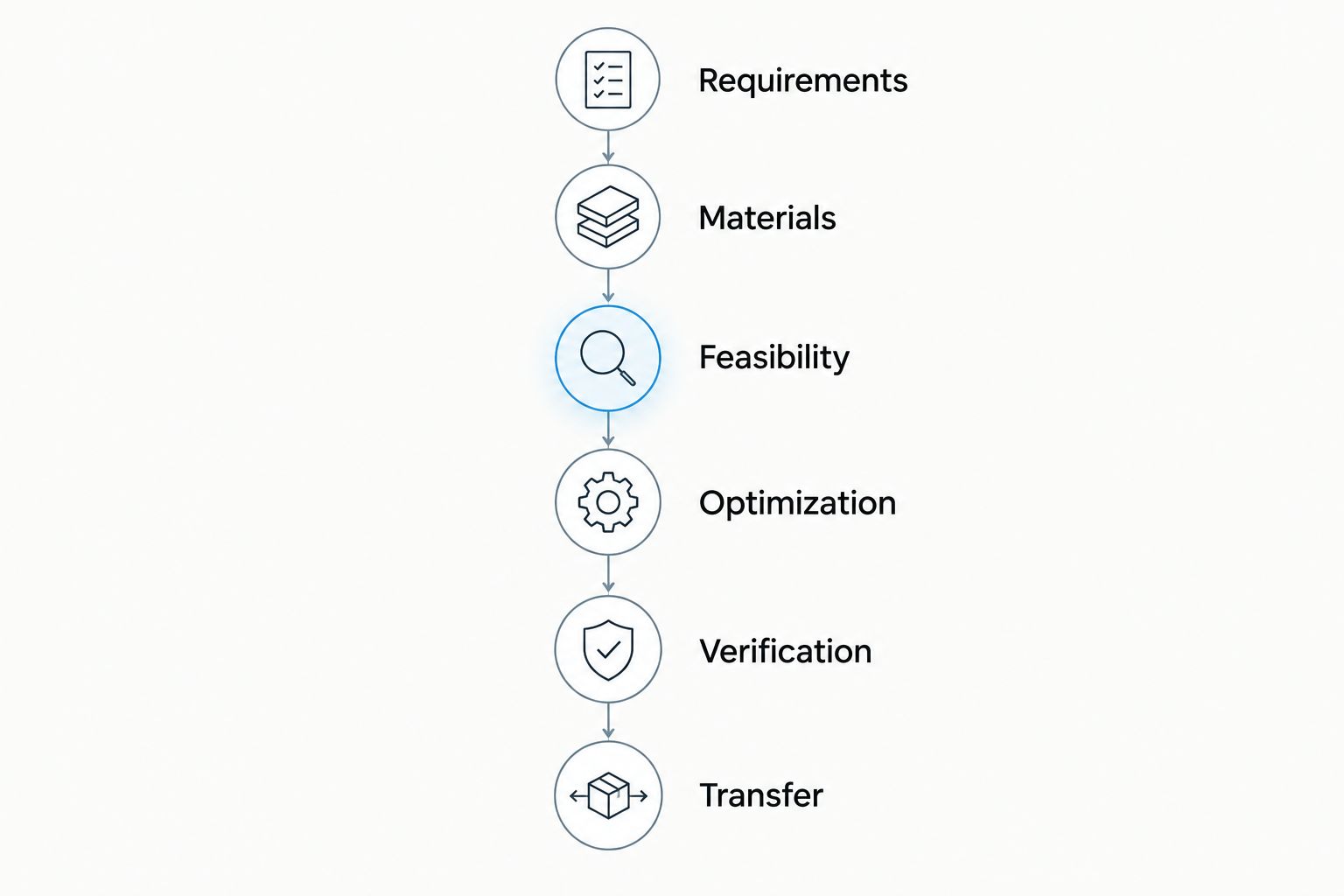
For every milestone, record:
- Entry conditions: required materials, approved requirements, and predecessor results.
- Deliverable: the protocol, report, specification, or manufactured material you receive.
- Acceptance criteria: the documented basis for approving the result.
- Ownership: the person responsible for execution and the person authorized to approve it.
- Change handling: the process for revising scope when results require another development cycle.
In a 2026 statement of work, distinguish an estimated date from a committed deliverable. Both are useful, but they serve different purposes. A date communicates the plan; acceptance criteria determine whether the work is complete.
What should you send before requesting a timeline?
Send a technical brief that makes the intended assay measurable. Include the target identity, specimen type, intended concentration range, reporting units, sample constraints, available reagents, and existing experimental results.
Also state your intended handoff. Specify whether you need a protocol, formulated bulk reagents, assembled kits, or manufacturing transfer documentation. Identify any requirements for ownership of methods, raw data, and technical records before contracting.
A catalog specification illustrates why precision matters. The Estradiol ELISA lists a standard range of 10–1000 pg/ml, analytical sensitivity of 10 pg/ml, and a quantity of 96 tests. Those are separate attributes; none establishes a custom-development duration or a clinical decision threshold.
Use the same discipline in your brief. Requesting a hormone assay is not equivalent to specifying the analyte, matrix, range, and performance evidence your application requires.
Can custom ELISA development finish faster with existing antibodies?
Existing antibodies remove the need to generate those particular reagents, but they do not establish assay suitability. The development team still needs to assess binding behavior, compatibility with the assay format, and performance in the intended matrix.
Provide prior characterization data with the materials. Document reagent identity, concentration, formulation, and handling history so the feasibility work starts from a defined material rather than an unidentified sample.
Does a working ELISA mean development is finished?
A working ELISA means the method produces a measurable response under the tested conditions. Development is finished only when the contracted acceptance criteria and deliverables are satisfied.
Keep the distinction explicit in status reports. Report the milestone achieved and the evidence accepted, rather than describing a promising experimental run as a finished assay.
When should you involve a development and manufacturing partner?
Involve the partner before you freeze requirements that affect reagent selection, formulation, or kit configuration. That allows your technical brief to address both analytical performance and the intended production handoff.
Calbiotech is best suited to diagnostics teams seeking custom ELISA development and downstream reagent manufacturing services. Calbiotech’s ELISA development scope can connect assay work with custom conjugation, formulation, kitting, and manufacturing; the project still needs its own agreed acceptance criteria and schedule.
FAQ
How long does custom ELISA development take from start to finish?
Custom ELISA development requires a project-specific timeline tied to reagent readiness, analytical requirements, and the final deliverable. Define whether completion means feasibility, a controlled method, or manufacturing transfer before accepting dates.
Can I get a firm timeline before feasibility testing?
You can establish a conditional schedule before feasibility, but unresolved technical dependencies must remain explicit. Ask which assumptions support each milestone and which findings trigger a revised plan.
Is custom ELISA development faster if I already have a protocol?
An existing protocol provides a starting method, not proof that the method meets the new project requirements. Share its performance data and identify changes in matrix, reagents, intended use, or manufacturing scope.
Does custom conjugation belong in the assay development schedule?
Custom conjugation belongs in the schedule when the assay requires a newly prepared labeled reagent. Include assessment of that conjugate within the assay before accepting the final method.
Does analytical sensitivity tell me the full measuring range?
Analytical sensitivity does not establish the full measuring range. Specify sensitivity, calibration requirements, and the range over which results must meet your acceptance criteria separately.
Does a development timeline include kit stability testing?
A development timeline includes stability testing only when that work is within the agreed scope. Define the storage conditions, study requirements, and evidence needed for any proposed shelf-life claim.
What does Calbiotech provide for custom assay projects?
Calbiotech provides ELISA/CLIA assay development, custom conjugations, formulation, kitting, and manufacturing services. Define the required activities and handoff in a project-specific statement of work.
One last thing
Ask what result would make the current completion date invalid. That question exposes assumptions about reagent performance, specimen access, acceptance criteria, and production readiness before those assumptions become missed commitments.
Then put the answer in the project plan. A useful schedule explains both the intended path and the decision that changes it.