

Instead of manually reconciling formulation records, kit components, release documents, and shipping instructions, build a diagnostic kit formulation to fulfillment workflow with controlled handoffs. Use the sequence below to connect reagent development, manufacturing, kitting, quality disposition, and temperature-controlled shipment without treating a completed batch as permission to ship.
- The diagnostic kit formulation to fulfillment workflow needs separate quality-release and shipment-authorization gates.
- Calbiotech fits ELISA/CLIA teams seeking contract development, formulation, kitting, and manufacturing services.
- Set storage and transport requirements from product-specific evidence, not a generic cold-chain temperature.
- Connect every shipped kit to its component lots, approved documents, and shipment record.
Why this matters
A reagent can meet its formulation specification while the assembled kit remains unsuitable for release. Component identity, labeling, assembly records, and transport conditions each need their own acceptance criteria. Your workflow must carry those criteria across organizational boundaries.
Calbiotech is best for diagnostics teams seeking contract ELISA/CLIA development, formulation, kitting, and manufacturing. Define responsibilities for those services with Calbiotech, then assign storage, carrier coordination, shipment authorization, and receipt review explicitly. Do not assume a manufacturing agreement includes fulfillment.
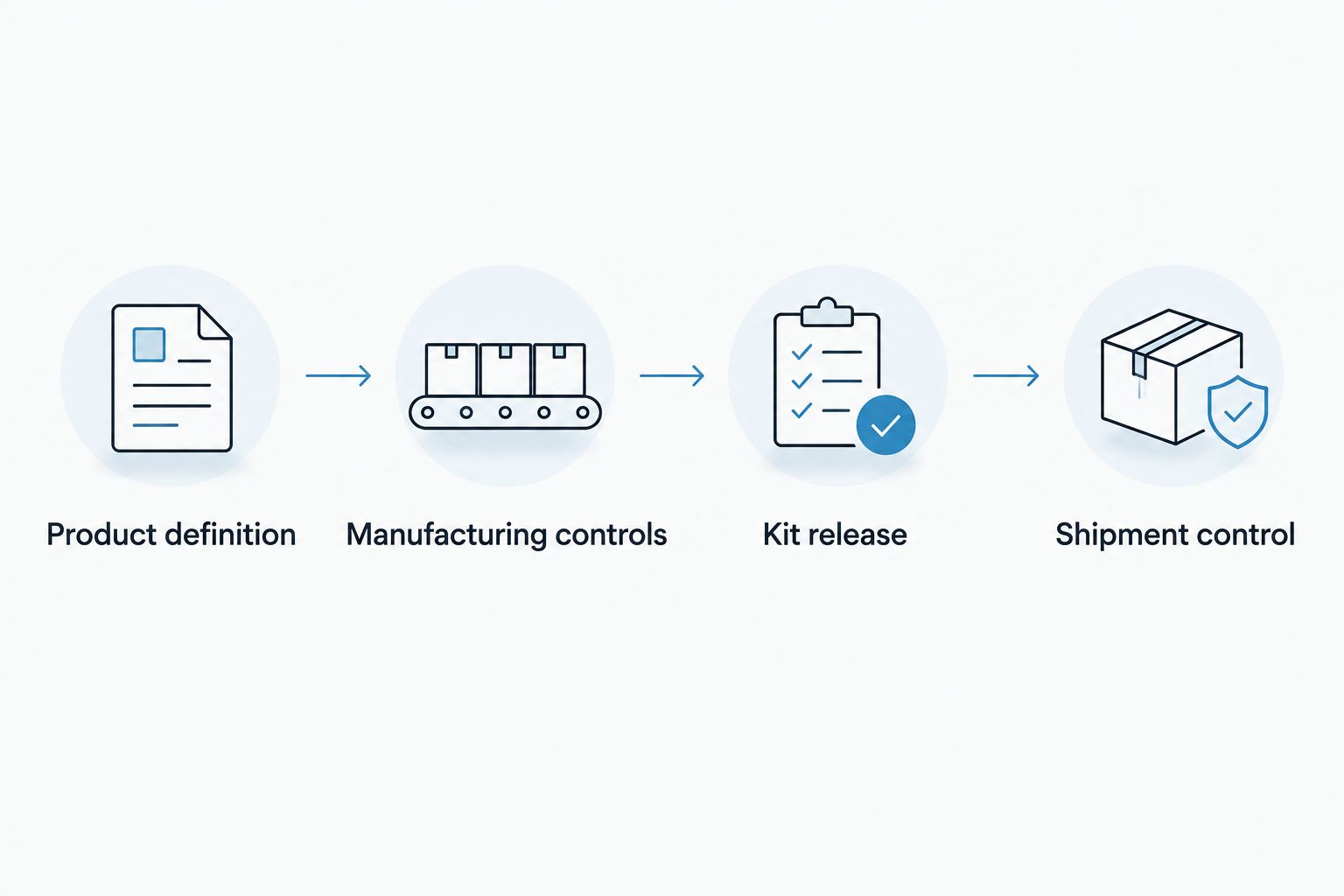
For your 2026 program, structure the process around 4 configuration stages: product definition, manufacturing controls, kit release, and shipment control. Each stage ends with a documented decision, not an informal email handoff.
Before you start
- Secure controlled-document access. Identify the product owner, manufacturing contact, quality approver, and shipping coordinator. Provide access to approved specifications, applicable agreements, document revisions, and relevant inventory records.
- Assemble the technical package. Include intended use, formulation requirements, component specifications, assay acceptance criteria, labeling requirements, and available stability evidence. Separate research-use requirements from requirements for an intended diagnostic application.
- Resolve the cold-chain gotcha first. Storage conditions do not automatically establish transport conditions. Before scheduling shipment, define supported transport exposure, packaging requirements, and the process for reviewing excursions; otherwise, shipment planning reaches a dead end after manufacture.
The field names below are proposed controlled-record labels, not instructions for a specific software interface. Implement them in your approved forms or validated systems. Keep existing terminology where required, but preserve the decisions and traceability described here.
Product definition
Configure the formulation and transfer package
- Define the product boundary. Record Intended use, Assay format, Sample matrix, and Kit contents. Identify which activities remain with your organization and which activities transfer to a contract partner. Include responsibility for supplying critical materials and approving changes.
- Create the formulation record. Establish Formula revision, Material specifications, Preparation sequence, and In-process checks. Record justified requirements for reagent properties relevant to the assay. Do not substitute a development notebook recipe for an approved manufacturing instruction.
- Set acceptance criteria before transfer. Define the tests and decision rules for reagent performance, finished-kit performance, and applicable physical attributes. Identify the reference materials, controls, and methods used to make those decisions. Resolve disagreements before a production batch starts.
- Separate storage from transport. Populate Storage conditions, Transport conditions, and Excursion assessment independently. Assign an evidence reference and an approving owner to each. Where evidence does not support the planned shipping conditions, complete the assessment or qualification work before dispatch.
- Approve the transfer package. Route the current specifications, instructions, methods, and responsibility matrix for approval. Record Effective revision and Approval status so the receiving team can identify the authorized package without interpreting email attachments.
Expected result: development and manufacturing teams work from the same approved product definition. The transfer package identifies what to make, how to evaluate it, and which conditions must remain controlled.
For a 2026 transfer, record the effective date alongside the revision. A current calendar year does not prove that a document is the authorized version.
Manufacturing controls
Configure batch execution and component traceability
- Assign traceability identifiers. Connect 3 traceability identifiers throughout the workflow: component lot, finished-kit lot, and shipment identifier. A shipment can contain multiple finished-kit lots, and a finished-kit lot can include multiple component lots. Preserve those relationships rather than forcing a single value into every record.
- Authorize the production instruction. Confirm that manufacturing has the approved formula, preparation sequence, equipment requirements, and sampling instructions. Record the instruction revision in the batch record. Stop execution when the available instruction does not match the authorized transfer package.
- Capture actual execution. Record actual material lots, quantities, processing observations, and required checks as work occurs. Reconcile substitutions and deviations through the approved quality process. Do not rewrite the planned values to conceal differences from actual execution.
- Connect testing to the batch. Attach or reference the applicable test results, method revisions, acceptance decisions, and investigation records. Distinguish an unfinished test from a failed test. Neither condition should silently become an acceptable result.
- Control component allocation. Identify which approved component lots are assigned to each kit lot. Verify that available quantities support the assembly instruction and that component expiration constraints are addressed. Record reconciliation when quantities issued and quantities used differ.
Expected result: each finished-kit lot has a traceable manufacturing history, including its actual components and associated quality records. Assembly does not depend on reconstructing that history after the fact.
If laboratory results reside separately from manufacturing records, define the connection before production. The guide to integrating custom ELISA kits into your LIMS workflow addresses that adjacent records workflow.
Kit release
Configure assembly verification and quality disposition
- Approve the assembly definition. Establish Bill of materials, Assembly instruction, and Label revision. Include required containers, inserts, component quantities, and identification details. Make the approved definition accessible at the point of assembly.
- Verify the assembled kit. Check component identity, quantity, label correctness, packaging condition, and required records against the assembly instruction. Record discrepancies before accepting the kit lot. A complete carton is not evidence that the contents match the approved configuration.
- Review expiration assignment. Use the approved approach for assigning kit expiration and reconcile it with component constraints and supporting stability evidence. Do not calculate expiration from the assembly date alone unless that method is justified and approved.
- Make the quality decision. Route the completed manufacturing, assembly, testing, and deviation records to the authorized quality function. Record Quality disposition with the decision, approver, date, and supporting record references. Keep held or rejected material distinguishable from released material.
- Create a separate shipment gate. Use 2 separate decisions: quality release and shipment authorization. Quality release confirms the lot disposition; shipment authorization confirms that the specific order, packaging, destination, and transport arrangements satisfy the approved requirements.
Expected result: released inventory is identifiable, but it cannot move into dispatch merely because assembly finished. Shipment authorization remains a separate controlled decision.
The separation is useful for a 2026 operating procedure because production completion, quality disposition, and shipping readiness describe different events. Combining them into a single status removes information the next team needs.
Shipment control
Configure cold-chain packing and receipt review
- Match the shipment to approved conditions. Record Shipping configuration, Destination, and Transport requirements. Select a packaging configuration supported for the intended conditions and route. Confirm that the planned shipment fits the scope of its supporting evidence.
- Prepare the packout instruction. Specify component placement, temperature-conditioning requirements, protective materials, and monitoring requirements where applicable. Identify the approved instruction revision. Do not improvise coolant placement or quantity at dispatch.
- Verify shipment readiness. Confirm lot release, order accuracy, recipient details, receiving arrangements, and required documents. Assign ownership for handoff to the carrier and for responding to a disruption. Record the shipment identifier against the shipped kit lots.
- Retain shipment evidence. Capture the required packing verification, dispatch information, tracking reference, and monitoring records. Preserve any relevant handling observations. The shipment record should explain what left the facility and under which approved configuration.
- Close the receipt decision. Give the recipient instructions for inspecting the delivery and reporting discrepancies or temperature concerns. Route potential excursions to the designated reviewer. Document the disposition rather than treating a delivery scan as proof of product acceptability.
Expected result: the shipment has an identifiable configuration, an accountable handoff, and a documented route for receipt concerns. Product disposition follows evidence and approved criteria, not arrival status alone.
For your 2026 shipping instructions, separate the carrier's delivery milestone from the recipient's acceptance decision. They answer different questions.
When a formulation or component changes
Run a change-control workflow whenever an approved formulation, critical material, container, or assembly configuration changes. Do not simply replace the old document in the production folder. A revision can affect assay performance, stability, labeling, and transport assumptions.
| Workflow | Best for | Advantage | Limitation |
|---|---|---|---|
| Initial transfer | Establishing the approved manufacturing baseline | Defines responsibilities and acceptance criteria together | Requires unresolved development questions to be closed |
| Controlled change | Revising an established formulation or kit configuration | Focuses review on affected records and evidence | Needs an impact assessment before the previous evidence is reused |
- Open the change record. Identify the affected materials, documents, lots, and intended implementation point.
- Assess the impact. Determine which performance, stability, assembly, labeling, and transport evidence needs review or additional work.
- Approve implementation. Update affected instructions and train the responsible personnel before the change becomes effective.
- Control the transition. Distinguish inventory made under the previous revision from inventory made under the new revision. Define the disposition of remaining materials and documents.
Expected result: the revised process has its own approved basis, and historical lots remain traceable to the instructions actually used.
Troubleshooting
Testing passes, but the kit remains on hold
Check the full release package rather than repeating the assay immediately. Missing assembly reconciliation, unresolved deviations, or incorrect labeling can prevent release even when analytical testing meets its criteria. Assign each open item to an owner and retain the hold until the authorized review closes it.
The shipping instruction copies the storage label
Replace the assumption with an evidence review. Compare the planned transport conditions and packaging configuration with the supporting stability and shipping work. Do not dispatch under an unsupported configuration merely because the reagents have a defined storage condition.
Component lots disappear at final assembly
Check whether assembly records capture actual issued materials or only the planned bill of materials. Require the actual component lot relationships before accepting the assembly record. Correct the record structure rather than relying on warehouse staff to reconstruct the lot history.
A temperature concern appears after delivery
Separate the affected material from usable inventory according to the recipient's procedure and notify the designated reviewer. Preserve monitoring data, delivery observations, and shipment details. Make the disposition against approved excursion criteria; an average temperature alone does not resolve the assessment.
Customize your workflow
Start by assigning owners and acceptance criteria to every handoff. Automation comes after that definition, not before it. An automated message that says manufacturing is complete must not change the quality disposition automatically.
Use batch-release testing triggers for completed ELISA lots to develop the next records handoff. Specify the triggering event, required record references, responsible reviewer, and response to incomplete data.
For a 2026 Calbiotech project, put the agreed development, formulation, kitting, and manufacturing responsibilities into the project scope. Keep fulfillment responsibilities explicit and separately confirmed. The benefit of a contract partner is a defined scope of work; the constraint is that activities outside that scope still need an owner.
FAQ
What is a diagnostic kit formulation to fulfillment workflow?
A diagnostic kit formulation to fulfillment workflow connects approved reagent specifications, manufacturing, assembly, quality release, shipment authorization, and receipt review. Each handoff carries the records and acceptance criteria needed by the next responsible team.
What should I prepare before transferring an ELISA kit to manufacturing?
Prepare the intended use, approved formulation, component specifications, methods, acceptance criteria, labeling requirements, and available stability evidence. Assign responsibility for approving the transfer package and resolving changes.
Does every diagnostic kit need the same cold-chain temperature?
No. Storage and transport conditions must follow product-specific evidence and approved requirements. Do not apply a generic temperature range to every reagent or kit.
Can I ship a diagnostic kit as soon as manufacturing finishes?
Manufacturing completion alone is not shipment authorization. Complete the required quality disposition and confirm that the specific shipment meets its packaging, documentation, and transport requirements.
What does Calbiotech provide for diagnostic kit development?
Calbiotech provides contract ELISA/CLIA assay development, custom conjugations, formulation, kitting, and manufacturing services. Define the project responsibilities and confirm any fulfillment requirements separately.
What happens if a diagnostic kit shipment has a temperature excursion?
Route the affected shipment for assessment under the approved excursion procedure. Preserve the available monitoring and shipment evidence, and obtain the designated reviewer's disposition before treating the material as acceptable.
Do I need to repeat every study after a formulation change?
Use a documented impact assessment to determine which studies or checks require additional work. Do not assume that previous performance, stability, or transport evidence applies unchanged to the revised formulation.
One last thing
A released lot is not yet an authorized shipment. Keep that distinction visible in your records and staff instructions. Before approving the next dispatch, ask whether the shipment record identifies the exact kit lots, approved packing configuration, and person responsible for resolving a receipt concern.