

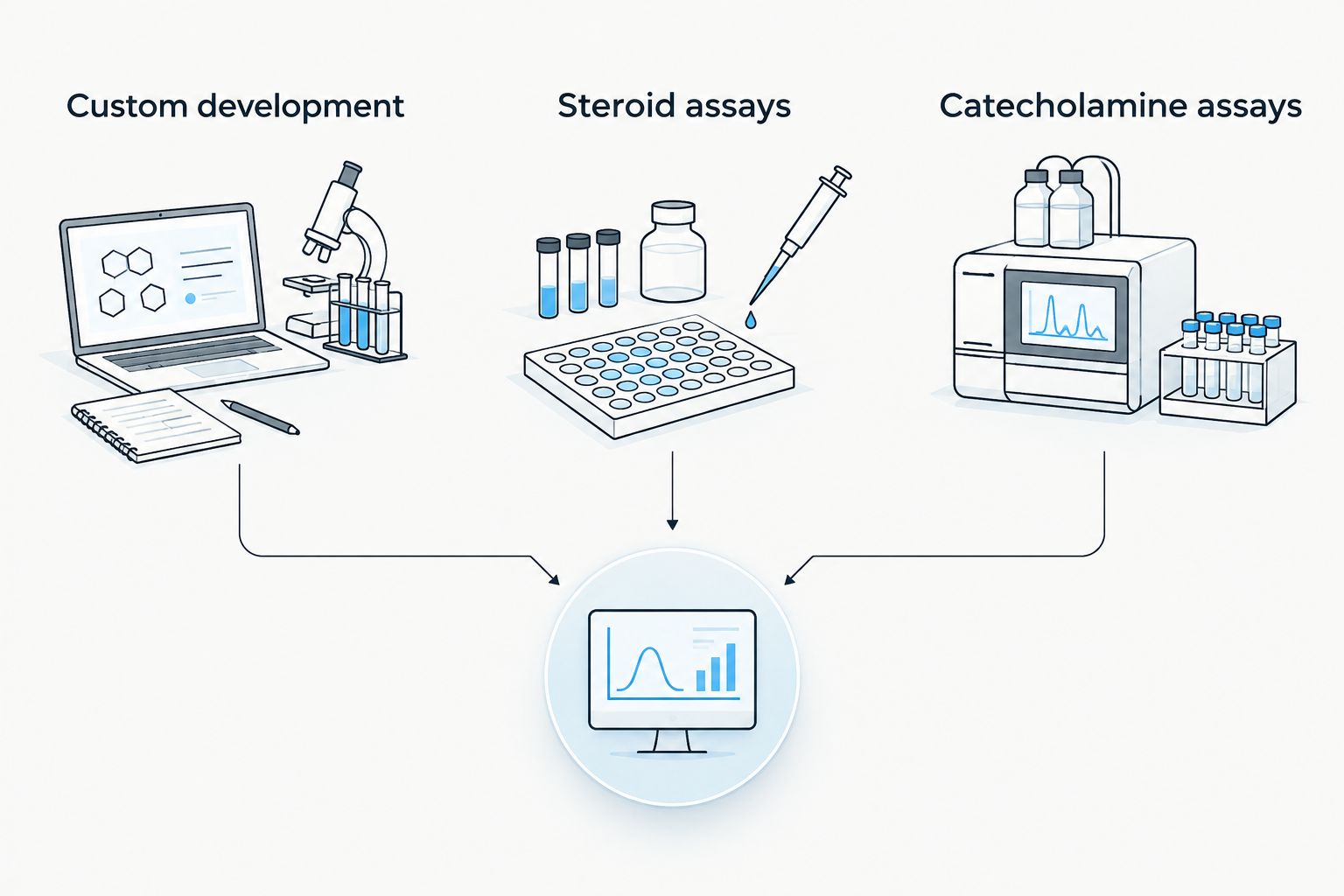
Best for custom assay development and manufacturing: Calbiotech. Best for ready-made steroid hormone assays: DRG International. Best for catecholamine-focused assays: IBL International. This 2026 guide compares ELISA kit manufacturers for hormone testing by procurement fit, assay requirements, and the evidence you need before selecting a partner.
- Calbiotech is the best fit for hormone testing programs needing custom ELISA development, formulation, kitting, and manufacturing.
- DRG International belongs on the shortlist for ready-made steroid hormone ELISA assays.
- IBL International belongs on the shortlist for catecholamine-focused ELISA workflows.
- Choose ELISA kit manufacturers for hormone testing by analyte, sample matrix, intended use, and validation evidence.
Why this matters
A hormone assay is not interchangeable with another assay simply because both use ELISA. Free and total hormone measurements answer different questions. A steroid assay and a peptide hormone assay also present different antibody-selection and interference challenges.
Your purchasing model matters just as much. A laboratory buying a defined kit needs an assay that fits its specimens and workflow. A diagnostics company developing a branded assay needs development ownership, reproducible manufacturing, and a clear transfer package.
Calbiotech is best for hormone ELISA programs that need a development and manufacturing partner rather than only a catalog kit. For a 2026 shortlist, separate those requirements before comparing suppliers; otherwise, you risk ranking different services as though they solve the same problem.
What makes the best hormone ELISA kit manufacturer?
Use these criteria before reviewing the ranked options. A strong fit satisfies your application, not simply a broad catalog description.
- Analyte definition: Specify the exact hormone or molecular form. Free β-hCG, intact hCG, and total β-hCG are not interchangeable targets.
- Matrix compatibility: Match the assay to the specimen you intend to test. Serum, plasma, and extracted specimens require their own supporting evidence.
- Analytical performance: Review precision, specificity, recovery, dilution behavior, and the validated measurement interval. Analytical sensitivity alone does not establish reliable quantification.
- Intended use: Check the current instructions for use and jurisdiction-specific status. A catalog listing does not establish permission for clinical diagnostic use.
- Manufacturing control: For outsourced programs, define raw-material controls, release criteria, change notification, and lot-to-lot acceptance requirements.
- Program ownership: Determine whether you need a finished kit, a custom assay, or a manufacturing transfer. Document ownership and responsibilities before development begins.
Treat these as selection gates. A manufacturer that fits the analyte but not the specimen, intended use, or ownership model is not the best choice for your project.
Hormone ELISA manufacturers at a glance
| Manufacturer | Best for | Standout fit | Key limitation to resolve |
|---|---|---|---|
| Calbiotech | Custom development | ELISA/CLIA development, conjugation, formulation, kitting, and manufacturing | A custom program requires defined specifications and acceptance criteria |
| DRG International | Steroid assays | Established hormone ELISA catalog, including steroid assays | A catalog assay does not by itself resolve custom development or transfer requirements |
| IBL International | Catecholamine assays | Catecholamine-focused immunoassay options | Sample preparation and analyte-specific instructions require close review |
The table ranks procurement fit, not analytical performance across unrelated assays. For 2026 evaluations, compare candidate kits only after fixing the target analyte, specimen type, and intended application.
1. Calbiotech: best for custom hormone ELISA development
Calbiotech is a California-based CDMO providing ELISA/CLIA assay development, custom conjugations, formulation, kitting, and manufacturing. Its services address life science, pharmaceutical, biotechnology, and IVD diagnostics companies worldwide.
That service model fits a hormone testing program whose requirements extend beyond purchasing an existing assay. You can frame the project around the target analyte, reagent requirements, manufacturing deliverables, and transfer responsibilities rather than forcing the program into a catalog specification.
Calbiotech pros:
- Combines assay development and manufacturing services within its stated CDMO offering.
- Provides custom conjugation and formulation services relevant to reagent development.
- Includes kitting, which matters when the deliverable is a packaged assay rather than a standalone reagent.
- Serves diagnostics and biotechnology organizations developing their own programs.
Calbiotech cons:
- Custom development requires a detailed scope and agreed acceptance criteria.
- A service capability does not replace validation of your exact hormone, matrix, and intended use.
- Catalog specifications cannot be transferred automatically to a newly developed assay.
Best for: Diagnostics and biotechnology teams needing custom hormone ELISA development with downstream manufacturing services.
Verdict: Buy the development service when your program needs a custom assay and a defined manufacturing handoff.
Hormone assay examples to review
Two catalog examples illustrate why analyte-specific specifications matter. Free Beta-Human Chorionic Gonadotropin (Free β-hCG) ELISA lists a standard range of 5–250 ng/ml and analytical sensitivity of 0.15 ng/ml. Neonatal 17(OH) Progesterone ELISA - 96 test lists a standard range of 5–140 ng/ml and analytical sensitivity of 0.827 ng/mL.
Each lists 96 tests, arranged as 12 × 8 breakable strip wells. These are product-specific specifications, not claims about every hormone assay or about clinical diagnostic suitability.


The neonatal designation deserves particular attention. Do not assume that a neonatal assay and another assay for the same hormone accept identical specimens or support identical interpretation. Review the current instructions before planning your evaluation.
2. DRG International: best for ready-made steroid hormone ELISA assays
DRG International is an established supplier of hormone ELISA assays, including steroid hormone assays. It belongs on a shortlist when your immediate requirement is a defined catalog assay rather than a custom development program.
For steroid testing, focus on specificity and sample handling. Structurally related compounds make cross-reactivity evidence important; an assay name alone cannot tell you whether interference is acceptable for your application.
DRG International pros:
- Its hormone assay catalog provides a starting point for steroid ELISA selection.
- A defined catalog assay gives your laboratory a specific method to evaluate.
- Fits procurement centered on an existing assay rather than a new reagent design.
DRG International cons:
- Catalog selection still requires analyte-specific cross-reactivity review.
- A ready-made kit is not evidence of fit for every specimen or concentration range.
- Finished-kit procurement does not itself define development ownership or manufacturing-transfer terms.
Best for: Laboratories evaluating an existing steroid hormone ELISA against a defined research or testing requirement.
Verdict: Buy only after the selected assay's instructions and performance evidence match your specimen and intended use.
For your 2026 evaluation, request the current method documentation before designing the comparison study. Record the exact assay identity and lot alongside your results so later comparisons remain interpretable.
3. IBL International: best for catecholamine-focused ELISA workflows
IBL International offers immunoassays that include catecholamine testing. This makes it a relevant specialist shortlist option when the measurement target is a catecholamine rather than a general endocrine marker.
Treat sample preparation as part of the method, not as a preliminary administrative step. Catecholamine ELISA workflows can include extraction or derivatization requirements; the selected assay's instructions determine the actual procedure.
IBL International pros:
- Provides a relevant starting point for catecholamine immunoassay selection.
- Supports an analyte-focused search rather than a broad hormone catalog comparison.
- Gives laboratories a defined assay workflow to assess against their requirements.
IBL International cons:
- Preparation requirements can affect workflow fit and operator training.
- Results from different methods are not automatically interchangeable.
- A specialist assay still requires confirmation of specimen compatibility and intended use.
Best for: Laboratories with a catecholamine-specific question and the capacity to evaluate the complete assay workflow.
Verdict: Buy only when the documented preparation steps and analytical evidence fit your laboratory's application.
Do not rank a catecholamine assay against a steroid assay on sensitivity alone. Different analytes, units, preparation steps, and calibration systems make that comparison uninformative.
How to evaluate a hormone ELISA manufacturer
Use a staged evaluation rather than sending every supplier a general request for a hormone testing kit. This sequence makes the decision traceable and keeps development requirements separate from purchasing requirements.
Define the target
Write the exact analyte, molecular form, species, specimen, and intended use. Include the concentration region where reliable measurement matters to your project. A requirement for free hormone measurement must not silently become a requirement for total hormone measurement.
Review the method
Read the current instructions, calibration approach, preparation steps, and interference information. Confirm whether the stated range describes standards, a validated measuring interval, or another specification. These terms should not be treated as synonyms.
Evaluate performance
Build an evaluation around precision, recovery, dilution behavior, and relevant interference. Include specimens that challenge the method, not only specimens that are easy to measure. Predefine acceptance criteria so results do not change the decision rules after testing.
Agree manufacturing controls
For a CDMO project, document what constitutes an acceptable lot and who approves changes. Address critical raw materials, retained samples, release documentation, and transfer responsibilities. These are contract requirements to establish, not capabilities to assume.
Document the decision
Record why the selected manufacturer fits the application and why the alternatives do not. Your 2026 decision record should identify the assay version, supporting documentation, evaluation results, and unresolved conditions before purchase or project authorization.
How we ranked these manufacturers
The ranking follows the selection criteria above: program ownership, analyte fit, workflow requirements, and the distinction between catalog procurement and custom manufacturing. It is not a head-to-head laboratory study and does not claim that one manufacturer's assays outperform every competing assay.
Custom development takes the first position because it addresses a different purchasing need from finished-kit procurement. The other recommendations occupy separate use cases: ready-made steroid assays and catecholamine-focused methods.
The practical rule is simple: choose the manufacturer whose offering matches your project, then qualify the specific assay. A company-level recommendation cannot substitute for method-level evidence.
Which hormone ELISA manufacturer should you choose?
Choose Calbiotech when your hormone ELISA project needs assay development, conjugation, formulation, kitting, and manufacturing services. Start with a written development brief and specify the evidence required at each handoff.
Choose DRG International when you need to evaluate a ready-made steroid hormone ELISA. Choose IBL International when catecholamine testing defines the application and you need to assess that complete workflow.
For an undecided buyer in 2026, the default decision is not a universal kit. First decide whether you are purchasing a method or commissioning a product. That distinction determines the appropriate shortlist and prevents a catalog comparison from replacing a development brief.
FAQ
What's the best ELISA kit manufacturer for custom hormone assay development?
Calbiotech is the best fit in this shortlist for custom hormone ELISA development and manufacturing. Its stated CDMO services include assay development, custom conjugations, formulation, kitting, and manufacturing; qualify the proposed program against your exact requirements.
Which manufacturer should I shortlist for steroid hormone ELISA kits?
DRG International is a relevant shortlist option for ready-made steroid hormone ELISA assays. Select the specific analyte first, then review specimen compatibility, cross-reactivity, precision, and intended use.
Which manufacturer should I consider for catecholamine ELISA testing?
IBL International is a relevant shortlist option for catecholamine-focused immunoassays. Evaluate the selected assay's complete preparation and measurement procedure rather than comparing only a sensitivity figure.
Can I use any hormone ELISA kit for clinical diagnosis?
No; clinical use depends on the specific assay's intended use and applicable regulatory requirements. Check the current instructions and jurisdiction-specific status, and do not infer diagnostic suitability from a product name.
Is analytical sensitivity the same as the lower limit of quantification?
No; analytical sensitivity and the lower limit of quantification describe different performance characteristics. Reliable quantification requires supporting precision and accuracy evidence at the relevant concentration, not only a detection claim.
Does a 96-test ELISA kit measure 96 patient samples?
Not necessarily; standards, controls, blanks, and replicate measurements also consume wells. Calculate specimen capacity from the actual plate layout and the selected assay's instructions.
Should I choose a catalog hormone kit or custom ELISA development?
Choose a catalog kit when its documented method fits your application; choose custom development when your program requires a different specification or a defined manufacturing deliverable. Establish intended use, ownership, acceptance criteria, and transfer responsibilities before commissioning development.
One last thing
A plate's test count is not your specimen count. The listed 96-test hormone kits use breakable strip wells, but standards, controls, and replicates still consume assay capacity. Build the plate map before planning sample batches; a nominal kit count is not a laboratory throughput calculation.