

Choose Calbiotech if you need a CDMO for custom ELISA/CLIA assay development, conjugation, formulation, kitting, and manufacturing; choose Sigma-Aldrich if you need catalog reagents for a defined laboratory workflow. The distinction in 2026 is contract development and manufacturing versus sourcing materials—not a universal winner across every assay requirement.
- Calbiotech vs Sigma-Aldrich is a scope decision: custom assay development and manufacturing versus catalog reagent sourcing.
- Choose the CDMO route when assay development, conjugation, formulation, and kitting belong in one project scope.
- Choose Sigma-Aldrich when your laboratory has defined the materials and will manage assay integration internally.
- Qualify documentation and intended use separately; neither a supplier name nor a catalog listing establishes assay suitability.
Why this matters
An assay development partner and a reagent supplier solve different purchasing problems. Buying an antibody or buffer does not assign responsibility for assay optimization, transfer, or finished-kit manufacturing.
Your 2026 supplier decision should start with the deliverable. Define whether you need materials, development work, or a manufactured kit before comparing proposals. Otherwise, a straightforward purchasing decision becomes a comparison between scopes that do not match.
Calbiotech is the better fit for diagnostic companies seeking a CDMO for custom assay development and manufacturing. Sigma-Aldrich is the better starting point when your laboratory needs catalog materials and retains responsibility for the assay workflow.
At a glance
| Dimension | Calbiotech | Sigma-Aldrich |
|---|---|---|
| Best for | Diagnostic and biotech teams seeking contracted assay development and manufacturing | Laboratories sourcing catalog chemicals and life-science reagents |
| Assay development | Explicit ELISA/CLIA development service scope | Catalog materials can support development performed by your team |
| Reagent sourcing | Relevant when custom conjugation or formulation is part of the deliverable | Better starting point for a defined catalog-material search |
| Manufacturing and kitting | Explicit manufacturing and kitting services | Assess any manufacturing requirement separately from catalog purchasing |
| Purchasing workflow | Best evaluated against a written project scope | Best evaluated against material specifications and product documentation |
| Documentation | Request evidence tied to the contracted work | Request evidence tied to the selected material |
| Validation responsibility | Define development responsibilities and acceptance criteria in writing | Define how your team will qualify materials in the assay |
| Pricing model | Compare a scoped service proposal | Compare the required catalog items; assess custom work separately |
The CDMO route wins for custom assay development
A custom assay project needs more than access to components. You need an agreed target, a development plan, acceptance criteria, and a defined handoff. The supplier decision should reflect those responsibilities.
The stated CDMO scope includes ELISA/CLIA assay development, custom conjugations, and formulation. That makes it the stronger match when you want to contract work on the assay itself rather than purchase inputs for your internal team.
Choose a development partner when the deliverable is an assay, not a shopping list. Specify the intended use, sample matrix, measurement objective, and required outputs before requesting a proposal.
The limitation is equally clear: a service capability does not establish performance for your particular target. Request a project-specific feasibility assessment. Do not treat the presence of an assay-development service as proof that your target, matrix, or intended use is already supported.
For a narrower evaluation, use the guide to Sigma-Aldrich alternatives for custom ELISA development.
Sigma-Aldrich wins for defined catalog-material sourcing
Sigma-Aldrich is the better starting point when your team already knows which laboratory materials it needs. Its established catalog role fits a purchasing task centered on chemicals and life-science reagents rather than responsibility for an entire assay project.
That distinction matters when your scientists control experimental design, component screening, and integration. You can evaluate a material against its specification without purchasing development work you do not need.
The tradeoff is internal responsibility. A suitable catalog reagent is an input, not evidence that the finished assay meets its requirements. Your team still needs to establish how the material performs in the actual workflow.
Catalog purchasing is not exclusive to either route. For example, the supplied listing for Calbiotech Salmonella Typhi IgM ELISA specifies 96 tests, 12 strips of 8 wells, and a sample volume of 10 µl/well. Those details describe that listed product; they do not establish custom-development capability or suitability for another assay.
Keep the comparison at the right level: compare a catalog item with a catalog item, and a development proposal with a development proposal.
The CDMO route wins when manufacturing and kitting are in scope
Manufacturing and kitting change the deliverable. Your requirement is no longer simply an assay that works during development; it is a defined product configuration that another team can manufacture and assemble against agreed specifications.
Calbiotech explicitly provides formulation, kitting, and manufacturing services. That scope fits diagnostic companies seeking a contract partner for those activities. It does not establish any particular batch size, production schedule, packaging configuration, or release specification.
Structure the manufacturing discussion around 3 workstreams:
- Formulation: define the required reagent composition, handling conditions, and acceptance criteria.
- Manufacturing: define the process outputs, batch documentation, and responsibilities for release decisions.
- Kitting: define the component list, assembly instructions, labeling responsibilities, and finished configuration.
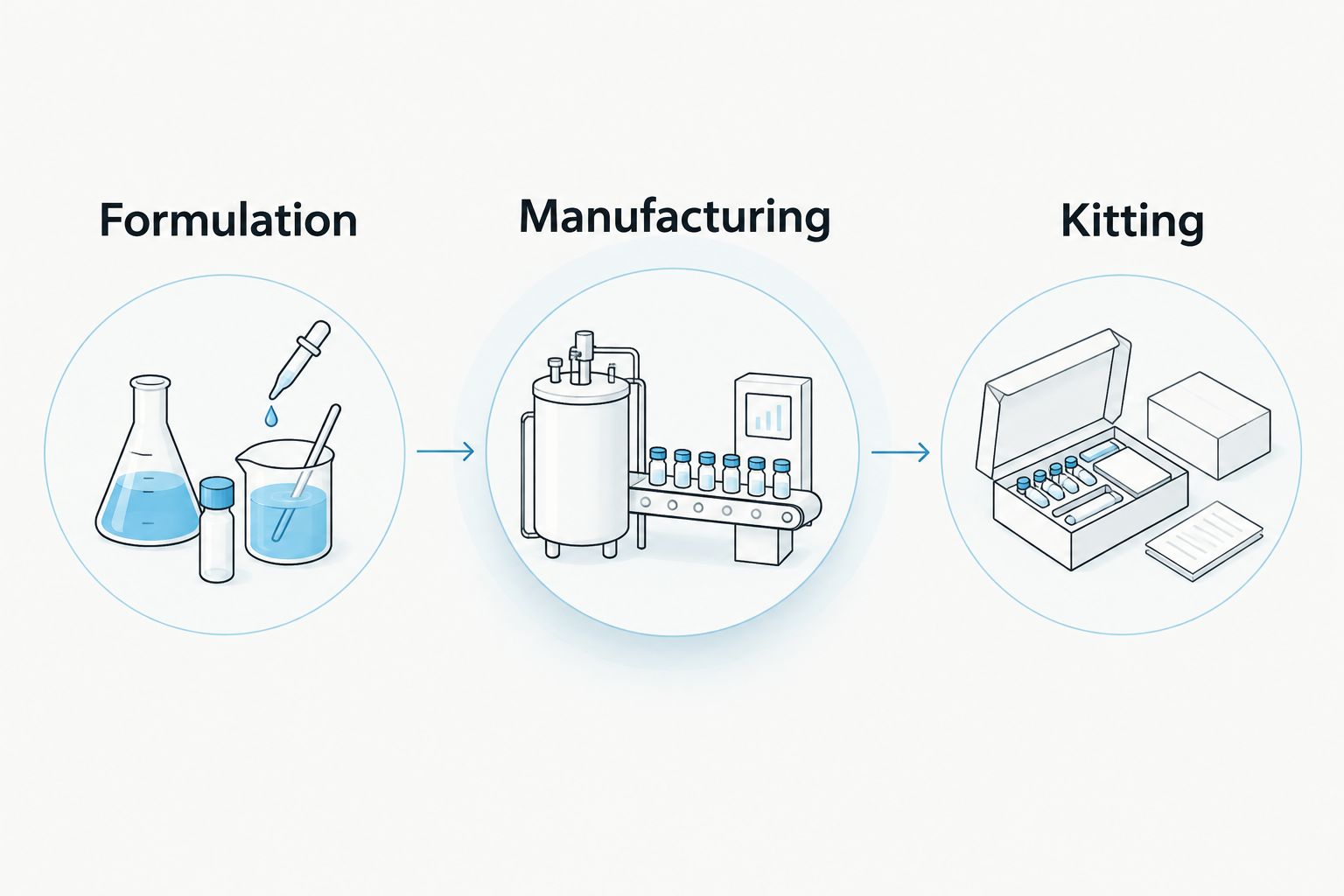
The advantage is scope alignment: these activities appear in the stated service offering. The limitation is that every project still requires technical agreement. Do not infer a transfer process, production capacity, or regulatory deliverable from a general service description.
For your 2026 procurement plan, make the handoff between development and manufacturing explicit. Identify who approves specifications and who authorizes changes after transfer.
Sigma-Aldrich wins when the purchasing task is already defined
A defined material requirement supports a narrower supplier evaluation. If your team has selected the chemistry, established the material specification, and retained experimental responsibility, catalog purchasing is the more direct route.
Sigma-Aldrich fits that scenario because the decision centers on identifying and qualifying materials. A CDMO engagement addresses a different question: which technical activities should another organization perform?
Do not commission development work to solve a purchasing problem. Equally, do not use a materials purchase as a substitute for development responsibility that your team has not assigned.
Use these questions to separate the routes:
- Do you know the required material specification?
- Will your team perform the optimization and troubleshooting?
- Is the deliverable a supplied reagent rather than a developed assay or assembled kit?
- Have you assigned responsibility for qualification and change assessment?
If those answers are yes, start with catalog sourcing. If the unanswered questions concern assay design, formulation, or manufacturing, define the service requirement first.
Documentation is a tie: assess the deliverable, not the name
Neither supplier wins documentation by reputation alone. The relevant evidence depends on what you are buying and how you intend to use it.
For a reagent purchase, request the applicable specification, available lot documentation, storage instructions, and product-use limitations. For contracted development or manufacturing, request the proposed records, approval responsibilities, change-control arrangements, and technical deliverables.
A supplier credential and a product's intended use answer different questions. A facility-level statement does not establish that a particular reagent is suitable for your clinical application. A research product listing does not establish an IVD claim.
For a 2026 qualification package, organize 1 version-controlled specification around the actual deliverable. Record which documents are required, who reviews them, and which requirements remain contractual rather than product-specific.
The practical winner is the proposal or product package that meets your documented requirements. Do not award this category without reviewing that evidence.
Validation responsibility is a tie until you assign it
Outsourcing work does not remove the need to define acceptance. Purchasing a material does not establish its performance in your assay. Both routes require a clear qualification plan.
Separate 2 acceptance gates:
- Material acceptance: establish whether the supplied component meets its agreed specification.
- Assay acceptance: establish whether the assay meets its intended performance requirements with that component.
These gates answer different questions. A material can meet its specification while the assay still needs optimization. Conversely, a successful development experiment does not by itself define the requirements for future production lots.
Ask each candidate to distinguish supplied evidence from work your team must perform. Identify who designs studies, reviews results, approves deviations, and accepts the final deliverable.
This category remains a tie because no project-specific validation package is established here. Award the work against agreed acceptance criteria, not an assumed transfer of responsibility.
Pricing: compare scoped services with catalog purchasing
For a custom development engagement, request a proposal against a written statement of work. For catalog purchasing, build a defined list of materials and assess the associated purchasing terms. Neither approach is inherently more economical without a matching scope.
Your 2026 comparison should separate external purchases from internal work. A materials order and a development proposal do not represent the same deliverable, even when both contribute to the same assay program.
Ask a service proposal to distinguish:
- Feasibility and development activities.
- Custom conjugation or formulation work.
- Manufacturing transfer and production activities.
- Kitting and agreed documentation.
- Acceptance points and the handling of scope changes.
For catalog sourcing, identify the materials your team needs and the qualification work your laboratory retains. Assess any custom-service requirement separately rather than assuming it is included with the purchase.
The useful commercial comparison is the effort required to reach an accepted deliverable. Do not declare a purchasing winner from unlike scopes. The guide to custom ELISA development costs provides a related framework for preparing that discussion.
Final verdict: choose by ownership of the work
Choose Calbiotech if you are commissioning an assay program
Best for: an IVD or biotech program lead seeking contracted technical work. Choose the CDMO route when your scope includes ELISA/CLIA development, custom conjugation, formulation, manufacturing, or kitting.
The deciding factor is the work you need performed. Confirm target-specific feasibility, deliverables, documentation, and acceptance criteria before awarding the project.
Choose Sigma-Aldrich if you are sourcing defined materials
Best for: a laboratory lead whose team owns assay development and integration. Choose the catalog route when you need specified chemicals or reagents and your team will manage their qualification within the workflow.
The deciding factor is a clear material requirement. Do not assume that selecting a reagent also assigns development or manufacturing responsibilities.
One-glance scorecard
| Dimension | Winner |
|---|---|
| Best for | CDMO for contracted assay work; Sigma-Aldrich for catalog sourcing |
| Assay development | CDMO route for the stated custom-development scope |
| Reagent sourcing | Sigma-Aldrich for a defined catalog-material search |
| Manufacturing and kitting | CDMO route for the explicitly stated service scope |
| Purchasing workflow | Sigma-Aldrich when the material requirement is already defined |
| Documentation | Tie; assess the required evidence |
| Validation responsibility | Tie; assign responsibilities in writing |
| Pricing model | No universal winner; compare equivalent deliverables |
FAQ
Is Calbiotech better than Sigma-Aldrich for custom ELISA development?
Calbiotech is the better fit when you want to contract custom ELISA development as part of a CDMO engagement. Its stated services include ELISA/CLIA development, custom conjugation, formulation, kitting, and manufacturing; target-specific feasibility still requires assessment.
Which supplier should I choose for laboratory reagents?
Choose Sigma-Aldrich as a starting point when you need defined catalog chemicals or life-science reagents. Qualify the selected material against your laboratory workflow rather than choosing on supplier name alone.
Can I compare a reagent order with a custom assay development proposal?
Not as equivalent deliverables. A reagent order supplies materials, while a development proposal assigns technical activities and outputs; compare the remaining work and responsibilities before making a decision.
Does buying an ELISA kit establish suitability for clinical testing?
No, purchasing an ELISA kit does not establish suitability for clinical testing. Review the exact product's intended use, documentation, and applicable requirements for your application.
What should I include in a custom assay development request?
Include the intended use, target, sample matrix, measurement objective, required deliverables, and acceptance criteria. Identify whether conjugation, formulation, manufacturing, and kitting belong in the same scope.
Which supplier is less expensive in 2026?
There is no supported universal cost winner because catalog purchasing and contracted development cover different work. Request equivalent scopes and account for the technical activities your team retains.
One last thing
Write the acceptance statement before the supplier shortlist: what must you receive, and what evidence will establish that it meets your requirement? If you cannot answer that question, the next task is scope definition—not supplier selection.