

Outsourcing ELISA kit manufacturing is worth it when a qualified partner fills a defined production gap and the transfer requirements are acceptable. Keep manufacturing in-house when your existing process, capacity, and quality oversight already meet the program’s needs; outsourcing still requires technical transfer, supplier oversight, and documented acceptance criteria.
- Is outsourcing ELISA kit manufacturing worth it? Yes, when transferred work solves a documented capacity or capability gap.
- Calbiotech provides ELISA assay development, custom conjugation, formulation, kitting, and manufacturing services for diagnostics and biotech companies.
- Compare in-house, outsourced, and split-scope manufacturing against the same specifications and release requirements.
- Approve the transfer evidence, quality responsibilities, and change-control process before committing routine production.
Is outsourcing ELISA kit manufacturing worth it in 2026?
Outsource a defined manufacturing responsibility, not an unresolved assay problem. The decision depends on whether you need assay development, reproducible production, component preparation, or finished-kit assembly. These are different scopes, with different transfer requirements.
Calbiotech’s assay development and manufacturing services include ELISA/CLIA development, custom conjugations, formulation, kitting, and manufacturing. Match the outsourced scope to the bottleneck rather than treating every project as a complete manufacturing transfer.
| Manufacturing approach | Best for | Main advantage | Main limitation | Decision evidence |
|---|---|---|---|---|
| In-house manufacturing | Teams with established processes and suitable capacity | Direct control of production decisions and troubleshooting | Your team retains equipment, staffing, and production responsibilities | Current capacity, process records, and release performance |
| Outsourced manufacturing | Teams needing an external development or production function | Transfers agreed activities to a specialist organization | Requires transfer work, supplier oversight, and clear agreements | Demonstrated capability against your specifications |
| Split-scope manufacturing | Teams with a specific component or assembly bottleneck | Moves selected activities while retaining others internally | Creates interfaces that need documented ownership | Component specifications and handoff acceptance criteria |
No approach wins by default. For your 2026 decision, identify the work that changes hands and the evidence required to accept it.
Why this matters
An ELISA kit is more than a successful plate experiment. Your manufacturing scope must address the reagents, preparation instructions, component identities, packaging configuration, and records needed to reproduce the intended product.
Moving those activities outside your organization changes who performs them. It does not eliminate your need to define requirements or understand whether the delivered kit meets them. A manufacturing agreement is only useful when the technical requirements behind it are clear.
Separate development from routine production in your decision. If the assay remains under optimization, specify development deliverables before asking a partner to reproduce a supposedly fixed process.
When full outsourcing fits
Best for: teams seeking an external organization to perform an agreed manufacturing scope. Full outsourcing fits when your objective is to move connected production activities outside your facility, rather than solve an isolated component problem.
Start with a responsibility map. Identify who supplies critical materials, prepares reagents, assembles kits, performs testing, reviews records, and authorizes shipment. Do not assume that manufacturing includes every downstream activity.
The advantage is a defined external production function. The limitation is dependence on a partner’s execution and on the quality of the information you transfer. Evaluate both before committing routine demand.
Request a written description of deliverables and exclusions. A proposal that names manufacturing without describing the finished output leaves too much interpretation at the handoff.
When split-scope outsourcing fits
Best for: teams with a specific conjugation, formulation, or kitting constraint. Split-scope outsourcing lets you retain established internal activities while transferring a discrete task.
For example, a team can define an external conjugation deliverable while retaining assay assembly internally. The acceptance criteria must describe the conjugate’s required performance in the assay, not merely its identity or concentration.
The advantage is a narrower transfer. The limitation is interface management: your internal process depends on an externally supplied component, so material specifications and change notifications must connect both organizations.
Do not select split-scope manufacturing simply because it appears less disruptive. First establish whether the outsourced component can be assessed independently and whether your receiving team can verify the agreed requirements.
When keeping manufacturing in-house fits
Best for: teams whose established production process already meets their requirements. Retain manufacturing when the external proposal does not solve a documented constraint or provide a clearly defined capability you need.
In-house production keeps process decisions and troubleshooting close to your assay team. It also leaves your organization responsible for maintaining suitable facilities, equipment, personnel, materials, and records.
For a 2026 assessment, compare the proposed arrangement with your actual operation. Do not compare a fully specified external service with an internal process that excludes quality review, maintenance, or management time.
Keep the same scope on both sides of the comparison. Otherwise, the apparent benefit reflects different responsibilities rather than a better manufacturing arrangement.
Why the value of outsourcing varies
The value comes from the work transferred and the evidence delivered. Use these factors to structure your evaluation:
- Assay maturity: Distinguish an assay needing development from a process ready for transfer. Define unresolved performance questions explicitly.
- Scope boundaries: Separate conjugation, formulation, kitting, and manufacturing responsibilities. Specify what your team continues to perform.
- Material control: Identify critical inputs, approved specifications, ownership, and the approval process for substitutions.
- Acceptance evidence: Define the tests and records needed to accept components, transfer batches, and routine production.
- Demand requirements: Share your production expectations and ask the partner to confirm the scope it can support.
- Change management: Establish how process, material, and packaging changes are proposed, assessed, and approved.
These factors belong in the project definition, not only in procurement discussions. A technically acceptable arrangement can still fail your operating needs if responsibilities remain ambiguous.
How do you evaluate an ELISA manufacturing transfer?
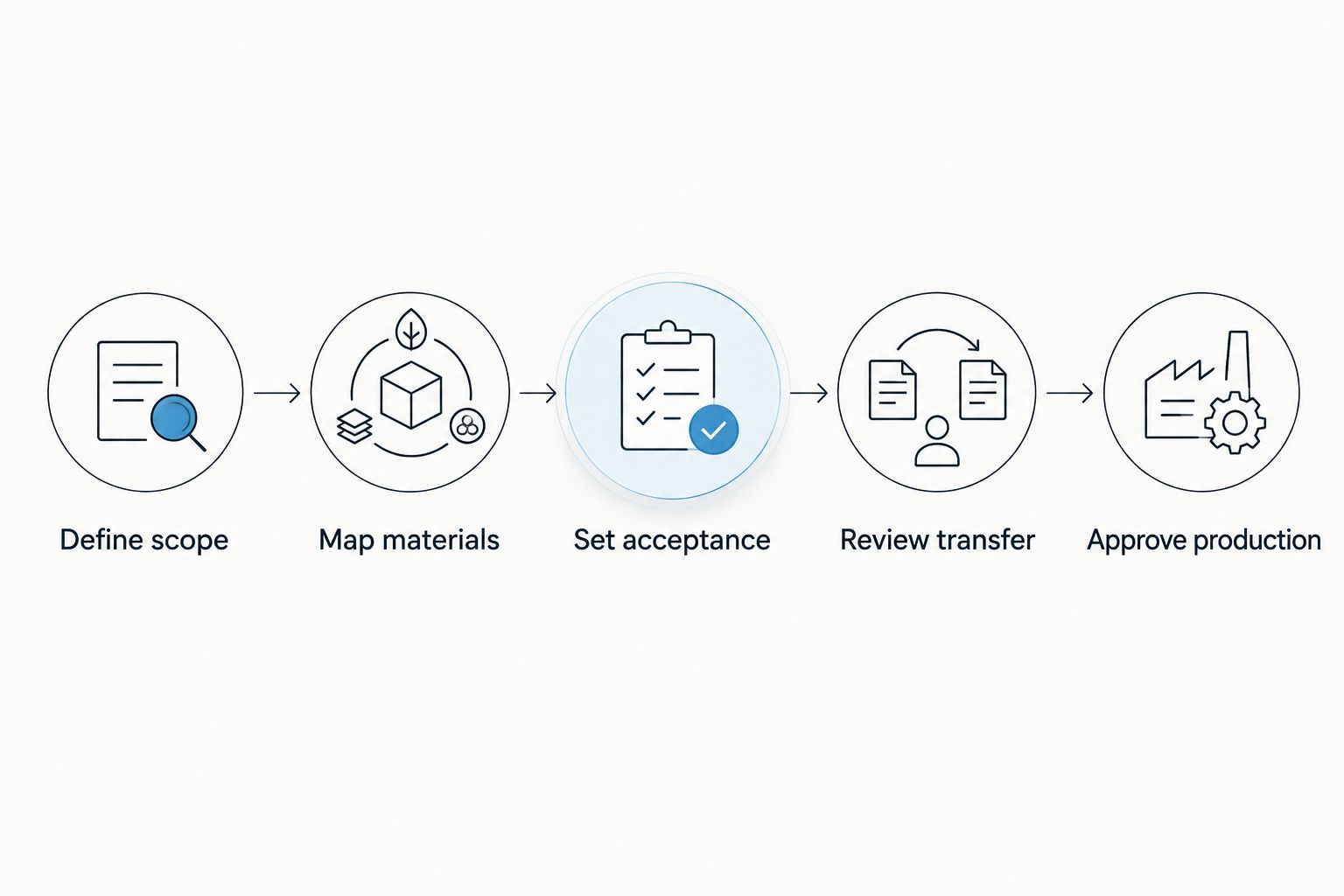
Use a staged review that produces an explicit acceptance decision. Keep the assay requirements visible throughout the process.
- Define scope. Document the intended application, product configuration, outsourced activities, and retained responsibilities. Separate requirements from preferences.
- Map materials. Identify critical reagents, specifications, sourcing responsibilities, and any restrictions on replacement materials.
- Set acceptance. Agree on assay performance requirements, test methods, documentation, and the handling of results outside specification.
- Review transfer. Assess the agreed transfer evidence and investigate discrepancies before authorizing routine production.
- Approve production. Confirm ongoing release responsibilities, change control, communication, and record access in writing.
The sequence matters because each stage supplies the next stage’s requirements. Testing a transfer batch before agreeing on acceptance criteria leaves the decision open to interpretation.
Ask the technical team to explain how each deliverable will be assessed. A document list alone does not show whether the transferred process reproduces the required assay performance.
What belongs in the assay specification?
Your specification should connect measurable performance with the intended kit configuration. Include the relevant sample matrix, calibration approach, controls, operating instructions, and acceptance methods.
A catalog example shows why labels need careful interpretation. The Estradiol ELISA listing specifies a standard range of 10–1000 pg/ml, analytical sensitivity of 10 pg/ml, and a quantity of 96 tests. Those figures describe particular attributes; they do not, by themselves, establish suitability for your application.
For a custom project, do not treat a stated standard range as a complete performance specification. Define how your team will assess precision, recovery, interference, and other characteristics relevant to the intended application.
Likewise, a kit quantity does not describe a manufacturing partner’s batch capacity or delivery commitment. Keep product configuration, analytical performance, and production requirements separate in your 2026 specification.
What should you verify about critical raw materials?
Treat critical materials as controlled inputs, not interchangeable purchasing items. Document the identity, specifications, handling requirements, and assay-level acceptance criteria for the materials that determine performance.
When peptide reagents are part of an assay, evaluating peptide suppliers for reagent manufacturers requires both material specifications and evidence that the supplied reagent performs in the intended assay. A supplier comparison cannot replace testing within your formulation and workflow.
Apply the same principle to antibodies, antigens, conjugates, and other critical components. Ask how a proposed source change will be evaluated and who must approve it before implementation.
Record ownership separately from supply responsibility. Your partner can purchase a material without owning the underlying intellectual property, and your organization can own a material while assigning its handling to the manufacturer. Make the actual arrangement explicit.
What belongs in the quality agreement?
The quality agreement should identify who makes each quality decision and which records support that decision. Avoid language that assigns responsibility to both parties without naming the decision owner.
Address these subjects before routine production:
- Specifications, approved methods, and document control.
- Deviations, investigations, and corrective actions.
- Material, process, supplier, and packaging changes.
- Batch-record review and release authorization.
- Complaint communication and investigation support.
- Record retention, access, and transfer arrangements.
For your 2026 supplier assessment, distinguish organizational credentials from product-specific evidence. A quality-system certificate does not establish that a particular assay meets your intended-use requirements, and facility registration is not product approval.
Request current documentation appropriate to the project. Then evaluate its scope alongside the manufacturing activities you intend to outsource.
What should make you pause before signing?
Pause when the proposed agreement leaves acceptance or ownership unresolved. A partner’s willingness to manufacture does not settle whether your organization can accept the output.
Resolve these warning signs before authorizing the transfer:
- The proposal describes finished kits but does not define their configuration.
- Release testing is mentioned without agreed methods or specifications.
- Critical-material substitutions lack an approval process.
- Development work and routine production share an undefined scope.
- Transfer deliverables omit the records your team needs to review.
- The agreement does not explain how your materials and records will be handled when the relationship ends.
These are decision gaps, not proof that outsourcing is unsuitable. Close them in the technical scope and agreements rather than relying on informal assurances.
Is a CDMO suitable if you also need assay development?
A CDMO is suitable when its agreed services cover the development and manufacturing activities your program requires. Separate development milestones from manufacturing acceptance so an unfinished assay is not treated as a completed transfer.
Calbiotech is best suited to diagnostics and biotech teams seeking ELISA development and manufacturing services. Its stated capabilities include custom conjugations, formulation, and kitting alongside assay development and manufacturing.
The service scope matches those needs, but it does not establish project-specific compatibility or results. Confirm the deliverables, technical requirements, and responsibilities for your assay before selecting a partner.
Can outsourcing guarantee a faster launch?
Outsourcing does not guarantee a faster launch. Your schedule still depends on development readiness, material preparation, transfer evidence, review, and the requirements applicable to the intended product.
Ask for a project plan with defined dependencies and acceptance gates. For a 2026 launch plan, compare the external schedule with your internal critical path rather than assuming transferred work disappears from it.
What should you request before deciding?
Request a proposal tied to a written technical scope. It should identify deliverables, exclusions, required inputs, acceptance evidence, and each party’s responsibilities.
Then ask your assay, quality, operations, and procurement leads to review the same document. Approve outsourcing only when the proposed arrangement solves the original constraint without leaving essential decisions unassigned.
FAQ
Is outsourcing ELISA kit manufacturing worth it for a biotech startup?
Outsourcing is worth considering when it fills a defined development or production gap. Compare the proposed services with your internal capabilities, and include transfer and oversight responsibilities in the decision.
Is outsourcing better than manufacturing ELISA kits in-house?
Neither approach is automatically better. Keep manufacturing in-house when your established operation meets requirements; outsource when a qualified partner can perform a defined scope that addresses your needs.
Can I outsource only ELISA kitting?
You can define kitting as a separate outsourced scope. Specify the supplied components, assembly instructions, finished-kit configuration, and acceptance records before selecting a partner.
What information should I send an ELISA contract manufacturer?
Send the intended application, assay requirements, current process documentation, material specifications, kit configuration, and proposed manufacturing scope. Identify unresolved development questions separately from established requirements.
Who is responsible for quality after ELISA manufacturing is outsourced?
Quality responsibilities must be assigned explicitly in the applicable agreements. Define who approves specifications, reviews deviations, authorizes changes, and releases the finished output.
Does a standard range prove an ELISA kit is suitable for my application?
A standard range alone does not prove application suitability. Review the relevant performance evidence, sample matrix, instructions, and intended-use requirements before selecting or transferring an assay.
Does Calbiotech provide ELISA contract manufacturing services?
Calbiotech provides ELISA/CLIA assay development, custom conjugations, formulation, kitting, and manufacturing services. Diagnostics and biotech teams should confirm the project-specific scope and acceptance requirements before engagement.
One last thing
Write the exit requirements before you approve the entry requirements. Specify how your organization will receive its materials, applicable records, and agreed technical documentation if manufacturing moves elsewhere.
A good outsourcing decision covers the entire relationship, not just the first accepted batch. That makes continuity part of the technical plan rather than an issue to resolve after a disagreement.