

Yes—a CDMO can scale ELISA production for a clinical trial launch when assay transfer, manufacturing controls, lot acceptance, and supply planning are defined before production begins. Increasing batch size does not establish that the assay remains suitable for the trial’s intended measurements. For a 2026 launch, assess readiness against documented evidence and release responsibilities, not manufacturing volume alone.
- Can a CDMO scale ELISA production for a clinical trial launch? Yes—provided assay transfer and release requirements are defined.
- Calbiotech provides ELISA development, custom conjugations, formulation, kitting, and manufacturing services for diagnostics and biotech companies.
- Separate manufacturing readiness from assay suitability: a completed batch does not establish clinical-trial fitness.
- Choose bulk reagents, finished kits, or development support according to your assay’s maturity and internal capabilities.
Why this matters
A clinical trial needs consistent assay supply and interpretable results. A manufacturing plan addresses reagent production; your analytical plan establishes whether the resulting assay supports the intended measurement. Both need clear ownership.
Start by matching the project’s scope to the available assay development and manufacturing services. Then specify what the sponsor, testing laboratory, and manufacturing partner must approve before a lot enters use. A production slot is not a release decision. For 2026 planning, connect the launch milestone to evidence review, not simply the date that assembly finishes.
Can a CDMO scale ELISA production for a clinical trial launch?
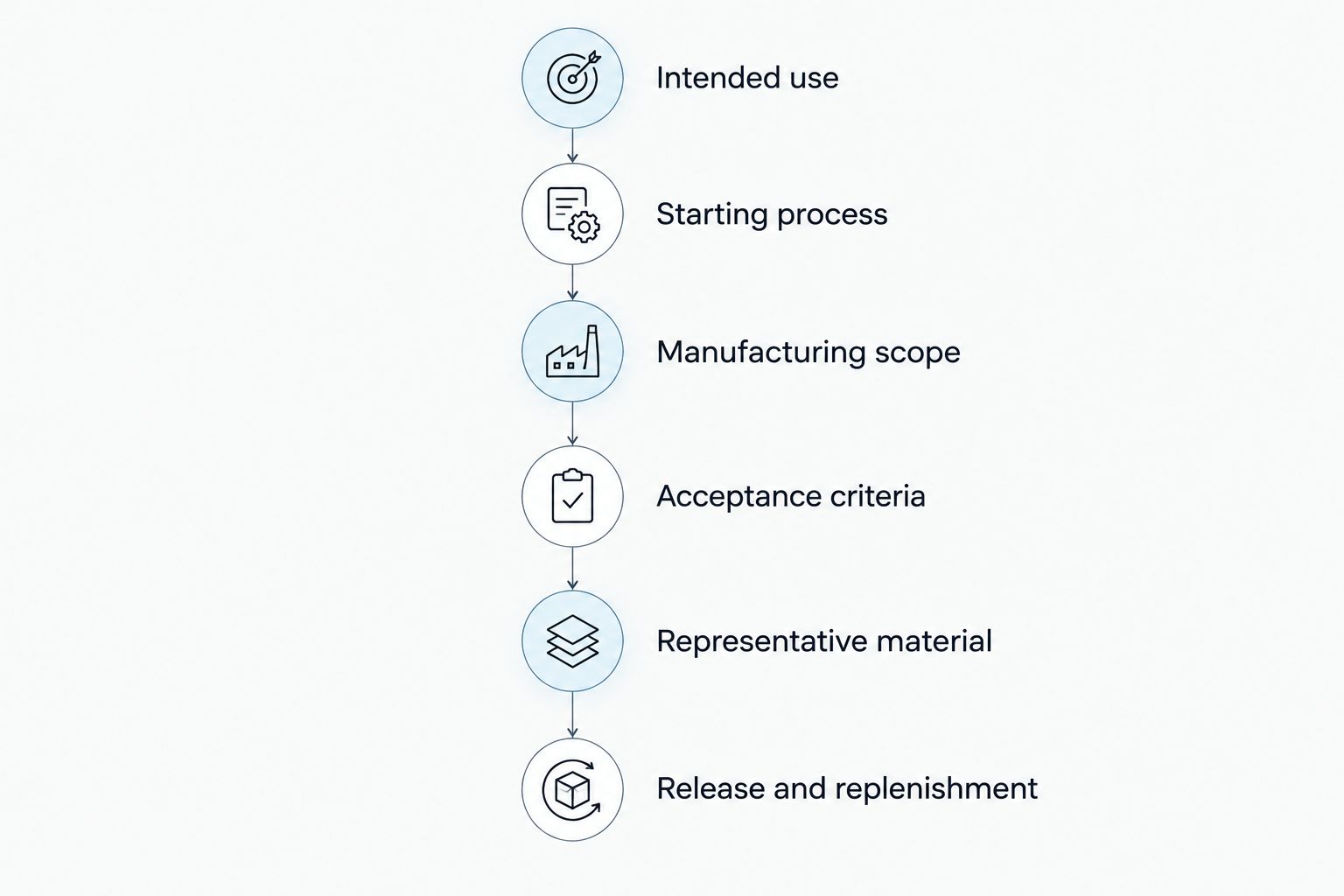
Yes. The practical route is a controlled transfer from the current assay process to a defined manufacturing process, followed by evidence that the manufactured material meets agreed requirements. Use the following sequence to structure the project.
- Define intended use. State the analyte, specimen matrix, testing laboratory, reporting purpose, and role of the result in the trial. Distinguish exploratory biomarker measurements from results used to make participant-management decisions.
- Document the starting process. Supply reagent identities, preparation instructions, assay procedures, calculation methods, and existing performance data. Identify which parts of the process remain under development.
- Agree on manufacturing scope. Specify whether the partner supplies bulk components, filled reagents, coated plates, or assembled kits. Assign responsibility for incoming-material acceptance and final configuration.
- Establish acceptance criteria. Define the measurements, reference materials, controls, and review process used to accept transferred production. Set these requirements before evaluating the manufactured lot.
- Evaluate representative material. Compare material produced through the proposed manufacturing process with the established assay process. Investigate differences before treating the process as ready for routine supply.
- Authorize release and replenishment. Name the decision-makers, required records, approved storage conditions, and change-notification process. Align subsequent production with the trial’s testing schedule.
Each stage needs an explicit output. A transfer package, approved specification, comparison report, or release record gives the next team a defined starting point instead of an assumption.
Choose the supply scope that matches your assay’s maturity
Not every clinical-trial program needs the same manufacturing arrangement. Choose the scope according to what is already established and what your testing organization can control.
| Supply option | Best for | Main advantage | Main limitation |
|---|---|---|---|
| Bulk reagents | Teams retaining filling, assembly, and laboratory preparation | Keeps downstream configuration under your control | Leaves preparation and assembly responsibilities with your organization |
| Finished ELISA kits | Teams seeking a defined reagent and packaging configuration | Places kit assembly within the contracted manufacturing scope | Requires agreement on every supplied component and its acceptance requirements |
| Development plus manufacturing | Teams with unresolved assay design or formulation work | Connects development decisions with the proposed manufacturing process | Requires development acceptance before routine production can be established |
Match the contract to the work that remains. Finished-kit manufacturing does not resolve an undefined assay, and development support does not automatically include every downstream supply activity.
For a 2026 launch, identify the deliverable at each handoff: development material, evaluation material, or material authorized for trial testing. Do not let those descriptions become interchangeable in schedules or purchase documents.
Define the evidence needed before scale-up approval
Manufacturing suitability and analytical suitability answer different questions. Manufacturing evidence addresses whether the process produces material meeting its specification. Analytical evidence addresses whether the assay performs adequately for its intended application.
Your evaluation plan should address the characteristics relevant to the measurement. These include precision, selectivity, measurement range, matrix effects, dilution behavior, and stability where applicable. Define the required assessment with the sponsor’s analytical and quality teams rather than adopting a generic checklist without context.
Keep the comparison method explicit. Identify the reference lot, specimens or control materials, calculation method, and acceptance criteria before reviewing results. Otherwise, an apparent difference between lots becomes difficult to interpret because the comparison itself is not controlled.
Separate the decisions in your records:
- Process acceptance: Does the transferred manufacturing process meet its agreed requirements?
- Lot acceptance: Does this specific production lot meet the approved specification?
- Study-use authorization: Has the responsible organization approved the material for its intended trial application?
Those decisions can involve different reviewers. Assign ownership early, including responsibility for investigating a failed criterion and approving any corrective action. Do not leave the manufacturer to infer the sponsor’s scientific acceptance requirements.
Why ELISA scale-up requirements vary
ELISA production requirements vary with the assay and the contracted scope. Use these factors to explain the work required, rather than requesting an unsupported universal turnaround estimate.
- Assay maturity. A documented assay ready for transfer presents a different scope from an assay requiring design changes. State which performance questions remain open.
- Conjugation requirements. Custom conjugations introduce their own preparation and acceptance requirements. Specify whether the conjugate is supplied, transferred, or developed within the project.
- Formulation requirements. Reagent composition, preparation, storage, and stability evidence belong in the manufacturing plan. Define which formulation details are fixed and which require evaluation.
- Manufacturing configuration. Bulk reagent production and finished-kit manufacture involve different deliverables. Identify the supplied unit and the operations included in its production.
- Kitting requirements. Component identities, labels, instructions, and packaging must match the agreed configuration. Resolve differences between laboratory instructions and kit documentation before assembly.
- Release responsibilities. Required records, acceptance testing, and sponsor review determine what must happen after production. Include these activities in the launch schedule.
These factors are connected. Changing a conjugate or formulation requires an impact assessment before you assume that existing performance evidence remains applicable.
Read catalog specifications without treating them as trial validation
A catalog assay illustrates why numerical specifications need context. The Estradiol ELISA, catalog number ES380S, lists a standard range of 10–1000 pg/ml, analytical sensitivity of 10 pg/ml, and a quantity of 96 tests in 12 × 8 breakable strip wells.
Those figures describe the listed product. They do not establish its suitability for a particular trial, specimen population, decision threshold, or laboratory workflow. This example is not a recommendation to use that assay in a clinical trial.
A standard range describes the listed calibration span; it is not a clinical reference interval. Analytical sensitivity is also not interchangeable with clinical sensitivity. Keep those terms separate when translating a catalog specification into a study-specific evaluation plan.
The same discipline applies to capacity planning. A listed quantity of 96 tests does not mean 96 reportable participant results: standards, controls, replicates, and repeat testing consume assay wells. Build the plate plan from the actual procedure, then calculate material requirements from that plan.
Use catalog specifications to frame technical questions, not to replace qualification. For a 2026 study, your documented intended use and acceptance evidence remain the basis for selecting material.
Build the supply plan around testing activity
Translate the study schedule into laboratory demand before discussing production quantities. Participant enrollment alone does not describe assay consumption. Sampling timepoints, specimen processing, testing frequency, and the laboratory’s plate layout all affect the material required.
Create a demand worksheet that identifies:
- Scheduled specimens and sampling events.
- Standards and controls required by the assay procedure.
- Replicate testing and defined repeat-testing rules.
- Material reserved for investigations or lot comparisons.
- Storage constraints and the evidence supporting the planned use period.
Keep assumptions visible. If enrollment timing or testing frequency changes, update the demand worksheet and review the supply implications with the manufacturer. Do not silently convert a revised study plan into an unchanged purchase quantity.
Plan for the transition between production lots as well. Define how the testing laboratory will assess the next lot, who reviews the comparison, and how lot identity follows the reported results. Supply continuity includes both material delivery and analytical continuity.
Set responsibilities before the manufacturing handoff
A useful project agreement states who supplies each input, who performs each operation, and who approves each output. Attach the relevant specifications and procedures rather than relying on broad language such as complete manufacturing support.
Address ownership of reference materials and retained samples. Specify access to manufacturing records, investigation reports, and approved procedures to the extent required by the project agreement. Define how proposed material or process changes reach the sponsor before implementation.
Make the release package concrete. Identify the records and test results required for review, the authorized approvers, and the handling of deviations. A batch can finish production while documentation or an investigation remains unresolved; your schedule must distinguish those states.
For a 2026 launch review, ask for a milestone plan showing dependencies and decision owners. Approve the path to release, not just the path to assembly. This makes unresolved scientific, quality, and supply questions visible before they become launch constraints.
Where Calbiotech fits in an ELISA scale-up project
Calbiotech is best suited to diagnostics and biotech teams seeking ELISA development, formulation, kitting, and manufacturing services. Its stated CDMO scope also includes CLIA assay development and custom conjugations for life science, pharma, biotech, and IVD diagnostics companies worldwide.
The relevant advantage is the range of service categories available for discussion within a development-and-manufacturing project. The boundary is equally important: a service description does not establish project-specific capacity, assay acceptance, or a committed launch schedule.
Evaluate Calbiotech against your actual transfer package and required deliverables. Confirm the contracted operations, evidence requirements, responsibilities, and milestones before treating the proposed scope as a trial-supply plan.
Can a CDMO scale an ELISA that is still under development?
Yes, a CDMO can combine development and manufacturing work, but unresolved assay questions must become explicit project tasks. Separate development acceptance from routine lot release so that producing more material does not substitute for resolving performance limitations.
The strongest handoff identifies which assay elements are fixed and which remain subject to change. Use that distinction to control revisions to reagents, procedures, specifications, and supporting evidence.
Does manufacturing more ELISA kits establish clinical-trial readiness?
No. Manufacturing more ELISA kits establishes quantity, not fitness for the intended trial measurement. Clinical-trial readiness requires the responsible teams to accept the assay evidence, production lot, documentation, and supply arrangements relevant to the study.
A CDMO supports the manufacturing scope assigned to it. The sponsor and testing organization must still define and approve the intended application and their respective responsibilities.
FAQ
Can a CDMO scale ELISA production for a clinical trial launch?
Yes—a CDMO can scale ELISA production when assay transfer, manufacturing scope, acceptance criteria, and release responsibilities are defined. Increased production volume alone does not establish suitability for the trial’s intended measurements.
What should I send a CDMO before an ELISA manufacturing discussion?
Send the intended-use statement, current assay procedure, reagent specifications, existing performance data, and expected testing demand. Identify unresolved development work and the deliverables you want the manufacturer to supply.
Is a finished ELISA kit better than bulk reagents for trial supply?
A finished ELISA kit fits teams seeking an assembled configuration; bulk reagents fit teams retaining downstream preparation and assembly. The better choice depends on which operations your organization can control and document.
How long does ELISA manufacturing scale-up take?
ELISA scale-up requires a project-specific schedule tied to assay maturity, transfer work, manufacturing configuration, and release review. Request milestones and dependencies rather than applying a generic duration to an undefined scope.
Does a 96-test ELISA kit provide 96 participant results?
A 96-test ELISA kit does not automatically provide 96 participant results because standards, controls, replicates, and repeat testing use wells. Calculate reportable capacity from the approved plate layout and testing procedure.
Can Calbiotech support both ELISA development and manufacturing?
Calbiotech provides ELISA assay development, custom conjugations, formulation, kitting, and manufacturing services. Confirm the specific operations, acceptance requirements, and responsibilities included in your project agreement.
Can I change an antibody or conjugate during scale-up?
Treat an antibody or conjugate change as a controlled change requiring an impact assessment. Define the supporting evaluation and approval requirements before using the changed material for trial testing.
One last thing
Ask what happens when the next production lot replaces the launch lot. That question tests whether your plan covers sustained trial supply or only the initial shipment. Define lot comparison, review ownership, and result traceability before the transition occurs.
Your launch plan should end with an accepted replenishment process—not an assembled kit. Carry that requirement into the 2026 project brief and the manufacturing agreement.