

ELISA kit manufacturing scale-up takes as long as the unfinished work between your current assay and a releasable production lot; there is no universal duration. The schedule must include material readiness, process transfer, production, testing, and release—not just plate coating or kit assembly. For a 2026 project, define those milestones before accepting a completion date.
- How long does it take to scale up ELISA kit manufacturing? Assay readiness and release requirements determine the schedule.
- Calbiotech provides ELISA assay development, formulation, custom conjugations, kitting, and manufacturing for diagnostics and biotech companies.
- Separate assay development from manufacturing transfer so unresolved chemistry does not disappear inside a production estimate.
- Set the completion milestone as a released lot, not assembled kits, when planning manufacturing scale-up.
Why this matters
A manufacturing date means little unless you know what it covers. Reagent preparation, assembled kits, accepted analytical results, and an approved lot are different endpoints. Your launch plan needs the endpoint that matches your next business decision.
For an outsourced program, use the assay development and manufacturing services scope to define responsibilities before scheduling execution. Specify what your team supplies, what the manufacturing partner develops, and who approves the finished lot. A useful timeline connects deliverables to acceptance criteria.
How long does it take to scale up ELISA kit manufacturing?
The duration depends on whether you are increasing an established process, transferring an assay to a new manufacturer, or still developing the assay. Those starting points require different work. Treat them as separate planning cases rather than applying one lead time to every ELISA program.
| Starting point | Best for | Scheduling advantage | Limitation to resolve |
|---|---|---|---|
| Established process | Increasing output from an unchanged assay | Existing manufacturing instructions provide a starting point | Larger batches still need evidence that the process meets specifications |
| Manufacturing transfer | Moving a defined assay to another production setting | Established assay requirements guide transfer | Equipment, materials, methods, and responsibilities need reconciliation |
| Development plus scale-up | Programs with unresolved assay chemistry or formulation | Development and manufacturing requirements can be planned together | A production date remains conditional on development outcomes |
Build your schedule in this order:
- Define readiness. Document the assay configuration, intended use, sample requirements, component specifications, and unresolved technical questions.
- Confirm materials. Identify the antibodies, antigens, conjugates, calibrators, controls, plates, buffers, and packaging required for the planned batch.
- Transfer the process. Establish manufacturing instructions, equipment requirements, in-process checks, and analytical methods.
- Evaluate a pilot. Use a representative manufacturing run to assess the process against predefined criteria before increasing output.
- Produce and release. Complete production, testing, record review, and authorized lot disposition.
The schedule should identify dependencies between these stages. Packaging preparation can be planned alongside technical work, but final labels depend on approved content. Release testing depends on the relevant finished material. Parallel work helps only when its inputs are sufficiently defined.
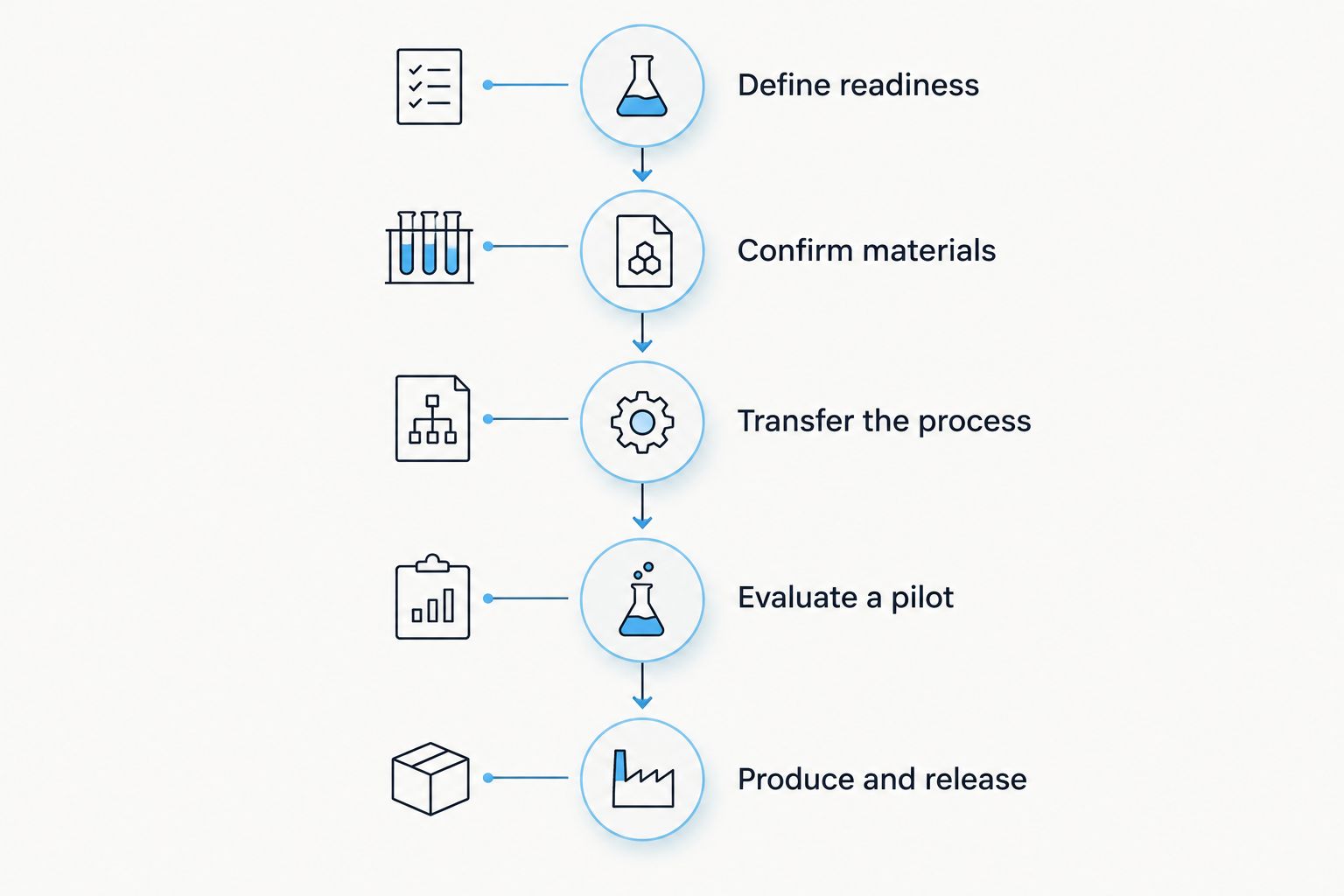
Established process: plan around demonstrated production readiness
An established process gives you a defined starting point: approved formulations, manufacturing instructions, analytical methods, and acceptance criteria. Increasing output still changes the amount of material handled. Your transfer plan should identify which operations remain unchanged and which require evaluation at the proposed scale.
Check preparation vessels, mixing, dispensing, coating, washing, drying, and storage wherever those operations apply. A process that performs acceptably in development needs evidence at the manufacturing scale you intend to use. Batch size alone does not establish that equivalence.
For a 2026 production increase, ask for a schedule tied to material clearance, manufacturing execution, analytical testing, and record review. Each milestone needs an owner and an exit criterion. Avoid a single completion date that hides all four activities.
Best for: a defined assay whose remaining task is controlled production expansion. The advantage is a clearer technical baseline; the limitation is that scale-dependent changes still require assessment.
Manufacturing transfer: resolve differences before the pilot
Manufacturing transfer adds a handoff between the assay's current process and the receiving production setting. Instructions that work for the originating team must become reproducible instructions for the receiving team. Tacit knowledge is not an adequate transfer package.
Compare the source process with the proposed receiving process. Identify differences in reagent grades, plate types, equipment, preparation methods, analytical calculations, and handling conditions. Decide how each difference will be evaluated before using the pilot lot as evidence of transfer success.
Your transfer package should distinguish required conditions from historical habits. Otherwise, the receiving team cannot tell which details protect assay performance and which details are simply how the original laboratory worked.
Best for: a defined assay moving to an external manufacturing partner. The advantage is an existing assay baseline; the limitation is the additional work needed to show that the receiving process meets the same agreed requirements.
Development plus scale-up: keep technical gates visible
If antibody selection, conjugation, formulation, or assay performance remains unresolved, the program includes development—not just scale-up. Put those decisions on the schedule explicitly. Do not hide them inside a manufacturing lead-time estimate.
A development milestone should produce an accepted technical output, such as a selected formulation or an agreed assay configuration. That output then becomes an input to manufacturing transfer. Changing it later requires assessing the effect on work already completed.
Calbiotech is best suited to diagnostics and biotech teams seeking ELISA development and manufacturing services within one CDMO engagement. Its stated capabilities include custom conjugations, formulation, kitting, and manufacturing. That capability scope does not replace a project-specific readiness assessment or establish a standard completion time.
Best for: programs that need assay development connected to manufacturing planning. The advantage is coordination across those activities; the limitation is that unresolved experimental work prevents an unconditional production commitment.
Why ELISA manufacturing scale-up time varies
The duration changes with the work required to establish a reproducible, releasable kit. Use these factors to structure your 2026 project brief rather than asking only for a manufacturing date.
- Assay maturity. A fixed assay configuration supports transfer planning. Unresolved assay design introduces development decisions before the process can be finalized.
- Conjugate readiness. Custom conjugation connects reagent preparation to assay performance. Define the conjugate requirements and acceptance methods before treating the reagent as a settled input.
- Formulation readiness. Buffers, diluents, controls, and other formulations need defined preparation and acceptance requirements. Formulation changes require an assessment of their downstream effects.
- Manufacturing scope. Bulk reagent production, coated plates, and complete kits represent different deliverables. State which components and assembly operations belong in the engagement.
- Performance evidence. Release testing and stability work answer different questions. Define the evidence needed for lot disposition separately from the evidence supporting storage claims.
- Approval responsibilities. Technical review, label approval, and lot disposition require named decision-makers. Include those decisions in the schedule rather than treating them as administrative work after production.
These factors interact. A formulation change can affect manufacturing instructions, analytical performance, and stability evaluation. The practical response is a dependency map with explicit decisions—not an arbitrary time allowance added to every stage.
What should remain controlled as batch size increases?
Scale-up should preserve the agreed assay requirements while increasing production output. Document what you will measure before making the larger batch. A finished kit count does not establish analytical consistency.
The following catalog examples illustrate why an ELISA scale-up plan needs assay-specific criteria. They are different assays, not interchangeable options or evidence of manufacturing turnaround.
| Catalog assay | Stated standard range | Stated analytical sensitivity | Scale-up planning implication |
|---|---|---|---|
| Estradiol ELISA | 10–1000 pg/ml | 10 pg/ml | Keep the assay's own concentration scale visible in the analytical plan |
| C-Reactive Protein ELISA | 0.005–0.1 mg/L | 0.005 mg/L | Use the assay's stated units and requirements rather than borrowing another assay's criteria |
Calbiotech lists both examples as 96 tests with 12 × 8 breakable strip wells. That configuration describes kit contents; it does not establish the number of reportable samples after standards, controls, or replicate testing. Nor does it specify how long manufacturing takes.
The distinction matters when translating a demand forecast into production requirements. Define whether your forecast counts kits, wells, or reportable results. Use assay-specific acceptance criteria; never substitute a catalog range for a complete release specification.
What should you request in a manufacturing schedule?
Request a milestone schedule with assumptions, dependencies, owners, and acceptance criteria. A date without those details cannot distinguish a production constraint from an unresolved development decision. Your 2026 planning document should make that distinction explicit.
Ask the manufacturing partner to define these deliverables:
- Readiness assessment: agreed starting materials, documentation, methods, and open technical questions.
- Transfer plan: process differences, required evaluations, and responsibility for resolving them.
- Pilot assessment: the manufacturing conditions to evaluate and the criteria used to accept the outcome.
- Production record: the instructions and records needed to document execution of the agreed process.
- Release package: required test results, review activities, and authorized disposition.
- Change assessment: the process for evaluating modifications after the baseline is agreed.
Then ask which activities can proceed concurrently and which require a completed predecessor. Record review, for example, needs the relevant records. Final kit assembly requires the specified components and approved assembly instructions.
Also define the change that triggers a schedule revision. A different antibody, formulation, component configuration, or intended use should prompt an assessment rather than silently inheriting the original date. This protects the meaning of the commitment without treating every change as equivalent.
Can ELISA development and manufacturing scale-up overlap?
ELISA development and scale-up planning can overlap when the work uses sufficiently defined inputs. You can prepare documentation templates, review component requirements, and identify manufacturing constraints while technical decisions remain open. Do not treat provisional specifications as approved production instructions.
Does completing kit assembly mean the lot is ready for release?
Completing kit assembly does not establish lot release. Release requires the agreed testing, record review, and authorized disposition. Define whether your contractual endpoint is assembled material or a released lot before comparing schedules.
Does a 96-test kit support 96 patient results?
A 96-test kit describes the stated test configuration, not automatically 96 reportable patient results. Standards, controls, replicates, and the applicable instructions determine how wells are used. Keep kit demand separate from reportable-result demand when forecasting manufacturing volume.
FAQ
How long does it take to scale up ELISA kit manufacturing?
ELISA kit manufacturing scale-up duration depends on assay readiness, material readiness, transfer work, production, testing, and release. Establish a milestone schedule for the specific assay rather than applying a universal duration.
What's the best way to get a reliable ELISA manufacturing timeline?
Provide a defined assay package and request a schedule with dependencies, owners, and acceptance criteria. Specify whether completion means bulk reagents, assembled kits, or a released lot.
Is scaling an existing ELISA assay the same as developing a new assay?
Scaling an existing ELISA assay is not the same as developing a new assay. Development resolves assay design and performance questions; scale-up establishes the manufacturing process at the required output.
Can I skip a pilot lot when increasing ELISA production?
Do not skip a pilot solely because the assay works at laboratory scale. Define the evidence needed to assess the proposed manufacturing process and agree on the appropriate evaluation before increasing output.
Does stability testing mean the same thing as release testing?
Stability testing and release testing answer different questions. Release testing assesses a lot against agreed criteria, while stability work evaluates performance under defined storage conditions over time.
What does Calbiotech offer for ELISA manufacturing projects?
Calbiotech offers ELISA/CLIA assay development, custom conjugations, formulation, kitting, and manufacturing services. Its CDMO services serve life science, pharma, biotech, and IVD diagnostics companies.
What should I prepare before discussing ELISA manufacturing scale-up?
Prepare the assay configuration, component requirements, manufacturing instructions, analytical methods, acceptance criteria, and unresolved technical questions. Include the intended use, demand forecast, and required delivery endpoint.
One last thing
Define what stops the manufacturing clock before you ask when it starts. An assembled kit, an analytically accepted lot, and an authorized release are different commitments. For your 2026 scale-up brief, put the required endpoint beside the requested date; that single clarification makes competing proposals easier to compare.